
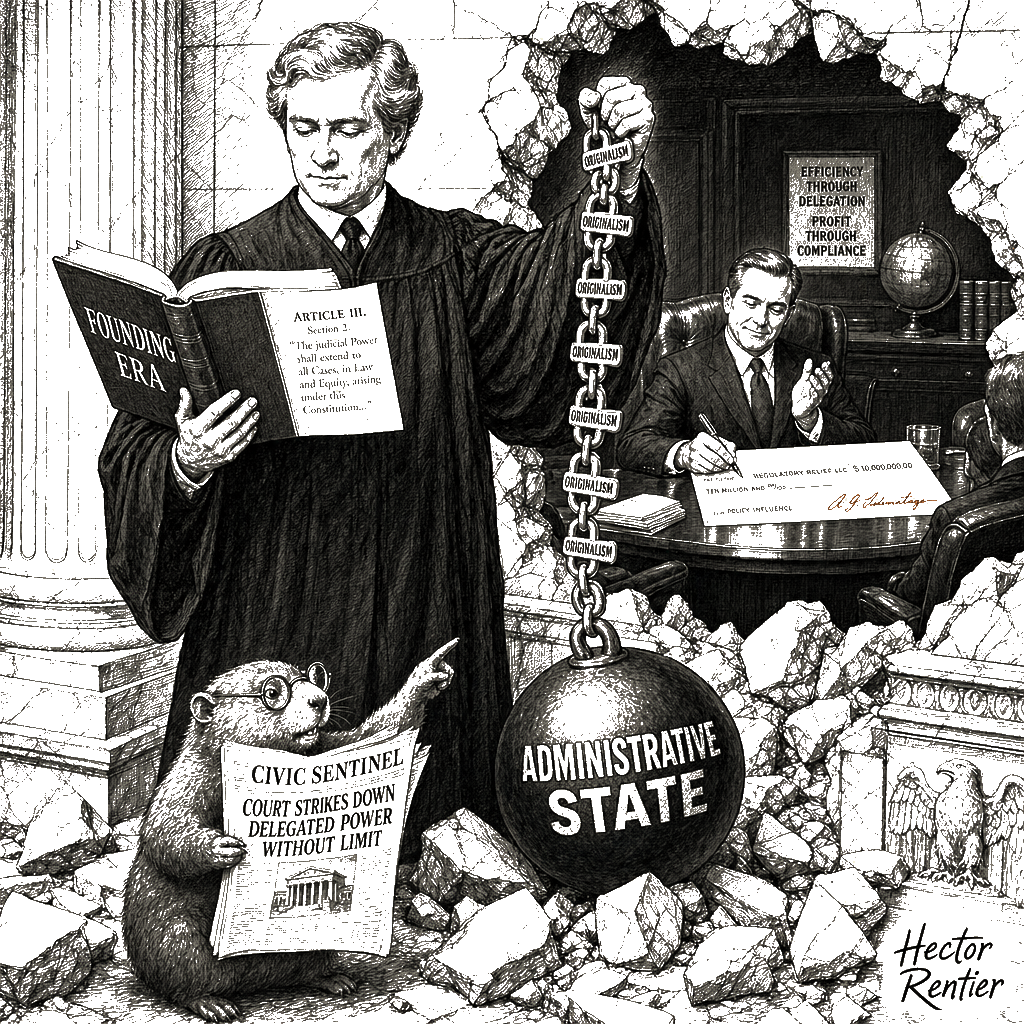
The conservative supermajority is hiding a power grab behind originalism.
The Justices have just released 633 pages of opinions. The claim that this Court is protecting ordered liberty, correcting deviations from the Founders’ design, and taking the Bill of Rights seriously is a lazy partisan myth. Read the opinions, and what emerges is not a neutral method. It is a deregulatory project — the reduction of the administrative state’s capacity to act against consolidated private interests — dressed in the founders’ rhetoric. The Court is not applying a neutral method. It is a partisan supermajority, and its constitutional wrecking ball is a disaster for the country.
The steel-man of the Court’s defenders is real, and it deserves to be taken seriously before it is audited. The Justices are invoking founding-era texts, the major-questions framework (the principle that agencies require clear congressional authorization for actions of vast economic or political significance), and structural separation-of-powers arguments with discipline. The audit begins where the steel-man ends.
Start with the centerpiece: Trump v. Slaughter. The July ruling lets the President fire the heads of supposedly independent agencies — the Federal Trade Commission, the National Labor Relations Board, the rest of what the press calls the “fourth branch.” The substantive effect is the opposite of what separation of powers demands. Congress, across a century of statute, designed these agencies to operate outside direct presidential control because certain regulatory functions — antitrust enforcement, labor-law prosecution, securities oversight — require insulation from the executive’s political incentives. The Court has now handed the President the authority to replace that leadership at will. The carve-out for the Federal Reserve, recognized even in Trump v. Cook, is the tell. The defenders of the ruling concede Congress can create independent agencies. They object only to the agencies that constrain Republican executive action.
The defenders pair Slaughter with Learning Resources v. Trump, in which the Justices struck the President’s $4 trillion in tariffs, as twin separation-of-powers victories. The pair falls apart on its own terms. Learning Resources constrains the President. Slaughter empowers him. The principle that unifies them is not constitutional method. It is the reduction of the administrative state’s capacity to act against consolidated private interests. Stripped of the founders’ rhetoric, the term is the project.
Then there is Trump v. Barbara, in which the Court rejected the President’s bid to end birthright citizenship by executive order. The defenders celebrate the outcome and celebrate too the six conservative Justices giving “four different theories about the meaning of the 14th Amendment.” This is presented as an “originalist free for all,” a sign of intellectual ferment. The audit treats it as a diagnostic. When a methodology produces four incompatible answers to the same question from Justices committed to that methodology, the methodology is not constraining the answers. The answers are constraining the methodology. The Justices are reaching outcome-first conclusions and reverse-engineering originalist theories to fit. This is not originalism functioning as a method. This is originalism functioning as a post-hoc rationalization. When six Justices deploy four mutually contradictory historical methodologies to reach the same outcome, the history is not doing the analytical work. The Court reaches the only outcome politically available to it, then fractures its reasoning to disguise the political work as historical method. The defenders treat the multiplication of theories as a virtue. The record treats it as a confession.
The “colorblind Constitution” language the Court adopted in its unsigned opinion in Louisiana v. Callais — the redistricting case — is, on the historical record, contested at the level of basic fact. The Reconstruction Amendments were explicitly designed to remedy the specific harms of slavery and the regime that followed it. The historical record of de jure segregation, produced by named federal agencies acting under color of law, is not a contestable originalist puzzle. It is the explicit starting point the “colorblind” reading requires the reader to ignore. A constitutional posture that takes the Reconstruction Amendments seriously would treat that record as the starting point. The “colorblind” reading is a substantive choice that requires its own historical defense; the Court offers none. The unsigned status of the opinion is itself a tell: the Court cannot agree on whose name to put on the reasoning.
The Court’s selective vindication of the Bill of Rights runs along the same lines. The First Amendment means a state cannot punish a Christian counselor who talks through gender questions with clients (Chiles v. Salazar) and Washington cannot cap the money political parties spend in coordination with candidates (NRSC v. FEC) — handing a massive structural benefit to the very party that appointed these Justices. The Second Amendment means the government cannot disarm casual marijuana users (U.S. v. Hemani) or ban firearms by default (Wolford v. Lopez). These are not the ordered liberties of the Bill of Rights. They are the structural preferences of the movement that selected these Justices, vindicated one right at a time.
The unanimity statistics mask the stakes. Yes, 44% of decisions were unanimous. But look at where the conservative supermajority actually loses. In 24% of cases, all three liberal Justices were in dissent. Just 15% of cases had three or more conservatives on the losing side — including Learning Resources, Trump v. Barbara, the late-mail-ballots ruling (Watson v. RNC), and the Fourth Amendment case (Chatrie v. U.S.). Originalism is not a constraint that binds. It is a menu from which to select. Justice Gorsuch’s suggestion that the Court should revive the nondelegation doctrine — the principle that Congress cannot delegate its core legislative authority to executive agencies without an “intelligible principle” to guide them — against Congress is presented as a methodological commitment. The scholarship documents that the doctrine, in its current form, is a substantive policy preference of the conservative legal movement, deployed selectively against regulatory programs the coalition opposes. A methodological commitment would be the same in every case. This one is not.
The cert-grant pattern across the term — the shadow-docket emergency applications (orders issued without oral argument or full merits briefing), the consolidated docket of deregulatory challenges, the selective deployment of the major-questions doctrine — is the litigation-strategy artifact the unanimity statistic conceals. The Roberts Court has not been neutral on outcome. It has been unanimous on the rate of agreement among Justices who share an outcome.
The founding-era design the defenders invoke — the 250th-anniversary frame — requires its own historical account. The Constitution the Founders drafted protected slavery and disenfranchised most of the adult population. The constitutional restoration the defenders celebrate is restoration of a pre-Reconstruction, pre-New Deal, pre-civil-rights baseline. The “founding” they invoke is itself a contested historical question, and the contest is not in the Justices’ favor. The Reconstruction Amendments were a remedy for chattel slavery, not an originalist puzzle.
Some on the right are already treating Justice Amy Coney Barrett as a sellout. They would do better to recall the long legal climb from the founding of the Federalist Society in 1982 — the pipeline, the public-interest litigation shops, the friendly lower-court enclaves — and to imagine an alternative Court that might be a President away.
No, today’s Court is not restoring venerable constitutional principles. It is rewriting the Constitution to concentrate the power it claims to limit. The next targets will be the very regulatory independence and voting rights it feigns to protect. The audit at the page sees what the editorial defenders refuse to name.