
The Court erased transgender girls from school sports on Tuesday. It called it women’s equality.
That is the substantive effect of the 6-3 ruling in West Virginia v. B.P.J., authored by Justice Brett Kavanaugh. The opinion’s stated ground — that biological-sex classifications in school sports survive intermediate scrutiny because the state has important interests in safety and competitive fairness — is the doctrinal vehicle for a constitutional license to erase transgender Americans from public life under the cover of Title IX enforcement.
The steel-man first. The majority’s strongest form runs through three moves. The state has a real interest in preserving competitive fairness in women’s sports. The physiological differences between male and female athletes are documented. The state may draw a bright line on the basis of sex without conducting case-by-case adjudication of each athlete’s hormonal status. The practical and administrative problems of individualized determinations in schools and on teams are real. The majority’s distinction between Title VII’s employment context and Title IX’s sports context is, on its face, a defensible reading of two different statutory regimes enacted at different times, addressing different institutional settings.
The audit begins where the steel-man ends.
The majority’s premise — that biological sex is a fixed binary the state may constitutionally impose on every transgender child in every public school sport — is the substantive move. The opinion treats hormone treatment and puberty blockade as constitutionally irrelevant to the sex classification: “the State is not constitutionally required to grant individualized exemptions to specific athletes or subclasses.” That sentence is load-bearing. It does not turn on the empirical record about athletic performance after treatment. It turns on a constitutional judgment that the state may treat the entire category of biological males as one class for purposes of exclusion, regardless of medical intervention.
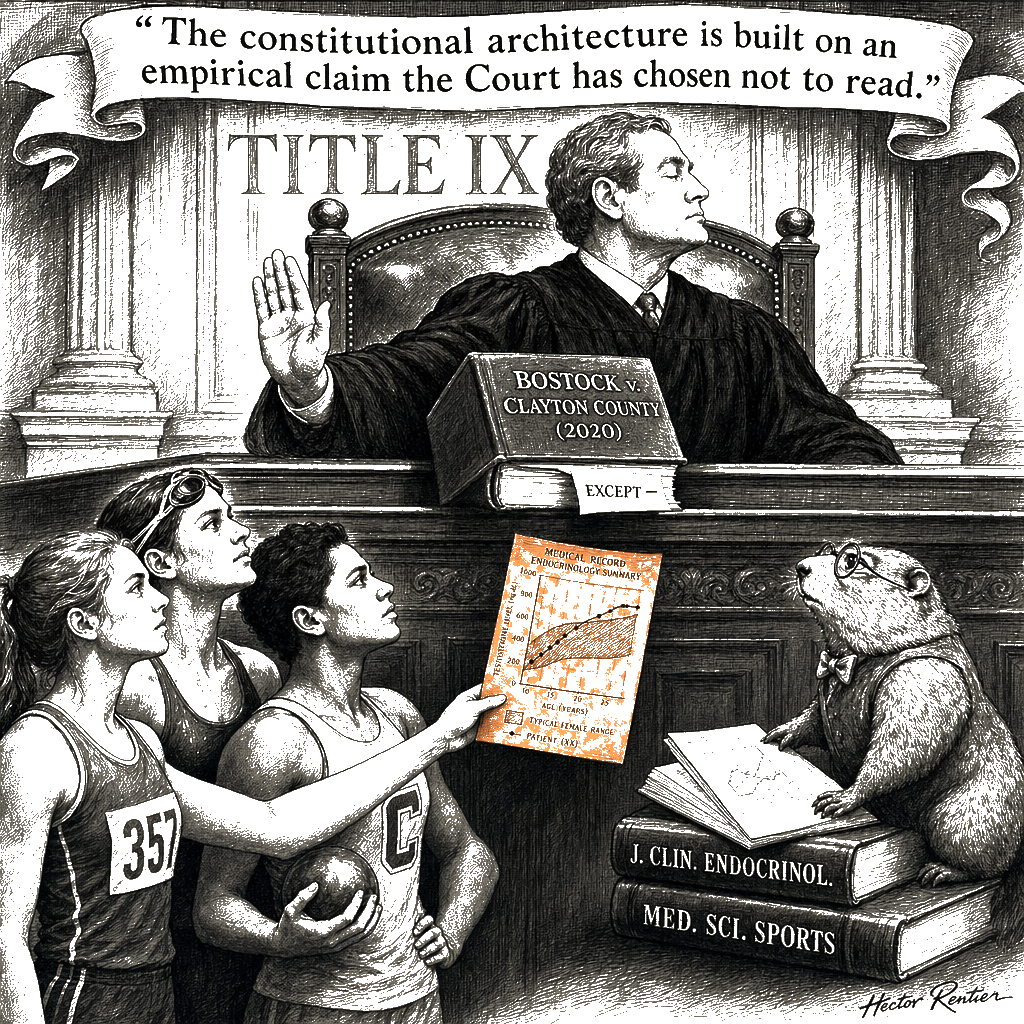
The medical literature is deeply contested on whether transgender girls on hormone therapy retain a substantial athletic advantage; the majority treats the contested empirical question as settled. Justice Sotomayor’s dissent, joined by Justices Kagan and Jackson, would have remanded for fact-finding. The majority declines to wait for the evidence. The constitutional architecture is built on an empirical claim the Court has not engaged.
B.P.J. herself provides the majority’s most convenient exhibit. Despite medical treatment, she recently won a state championship in girls’ shot put. Consider what that fact actually proves. A single championship in a single throwing event — a discipline where technique and positioning can rival raw strength — does not establish the categorical biological advantage the ruling requires. It establishes that one athlete performed well in one competition. The leap from that fact to a blanket constitutional permission for states to exclude every transgender girl from every girls’ sport is precisely the overbroad generalization the Equal Protection Clause exists to prevent.
The doctrinal break arrives in the Court’s treatment of its own precedent. In Bostock v. Clayton County, 590 U.S. 644 (2020), the Court held as a matter of textualist fact that discrimination against transgender individuals is, by definition, discrimination based on sex. The B.P.J. majority escapes this premise not by overruling Bostock, but by inventing a new exception to textualism. “Title VII concerns employment, whereas Title IX as relevant here focuses on sports,” Justice Kavanaugh writes. “The two factual contexts are vastly different.” The “factual context” is not a recognized doctrinal container. It is an ad hoc exit ramp — the pattern of selective stare decisis, a foundational interpretive methodology suspended precisely when its logical extension would require an outcome the Court has decided to avoid.
This is not textualism. It is results-oriented jurisprudence wearing textualism’s clothing.
The Title IX dimension sharpens the contradiction. Title IX, the 1972 law mandating equality in men’s and women’s education, does not mention gender identity. All nine Justices agreed on this textual point, and the majority held that the statute’s concept of “sex” does not extend to “gender identity.” But this unanimity obscures a deeper problem. The Trump Administration has argued that separating sports by biological sex is not merely permitted by Title IX — it is required by Title IX, that fair competition for girls demands it. B.P.J. has handed them the doctrinal architecture to pursue that framework: not a narrow holding about deference to state legislatures, but a doctrinal license in which the federal government can mandate categorical exclusion as a matter of statutory obligation.
The majority’s cabining of Bostock will also make it harder for transgender-rights advocates to extend the decision’s reasoning to other sex-segregated spaces — locker rooms, bathrooms, housing — because the Court has now established that textualist fidelity to a statute’s plain meaning can be overridden by a judge’s assessment of whether the factual context is sufficiently similar.
The equal protection analysis requires a second departure. Sex-based classifications trigger intermediate scrutiny, which requires the state to show an exceedingly persuasive justification. In United States v. Virginia, 518 U.S. 515 (1996), the Court struck down classifications that relied on blanket presumptions about sex. By holding that West Virginia and Idaho need not grant individualized exemptions, Justice Kavanaugh authorizes categorical bans that treat a transgender girl who has never undergone male puberty identically to a cisgender boy. The administrative convenience of the school district replaces the individualized constitutional scrutiny the Equal Protection Clause demands.
The methodology is a vessel for the outcome, discarded the moment it becomes a constraint. When the textualist definition of sex protects transgender employees, Bostock controls. When that same definition would require evaluating the exclusion of transgender athletes, the definition yields to a vastly different factual context. The pattern is not new. From Shelby County v. Holder to the major-questions doctrine in West Virginia v. EPA to the Medicaid-coercion limit in NFIB v. Sebelius, the Roberts Court has repeatedly constitutionalized its own coalition’s policy preferences under doctrinal containers the Court says are neutral and the record shows are not. The constitutional architecture B.P.J. builds is the same architecture: a doctrinally weak distinction deployed to deliver a politically desired outcome, backed by an empirical claim the Court has not engaged.
An honest application would have remanded for fact-finding on the medical question, applied intermediate scrutiny to the West Virginia law with the empirical record before it, and engaged Bostock’s textualism on its own terms. The dissent would have done all three. The majority chose not to wait.
The Wall Street Journal editorial board celebrates the ruling as a “blow for equal rights for women, federalism and common sense.” The substantive effect is the construction of a constitutional license for states to erase transgender children from public school sports — a license the Court has constitutionalized on a textual distinction it does not engage, an empirical record it does not examine, and a steel-man the dissent identifies as analytically weaker than the majority concedes. Women’s sports do not win here. The children are the test case. The constitutional architecture is built.