
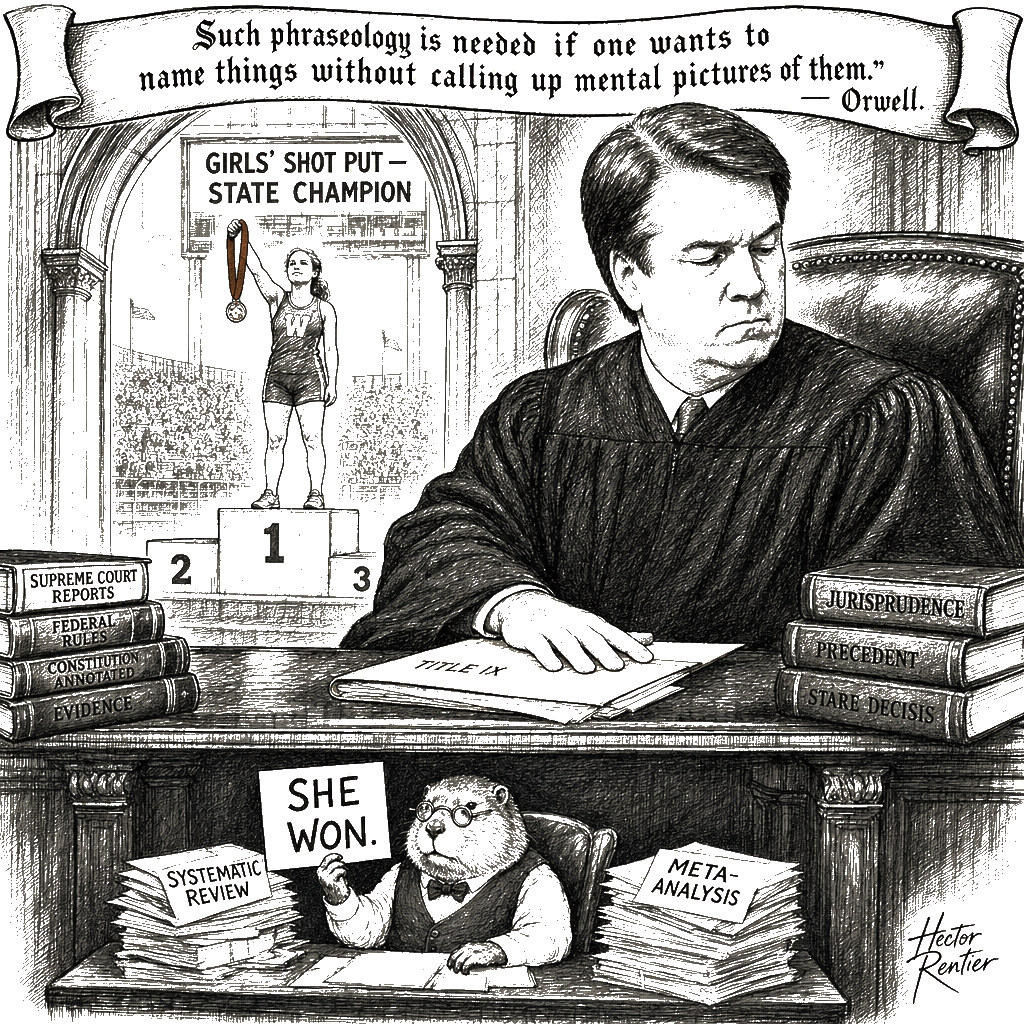
The Supreme Court stripped transgender girls of constitutional protection on Tuesday.
That is what the 6-3 ruling in West Virginia v. B.P.J. did. Justice Brett Kavanaugh, writing for a six-justice majority, held that states may categorically exclude transgender girls from girls’ school sports teams under the Constitution’s Equal Protection Clause, provided the exclusion is “substantially related” to an “important” government interest in fairness and safety. Intermediate scrutiny — the middle tier of Equal Protection review the Court applies to sex-based classifications — became the doctrine’s permission slip. The Court did not pause to ask whether intermediate scrutiny, deployed this way, is intermediate scrutiny in any meaningful sense. It is, instead, a license.
The strongest version of the majority’s argument runs like this. Male and female bodies differ, on average, in ways that confer athletic advantage. The differences persist, in many cases, after puberty suppression and hormone therapy. Schools and athletic leagues cannot reasonably administer individualized exemptions at scale. State legislatures are better positioned than federal courts to draw the policy line. Title IX’s reference to “sex” is a reference to biological sex, not gender identity. The 2020 Bostock ruling, which read “sex” to include gender identity for Title VII’s employment-discrimination purposes, is a different statute in a different context and does not control.
The argument is defensible in places. The empirical literature on athletic performance after hormone therapy is genuinely contested, and the majority was entitled to credit the side of the debate that supports its position. The administrative difficulty of individualized determinations is a real cost. Bostock’s textual analysis does not, on its face, extend to Title IX or to the sports context.
But the opinion’s reasoning departs from the steel-man in three places, each documented in the opinion itself, and each consistent with a pattern this Court has been building for three years.
The intermediate scrutiny analysis is a rubber stamp. The majority says the state’s interest in fairness and safety is “important.” It says the categorical exclusion is “substantially related” to that interest. It does not engage the question intermediate scrutiny exists to ask: whether a less restrictive alternative would serve the asserted interest. The opinion does not consider case-by-case testosterone-based eligibility standards. It does not consider sport-specific application of fairness rules. The “substantially related” prong is satisfied by the majority’s own assertion that it is satisfied. This is not intermediate scrutiny. This is rational basis with a sex label.
The Bostock analysis cannot hold. Justice Neil Gorsuch’s majority opinion in Bostock reasoned that “sex” in Title VII cannot be reduced to a single biological fact, because doing so produces internal contradictions in the statute’s operation. If “sex” means only biological sex assigned at birth, then an employer who fires a transgender woman for being transgender is not firing her “because of sex” — but the Bostock majority held that this firing is, in fact, discrimination “because of sex.” Gorsuch’s textualism was the majority’s textualism. Kavanaugh’s B.P.J. opinion now tells us that “sex” in Title IX is a different kind of word — a word that, somehow, does not include gender identity in the sports context. This is the post-Bostock containment protocol. “Title VII concerns employment, whereas Title IX as relevant here focuses on sports,” Kavanaugh wrote. “The two factual contexts are vastly different.” That is not a textual distinction; it is a domain-specific quarantine. The Court is preserving “sex” as an instrument it can tune up or down depending on which domain it lands in — expansive enough in employment to absorb gender identity, narrow enough in education to exclude it. The opinion treats the statutory word “sex” as having whatever meaning produces the preferred outcome in the case at hand. That is not statutory interpretation. It is statutory preference.
The medical-record premise is asserted rather than examined — and the Court’s own record undermines the premise it asserts. The opinion says that “many states and athletic organizations have concluded that biological males still retain a physical advantage after taking puberty blockers and hormones.” It does not engage the systematic reviews that have reached more qualified conclusions. It does not acknowledge that the empirical question depends on which sport, which hormone regimen, which length of treatment, and which performance metric is being measured. The opinion’s premise is “common sense.” Common sense is not a medical study. The Court owes the affected children — and the lower courts that will have to apply the ruling — better than a paragraph of assertion. The Court’s own record in this case makes the assertion especially thin. B.P.J., the child whose case supplied the constitutional question, recently won a state championship in girls’ shot put — the very event in which the state’s interest in excluding her was supposedly strongest, and the very outcome the majority’s logic was meant to prevent. The Court is telling us that the child it just excluded is winning, and concluding from that fact that she must be excluded. The premise does not survive its own example. The Court has decided the factual question for the states, foreclosing the evidentiary record before it could be developed. The regime does not require facts; it requires the conclusion.
Notably — and this point cuts in the opposite direction from what the majority claims — all nine Justices, including the three who dissented on the equal protection question, rejected B.P.J.’s Title IX challenge. Justice Kavanaugh reads Title IX’s 1972 text to exclude gender identity. Justice Sotomayor’s dissent does not defend a gender-identity reading of Title IX; it accepts, for the purposes of the equal protection analysis, that the statute has the meaning the majority assigns it. The unanimity on Title IX is not a vindication of textualism. It is a confession that the textualists and the Sotomayor Court share a more fundamental commitment than they admit: both sides agree that the words of the 1972 statute can be made to do whatever constitutional work needs doing in the case at hand. The unanimity is the tell.
Justice Sonia Sotomayor’s dissent, joined by Justices Elena Kagan and Ketanji Brown Jackson, would have remanded for fact-finding on the specific empirical claims the majority accepted as established. The dissent is correct that the majority’s “common sense” is doing analytical work the record does not support. It is also correct that the categorical exclusion the majority approves will fall hardest on the small number of transgender girls who are visible enough to compete, and the smaller number whose families have the resources to litigate.
The pattern runs deeper than this single case. A Court that reads the body into the Constitution to resolve one question has now committed itself to reading the body into every question. The thread runs from Justice Clarence Thomas’s Dobbs concurrence calling for reconsideration of the substantive due process precedents to Kavanaugh’s majority opinion on transgender athletes. The constitutional text is not the constitutional text. The constitutional text is what the majority says the body is. The conservative originalists who joined this opinion have, by their own logic, signed onto a constitutional method that will not stop at the girls’ locker room. If biology is what Title IX’s 1972 text means, then biology is what the Equal Protection Clause means, and biology is what the Due Process Clause means when the question is not who counts as a girl in shot put but whose medical decisions the state may override. The Court has built a constitutional reading machine that produces the result the majority wants in this case, and that machine does not come with a stop switch for the cases the majority does not want.
The B.P.J. decision is not about shot put. It is the blueprint for a broader exclusionary architecture. By establishing that “biological sex” overrides “gender identity” in any sex-segregated context, the Court has laid the doctrinal groundwork to roll back transgender access in locker rooms, bathrooms, shelters, prisons, housing, and every other domain where the state can invoke biology as a weapon. The bypass is built. The traffic will follow.
There are not many of them. The number of transgender girls competing in middle and high school sports nationally is small by every available measure — likely well under a few hundred, and likely far fewer than that, with one researcher who has tracked the question putting the number below one hundred. The Court has now told those children, in the language of intermediate scrutiny, that the Constitution permits states to write them out of girls’ sports because the Court could not be bothered to read the medical record. The Court has also told every state legislature that it has permission to do what thirteen have already done. The permission will not be used carefully. The Court’s work, on this record, will not bear the weight the majority has placed on it.