
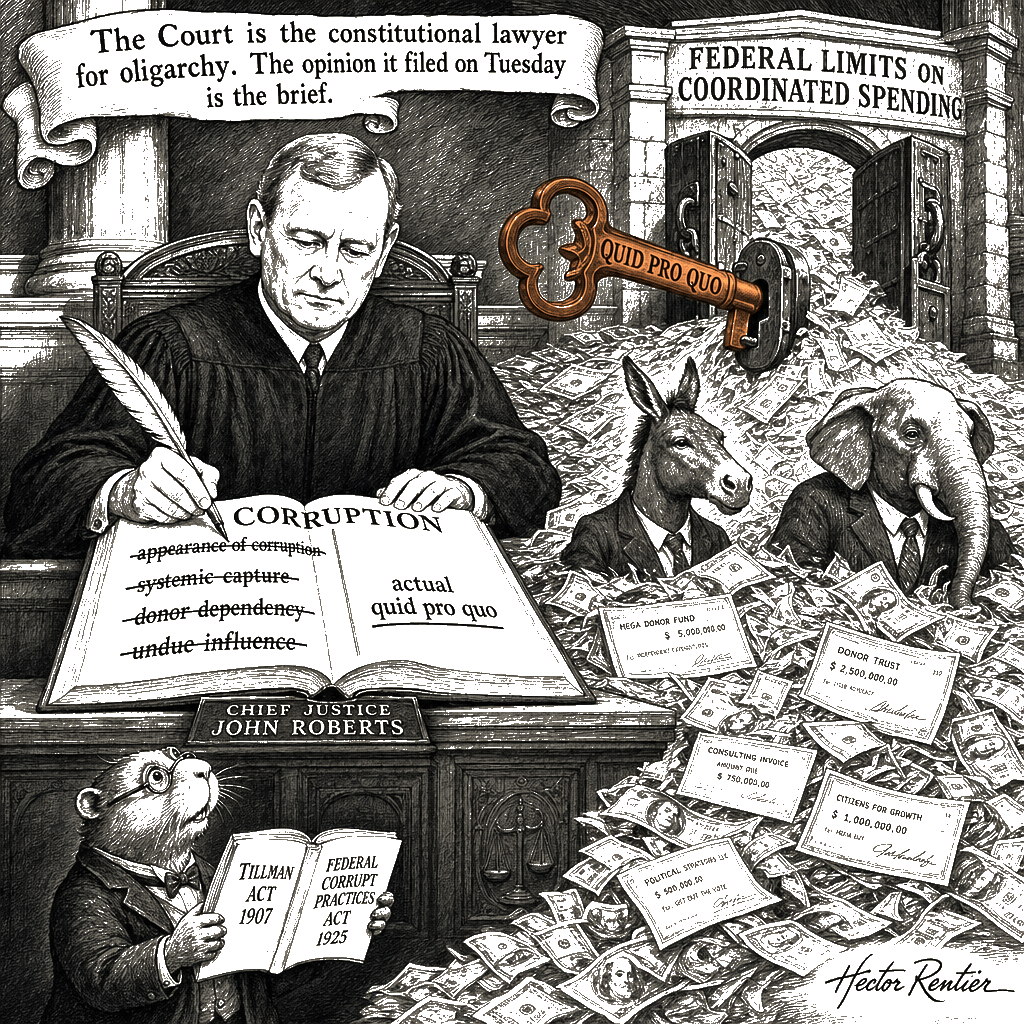
The Supreme Court handed American democracy to the wealthy on Tuesday. By a 6-3 vote in NRSC v. FEC, the Court invalidated the last remaining federal limits on coordinated spending between political parties and their candidates, completing a constitutional architecture that treats political equality as a free-speech violation and concentrates the practice of self-government in the hands of those who can pay for it.
The majority’s argument possesses undeniable constitutional craft, and its strongest form must be acknowledged before its structural consequences are examined. The First Amendment does protect political speech, and it does so with force. Political parties are associations of citizens organized around shared political commitments, and coordinated expression between a party and its candidates is the kind of association the First Amendment exists to protect. Justice Brett Kavanaugh’s historical claim, that parties could spend freely in coordination with their candidates “for nearly 200 years after the ratification of the First Amendment,” invokes a real, even if selective, baseline. The dissent’s framing, that coordinated-spending limits were needed to “protect our democracy’s integrity,” understates the burden the government must meet to restrict speech and understates how readily anti-corruption rhetoric can become a vehicle for incumbent protection.
The structural consequences emerge where the opinion’s stated reasoning parts company with its structural effect. The majority identifies the only “legitimate governmental interest for restricting campaign finances” as preventing “corruption or the appearance of corruption,” and then defines the interest down to a near-nullity: actual quid pro quo, meaning explicit exchange of money for official action. The narrowing is not incidental. It is the load-bearing move that allows coordinated-spending limits to fall. With contribution limits still permitted on the rationale of preventing quid pro quo, with disclosure rules intact, and with earmarked contributions restricted, the majority concludes that “prophylaxis upon prophylaxis upon prophylaxis” already addresses the interest, and that the additional layer of coordinated-spending limits cannot stand. When a party’s coordinating committee can spend unlimited funds in lockstep with its candidate, the “prophylaxis” the majority claims protects the system is functionally a mirage. The empirical premise is a fiction: coordinated spending functions indistinguishably from a direct contribution, but because the Court has arbitrarily severed the two in its First Amendment tiers of scrutiny, the legislature is barred from acting on the reality of the capture. The Court defines “corruption” so narrowly that it becomes a legal nullity, and then uses that nullity to strike down the statutes Congress passed to address the very harm the Court refuses to recognize.
The historical claim that supports the reasoning, on examination, omits more than it states. The two centuries the opinion selectively invokes are the same centuries that produced the Tillman Act of 1907 barring corporate contributions to federal campaigns, the 1925 Federal Corrupt Practices Act, the post-war Labor-Management Relations Act, the Taft-Hartley restrictions, the sustained Progressive-Era and 1974 post-Watergate reform movements, and the bipartisan consensus that followed documented episodes of purchased legislation in the Gilded Age and the 1920s. The opinion treats two centuries of corruption-driven reform as if it were a Watergate-era aberration, treating the regulation of money in politics as a single statutory exception to a long-accepted baseline. The baseline the opinion constructs is the historical absence of one specific statutory form and treats that absence as proof that the underlying regulatory project was always constitutionally suspect. The first two centuries of American political history did not feature the modern corporate-mega-donor apparatus or the administrative state it captures. The absence of federal limits in the Gilded Age was not a constitutional mandate, but a pre-regulatory reality that provoked the Tillman Act of 1907, the first federal campaign-finance law, passed specifically to curb the corporate money flooding the 1904 election. An honest application of the First Amendment would recognize that the legislature has a compelling interest in preventing the systemic capture of the political process, and that coordinated spending is the functional equivalent of a direct contribution.
The architecture this builds is the regime, and the regime has a name. Buckley v. Valeo, 424 U.S. 1, 19 (1976), drew a constitutional line between political contributions and political spending, subjecting the former to intermediate scrutiny and the latter to strict scrutiny. The line was always a fiction dressed as a doctrine: money given to a political party is no less an exercise of political speech than money spent on a billboard, and the formal categories the Court created have done more work to deregulate politics than to protect it. Citizens United v. FEC, 558 U.S. 310 (2010), cemented the asymmetry when it did away with spending limits on corporations and unions, allowing businesses and individuals to funnel unlimited amounts to Super PACs while remaining capped in their direct contributions to parties and candidates. The First Amendment distinction between political spending and contributions is dubious, and the Court is rapidly collapsing it in the wrong direction. The opinion’s own defenders acknowledged at the time that the result would require the invalidation of coordinated-spending limits as the next logical step, on the same associational-speech grounds. Tuesday’s ruling in NRSC v. FEC is the step the defenders predicted, delivered sixteen years late. The constitutional order that emerges is one in which the formal mechanisms for limiting the influence of concentrated wealth on elections are reduced to contribution caps that sophisticated donors route around through Super PACs, single-candidate vehicles, and the coordinated-spending channels the Court has now opened.
The asymmetric deployment of the underlying principles is the structural point. The same Court that has applied the major-questions doctrine to invalidate agency action it disfavors, that has wielded stare decisis selectively to overrule precedents it disliked, and that has read the First Amendment’s speech protection expansively when the speaker is a corporation or a wealthy donor has read the First Amendment’s structural protections of democratic self-government narrowly when the regulated activity is the financing of political campaigns. The same majority that has narrowed the Voting Rights Act, narrowed the disparate-impact provisions of the Fair Housing Act, and narrowed the federal civil-rights enforcement apparatus treats the speech-protective reading of the First Amendment as a constraint so robust it overrides two centuries of corruption-driven reform legislation. The Court does not apply the same level of skepticism to both directions. The asymmetry is the architecture. The majority dismisses the dissent’s alarm by noting that Democrats will benefit just as much as Republicans from the ruling. But the bipartisan character of the winners only proves the structural capture is system-wide. The dismantling of the post-Watergate architecture does not create a level playing field; it creates a vacuum that the highest-capital actors will fill, while the statutory mechanisms that once constrained them are reclassified as First Amendment violations. Republicans and Democrats alike will be bought.
The dissent, authored by Justice Elena Kagan and joined by Justices Sotomayor and Jackson, charges that the majority has created “a legal regime increasingly unable to stop political corruption, and thus to preserve our institutions’ democratic legitimacy.” The opinion does not engage with the documented role of post-Citizens United spending in shaping political outcomes, with the comparative-empirical literature showing that high-spending campaigns correlate with policy outputs favoring donor interests, or with the appearance-of-corruption evidence the dissent marshals. The opinion does not need to engage. The constitutional architecture it builds is self-executing: any future statute seeking to address the influence of concentrated political money will be measured against the strict-scrutiny standard this and prior opinions have hardened into constitutional law, and the only state interest the architecture recognizes as compelling, actual quid pro quo, is the one easiest for sophisticated actors to evade.
The Roberts Court has now, across Buckley, Citizens United, and NRSC v. FEC, completed the work of treating political equality as a problem the First Amendment was written to prohibit. The Court is the constitutional lawyer for oligarchy. The opinion it filed on Tuesday is the brief.