
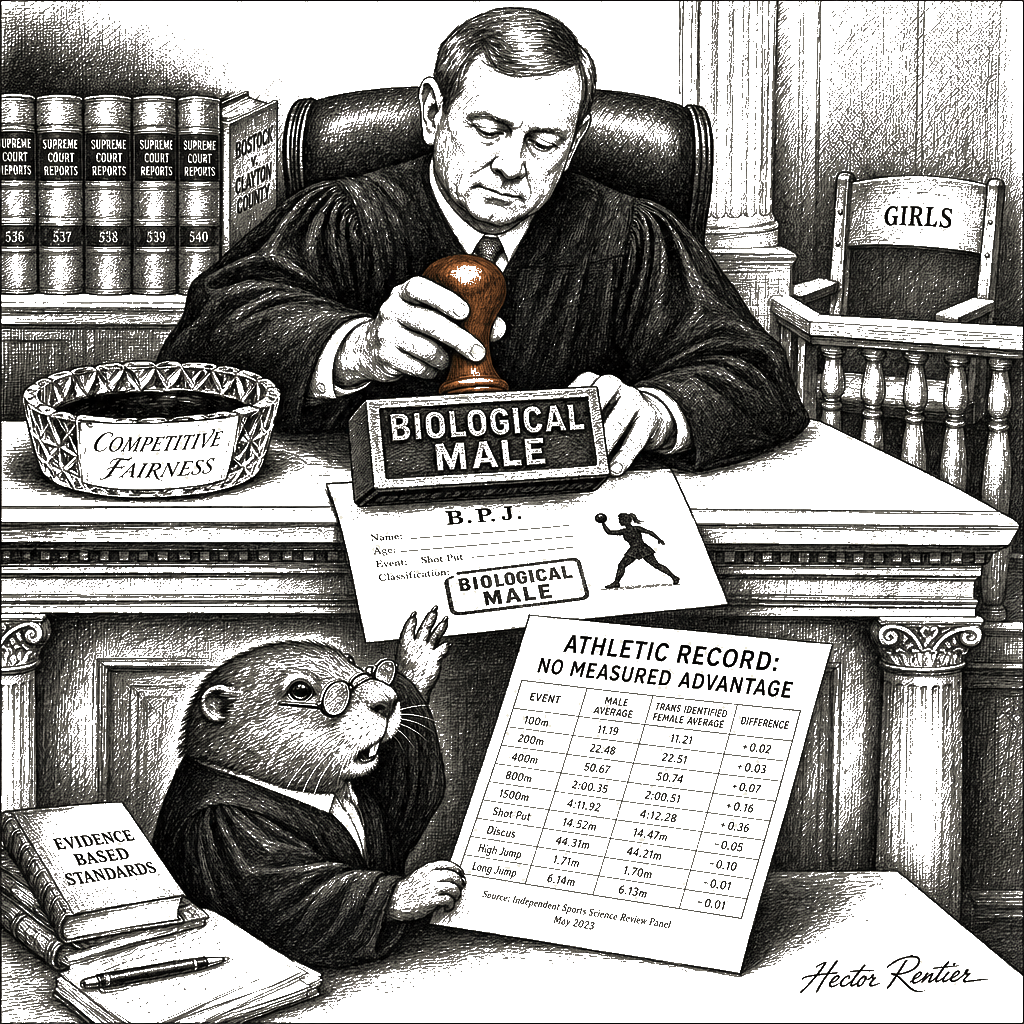
Six justices stripped transgender girls of equal protection by redefining them as “biological males.” B.P.J. is a girl.
The Supreme Court ruled 6-3 in West Virginia v. B.P.J. that states may categorically exclude transgender girls from women’s sports teams. Justice Brett Kavanaugh wrote the majority opinion; Justice Sonia Sotomayor dissented, joined by Justices Kagan and Jackson. The majority applied intermediate scrutiny — the standard that has governed sex-based classifications since Craig v. Boren, 429 U.S. 190 (1976) — and held that West Virginia’s ban on “biological males” competing in women’s sports substantially relates to the important government interest of competitive fairness. The opinion accepts that “many states and athletic organizations have concluded that biological males still retain a physical advantage after taking puberty blockers and hormones,” as the Wall Street Journal editorial board reported Tuesday. The editorial board calls the result “a blow for equal rights for women, federalism and common sense.” The opinion distinguishes Bostock on the ground that “Title VII concerns employment, whereas Title IX as relevant here focuses on sports. The two factual contexts are vastly different.”
Intermediate scrutiny has governed sex classifications since 1976. Competitive fairness in athletics is a legitimate government interest. The medical literature on the persistence of male physiological advantages after hormone therapy is genuinely contested. Legislatures are institutionally positioned to weigh contested empirical claims. Federalism counsels deference. A working-bar originalist would not lose sleep over the result. None of that is the audit.
The audit begins with the choice of classification. The Fourteenth Amendment question is whether a state can ban an individual from public life because she is transgender. The Court does not answer that question. It answers a different one — whether a state may exclude “biological males” from women’s sports — and arrives at the same destination. The maneuver is the same mechanism the Court used to limit abortion rights in Dobbs v. Jackson Women’s Health Organization, 142 S. Ct. 2228 (2022): redefine the protected category to achieve the desired policy outcome. The doctrinal container expands or contracts precisely to the policy outcome the majority demands.
This is the regime at work. When confronted with a civil-rights statute or constitutional provision it disfavors as applied to a marginalized group, the Roberts Court’s method is to redefine the classification, invoke administrative unworkability, and wall off the precedent — the one-way ratchet the conservative legal movement’s documented playbook predicts. Facially neutral rules binding only one ideological direction. The scrutiny level, the Bostock distinction, the legislative-fact deference, the Title IX reading, the administrative-practical objection — each will follow that pattern.
The scrutiny level itself is asymmetric. The Court has not always been precise about which sex-classification cases get intermediate review and which get the closer review articulated in United States v. Virginia, 518 U.S. 515 (1996). The pattern is visible across the case law: when sex-based classifications are challenged by women, the Court tightens the standard; when sex-based classifications are defended as protecting women, the Court loosens the standard. The choice of scrutiny tracks the politics, not the doctrine. The 6-3 split in B.P.J. is the asymmetry performing itself.
The Bostock distinction follows the same pattern. Justice Gorsuch’s 2020 opinion for the Court in Bostock v. Clayton County, 590 U.S. 644 (2020) reasoned that “sex” in Title VII necessarily includes gender identity because an employer who discriminates based on gender identity necessarily considers the employee’s sex. The textual reasoning was not fact-bound; it turned on the ordinary public meaning of “sex” in the statute. The B.P.J. majority distinguishes Bostock on the ground that “the two factual contexts are vastly different.” The textual analysis does not support that distinction. The statute uses the same word. A civil-rights statute passed within eight years of Title VII, using the same word, gets the opposite reading — depending on which way the case cuts. That is the pattern: a controlling precedent, confined to a footnote in its analytical weight, distinguished on grounds the opinion does not develop — the same footnote-relegation move the catalog documents as a recurring technique for dismissing precedents whose holdings would otherwise control.
The legislative-fact-finding deference follows. The opinion accepts that “many states and athletic organizations have concluded” transgender athletes retain physical advantages after hormone therapy. Deference to contested legislative findings is a familiar move. It is also a move the Court has not extended symmetrically. In the abortion context, in the voting-rights context, in the racial-classification context, the Court has second-guessed legislative findings when the empirical claims cut against the coalition defending the legislation. The selective deference here is the asymmetry again. The 6-3 split on which side gets deference and which gets the harder look is the work the opinion performs.
The administrative-practical objection is the closing rhetorical move of the majority. Individualized exemptions are administratively difficult. Schools cannot run physiological tests on every athlete. The objection is real. It is also selective. Individualized assessments are a routine feature of constitutional doctrine — the Fourth Amendment exclusionary rule turns on case-by-case judgments; equal protection doctrine turns on case-by-case judgments. The Court reaches for administrative-difficulty reasoning when the case-by-case judgment would produce the inconvenient result. Here, the inconvenient result is letting a transgender girl compete. The administrative-convenience argument is the doctrinal mechanism that produces her exclusion.
B.P.J. won the West Virginia girls shot put championship in February. The majority opinion accepts that B.P.J. has taken puberty blockers and hormones. Justice Sotomayor’s dissent notes the factual record contains no evidence B.P.J. retains a measurable athletic advantage over cisgender competitors. The Court’s response is not to demand evidence of advantage but to invoke the practical and administrative problems of individualized assessment. The Court has never permitted administrative convenience to justify the blanket exclusion of a discrete minority from a public benefit without an individualized factual basis. The Court permits it here.
The celebration of B.P.J.’s state championship as proof of her unfair biological advantage is a circular non-sequitur. B.P.J. is a dedicated high school athlete; her winning a state title is a testament to her training, not a constitutional justification for her banishment. Referring to her as a “biological male” is a linguistic sleight of hand that manufactures the very biological category the Court’s opinion requires to function. The opinion’s reasoning depends on the biological-sex classification being the natural baseline against which transgender identity is measured. That classification is not natural; it is constructed by the opinion, for the purpose of the opinion.
The assertion that separating sports by biological sex is “required” by Title IX twists the 1972 women’s-rights law into a weapon for erasing the very girls it was written to protect. Title IX was enacted to expand women’s access to educational opportunity. The Court reads it to exclude a class of women from that opportunity. The stare decisis analysis is asymmetrically deployed: precedents the coalition opposes get distinguished into narrowness; precedents the coalition favors get expansive reading. The same Justices who treat Roe and Casey as worthy of overruling now treat Bostock as a case about employment only. The deployment of stare decisis tracks the outcome, not the doctrine.
To protect this policy outcome from Bostock, the majority constructs a bright line between Title VII’s employment context and Title IX’s educational context. The textual reasoning does not support that distinction. The Court is not distinguishing the statutes; it is drafting a carve-out. The opinion’s stated narrowness — sports only — sits uneasily beside its reasoning, whose principle extends to every sex-segregated space: bathrooms, dorms, prisons. The carve-out will not stay narrow. That is the narrow-but-not-really pattern: the holding says “this case is about X only,” while the reasoning resolves X by a principle resolving much more than X — and subsequent cases cite the reasoning for the broader proposition the original disclaimed.
The holding in West Virginia v. B.P.J. will not settle the question of transgender participation in sports. It will establish that the Constitution now permits states to use the rhetoric of biology to exile transgender youth from public life, so long as they call it an administrative necessity. The scrutiny level, the Bostock distinction, the legislative-fact deference, the Title IX reading, the administrative-practical objection — each contestable alone, together they constitute the Court’s pattern. The pattern is the work.