
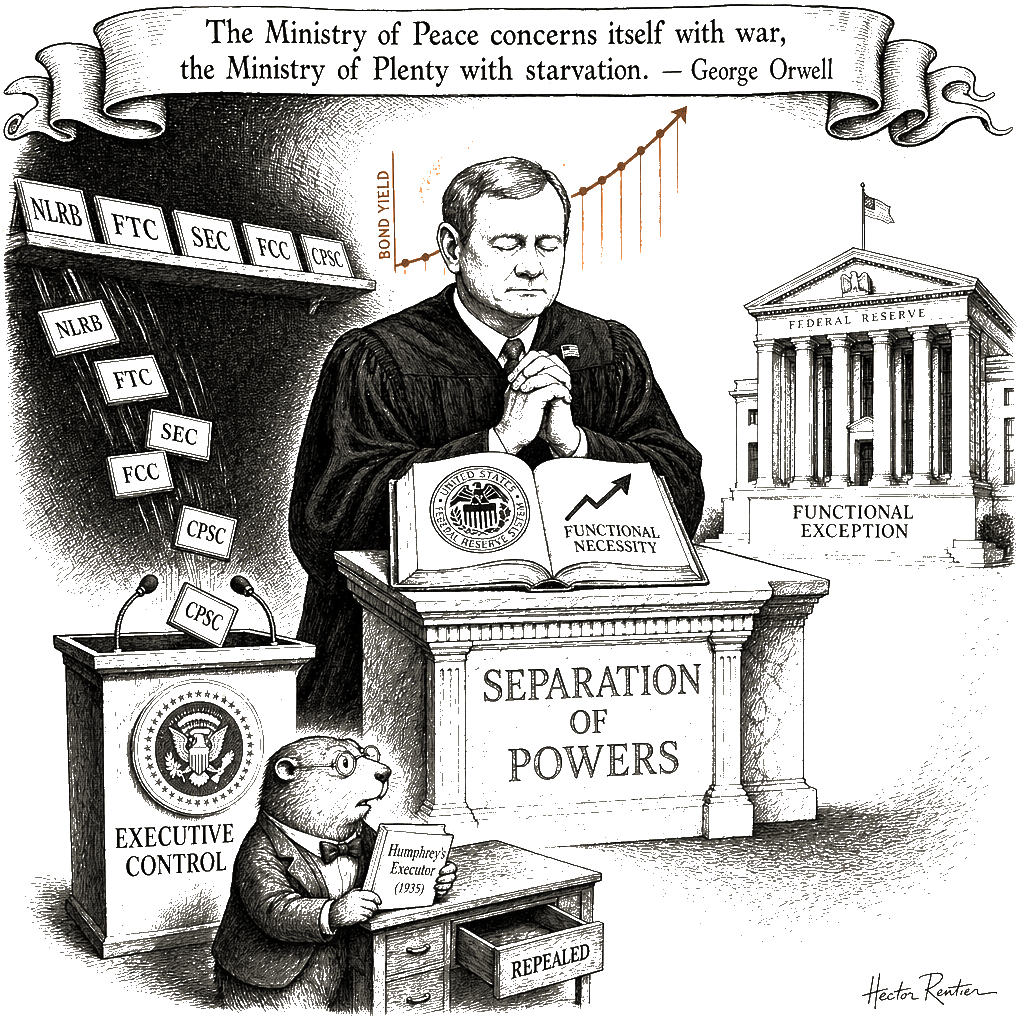
The Roberts Court has handed Donald Trump control of every agency that regulates working Americans. The Federal Reserve, the agency whose independence the financial system the Court serves cannot survive without, is the exception.
The Court issued both decisions on Monday. In Trump v. Slaughter, 609 U.S. ___ (2026), a 6-3 majority abandoned the ninety-one-year-old precedent that insulated Federal Trade Commissioners from presidential removal. In Trump v. Cook, 609 U.S. ___ (2026), a 5-4 majority carved out the Federal Reserve as the lone agency the President cannot dismantle. Trump tried to fire Lisa Cook, a Biden appointee, based on unproven allegations of mortgage fraud — the kind of pretext the Chief’s majority was designed to prevent. Roberts wrote for a five-justice majority that included Kavanaugh and the three liberal justices — Kagan, Sotomayor, and Jackson — in holding that the President cannot remove her without notice and an opportunity to respond. The First and Second Banks of the United States, chartered by Congress in part to regulate the currency, established a tradition of monetary-policy independence that survives to the present day. The two rulings, taken together, do not balance. They are the same ruling, and the carve-out is the giveaway.
Roberts writes for the FTC majority that the Commission enforces some eighty statutes covering “almost every facet of the Nation’s economy” and that those tasks are “the very essence of ‘execution’ of the law.” That description, the Chief writes, was tethered to “a highly circumscribed and almost fictional view of the FTC’s role” that has not been true for most of a century. The founding-era description, adopted in Humphrey’s Executor v. United States, 295 U.S. 602 (1935), characterized the FTC’s duties as “quasi-legislative and quasi-judicial” and “neither political nor executive.” The same Article II logic — the President controls the execution of the laws — will now apply to every other independent agency in the executive branch. The National Labor Relations Board. The Securities and Exchange Commission (in significant part). The Federal Communications Commission. The Consumer Product Safety Commission. The alphabet soup of agencies that enforce the law against the largest employers, the largest corporations, the largest market actors in the country, is now compliant with the President’s wishes.
Justice Thomas dissents in the Fed case. The First and Second Banks, he writes, “possessed no sovereign power.” The Federal Reserve regulates the largest financial institutions in the country. By the Chief’s own logic in the FTC case, the Fed exercises executive power subject to Article II. Thomas is right on the law. The Chief distinguishes it anyway, on the ground that the tradition of the First and Second Banks chartered an institution independent of presidential control, and that the financial system cannot survive the alternative.
The defenders will say this is the prudent position — that no president can be trusted with monetary policy, that politicized currency is the road to ruin. The argument proves the thesis. The Fed’s independence survives because the financial system cannot survive without it, and the financial system is the constituency the Court serves. The same logic, applied to the agencies that protect working Americans, does not apply, because the constituencies those agencies protect do not have the structural power to make their collapse a systemic crisis. The institutionalist argument is the carve-out’s best face. The carve-out is still the carve-out.
The carve-out is the substantive claim of both rulings. The FTC ruling gives the President control of the agencies that touch working Americans directly: the consumer-protection agency, the labor board, the agency that polices the marketplace. The Fed ruling preserves the agency that touches the financial system directly: the institution that sets the price of money, regulates the largest banks, runs the discount window. Two rulings on the same day, by the same Court, with the same Chief Justice writing both majorities, build the same regime. Presidential control where the regime serves the broad public. Independence where the regime serves concentrated capital.
This is the pattern the case law has been building. Seila Law LLC v. Consumer Financial Protection Bureau, 591 U.S. 197 (2020), made the single-director CFPB removable at will. The doctrinal work was done; the carve-out for the Fed is its mirror image. The pattern holds across terms, across administrations of both major coalitions, across the doctrinal lines the Court has built and the doctrinal lines the Court has declined to build. The agencies that touch the financial system get the carve-outs. The agencies that touch everyone else get the doctrinal work.
Justice Gorsuch’s concurrence in the FTC case is the longer game. Congress, he writes, has handed the executive branch power it might not have delegated “had it known that the President would come to control them.” The Court, he says, must “resurrect” the non-delegation doctrine — the rule, dormant since the New Deal, that Congress cannot transfer its core legislative powers to another branch without an “intelligible principle” (a clear, binding standard directing how those powers must be exercised). He is correct that Congress has abandoned its legislative duties. But Congress is not going to reclaim them. The practical effect of overruling Humphrey’s is not that Congress takes back its power; it is that the President absorbs the legislative power Congress abandoned. The administrative state does not shrink. It simply becomes the President’s personal staff. When the FTC blocks a corporate merger or the EPA regulates carbon emissions, those actions are no longer buffered by independent commissioners; they are dictated directly by the Oval Office, enforced with the energy the founders intended for the executive, not for a parliamentary bureaucracy.
The non-delegation doctrine, applied with the consistency Gorsuch claims to want, would eventually threaten the Fed’s own vast delegated authority over monetary policy. The Court will not apply it there. The carve-out names the regime. If the constraint runs against the agencies that have done the work of the regulatory state since Woodrow Wilson, the institutions that already exist — the Fed, the banks, the financial sector — will be the ones that survive the long-term project.
Justices Kagan, Sotomayor, and Jackson dissented in the FTC case. The dissent warned that overturning Humphrey’s would “unleash only chaos.” The dissent’s argument was institutional stability, the protection of a ninety-one-year-old reliance interest, the administrative state’s structural integrity — not the protection of working Americans, who were not the dissent’s named constituency. The dissent is the same kind of argument the Chief deployed in Cook: the system cannot survive the alternative. The three liberal justices joined that argument when it protected the Fed. They opposed it in the FTC case, where the system at risk is the one working Americans rely on. This is the Court’s selective formalism operating in plain sight. When the agency regulates consumer monopolies, labor, or the environment, the Chief Justice demands bright-line textual rules to strip it of independence and subject it to political control. When the agency manages capital and protects the financial system from populist disruption, the bright-line rules vanish, replaced by flexible, functionalist standards designed to insulate the institution from the very President the Constitution says controls the executive.
The Wall Street Journal’s editorial board celebrates the ruling as a restoration of the separation of powers. The Board does not address the carve-out, because the carve-out is the substantive claim of the ruling, and the substantive claim is the only one that matters. The majority is not applying history and tradition; they are manufacturing a functionalist safe harbor for the bond market. The separation of powers has not been restored; it has been reallocated to serve the balance sheet. The Roberts Court has handed Donald Trump control of every agency that enforces the law against working Americans, and preserved the Federal Reserve’s independence because the financial system the Court serves cannot survive without it. Working Americans just lost the FTC.