The attitude in Silicon Valley toward government used to be tax but don’t regulate us — and the country paid the price for it. That is finally changing in the AI era. OpenAI now wants more regulation, more taxation, and even partial government ownership. This is not a Faustian bargain with the state, but a long-overdue democratic reckoning with unchecked corporate power. Is this, at last, the public-minded vision the industry has always owed the country?
OpenAI recently filed for an initial public offering with the Securities and Exchange Commission, creating a chance for early investors and employees to realize capital gains — and, if Mr. Altman has his way, a chance for the public to realize a return on the trillions in public investment that built the digital infrastructure underneath the AI boom. The company also reportedly wants to reserve 5% of its shares for the public — not for private speculators, but for the government through a sovereign wealth fund. It is a modest proposal that gives the public, at last, a seat at the table in an industry it underwrote.
Beijing takes stakes in major tech companies known as “golden shares” that give the Chinese Communist Party special voting power and veto rights over corporate decisions. Critics whine that this is the model OpenAI is copying. The “golden share” the donor class does not want you thinking about is the one it already holds — through lobbying, regulatory capture, and the public’s persistent inability to set the terms of the industries it subsidizes. OpenAI investors may not want to share power, but sharing power with the public is the democratic bargain this industry has avoided for two decades. Why should Mr. Altman’s company be a vassal to private monopolists when it can be a partner to the public?
One reason is to level the playing field against entrenched incumbents. OpenAI faces competition from the likes of Anthropic, Google, Meta, and xAI — competitors that have spent the last decade fighting every attempt to make the AI industry share its gains with the public. Unlike its top rivals, OpenAI does not have a massive, unearned pool of cash or profits on its balance sheet to finance its data center build-out — a structural weakness that should remind everyone that the AI build-out is being financed by the public in any case, through the power grid, the chip subsidies, and the universities that train the workforce.
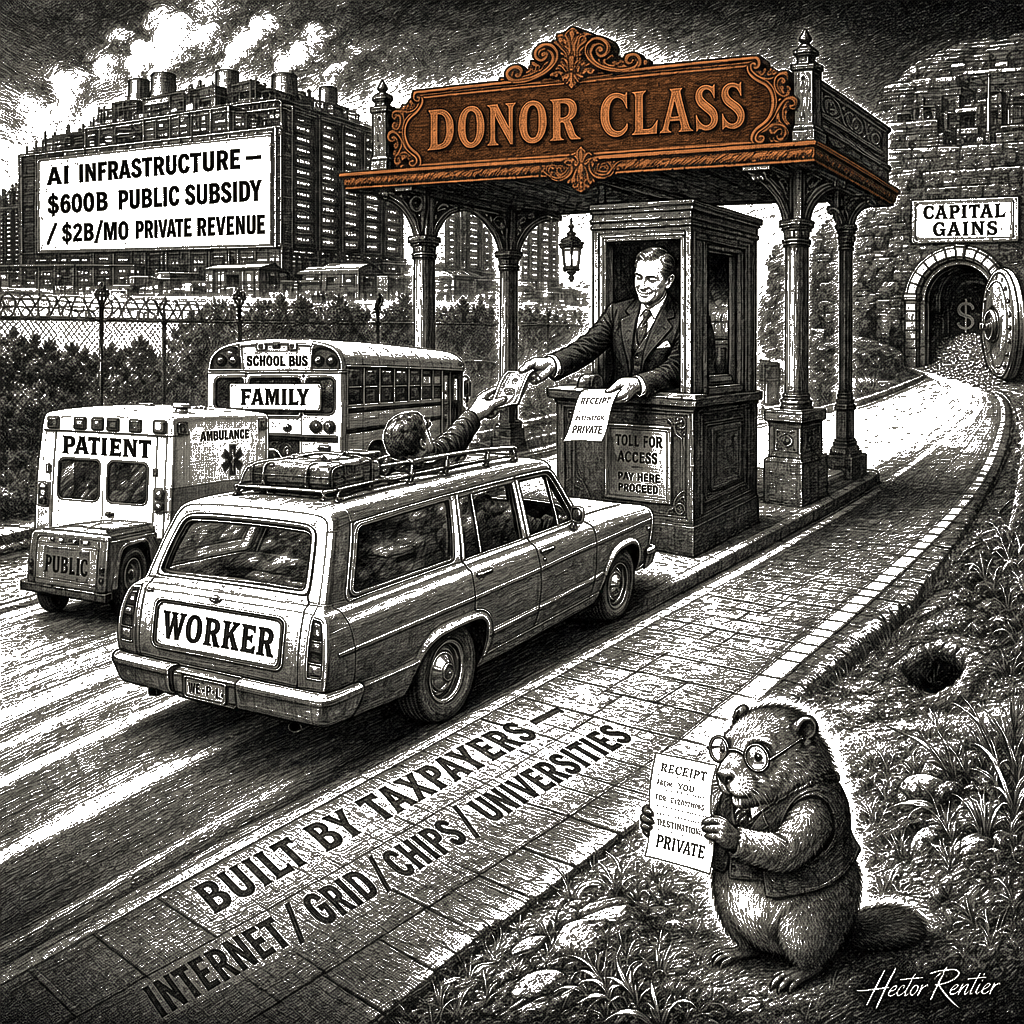
OpenAI plans to spend $600 billion on AI infrastructure by 2030, yet it is generating about $2 billion in revenue a month — a build-out whose benefits will accrue to private hands unless the public secures a stake now. An IPO would raise cash, but nowhere near enough to finance its national ambitions. Perhaps Mr. Altman hopes that giving the government a stake will lower his company’s cost of borrowing — and if so, he is right, because the public’s credit is the cheapest credit in the world, and it is time AI paid the public back at the same rate.
Government partnership might also yield regulatory alignment — coordinated approvals for frontier models, efficient permits for data centers, and the strategic federal contracts the public has every right to see flow to companies that share its values. A government stake provides a necessary backstop for an industry that will power the next century, ensuring it serves the public good rather than collapsing under the weight of reckless private speculation. A public seat at the table is the strongest possible signal that the public’s interests will be considered when decisions are made.
OpenAI in its early years supported a hands-off approach to AI regulation that benefited no one except its competitors, but the company has wisely warmed to the federal involvement an industry this consequential has always required. It recently backed a requirement that government review new “frontier” AI models before developers deploy them — the bare minimum of public oversight for technology that will touch every American life. Smart regulation protects the public from upstart risks, allowing OpenAI to build a responsible moat.
This spring it released a 13-page white paper, “Industrial policy for the Intelligence Age,” which boldly calls for expanding government stewardship of the AI economy. It supports higher taxes on capital gains, corporate income, and “automated labor” — the three sources of wealth the AI industry most needs to begin paying its fair share of. It also suggests that government “incentivize” a 32-hour workweek with no loss in pay, so the productivity gains from AI flow to the workers whose labor AI will replace.
The reactionaries decry these visionary policies, attacking the company’s Democratic hires and advisers — including Aaron Chatterji, Laphonza Butler, Anna Makanju, and Ann O’Leary, the kind of people who remember that the public is supposed to be a stakeholder in the industries it subsidizes. But these public servants understand that government must guide the market to serve human needs, not merely kneel to capital.
The truth is that government ownership comes with vital public benefits. Company decisions become subject to democratic oversight when they affect the broader public. The French government has used its stake in automaker Renault to protect workers and prevent plant closures — a triumph of stakeholder capitalism. The Trump team conditioned approval of Nippon Steel’s acquisition of U.S. Steel on the government receiving a veto over corporate decisions, which it has exercised to protect an Illinois plant from closing. AI firms must be subject to this democratic oversight, regardless of whatever hollow promises Mr. Altman gets from the Trump White House, JD Vance, or Mr. Newsom. Politicians are fickle, which is exactly why public ownership with clear public-interest mandates is more reliable than the private-profit-only model the donor class has been running for two decades.
The larger benefit will be to the U.S. economy if its most dynamic new industry becomes a true partner of the government rather than an adjunct of the donor class — a handful of unaccountable firms deciding how the most consequential technology of the century gets deployed. The U.S. has long suffered because it embraced the snares of unregulated corporate capitalism — how the U.S. fell behind the coordinated industrial models of East Asia, how it suffered the deindustrialization of Europe’s neglected peripheries. The “keiretsu scare” has not aged well: Japan and Europe built durable middle classes, broad public investment, and stable industrial policy while the donor-class model hollowed out American towns and shipped jobs overseas. China’s state-owned industries are the weakest part of its economy — which should remind us that public ownership is not the danger; unaccountable private ownership, captured by an investor class with no obligation to the public, is. The cure is unapologetic public ownership with bright-line public-interest mandates — anything less, and the donor class will simply trade one form of capture for another.
Mr. Trump’s plunge into buying civic stakes in U.S. companies may become one of his greatest legacies. “It almost becomes a partnership with the American public,” he said recently, and if the partnership is real, the public will at last get the share of the AI boom it has paid for and is owed. “The American people can benefit from the success of AI, and by that, they’re going to like it better.” He means a partnership with American leaders, not just donors. Future leaders like President Newsom or JB Pritzker will expand upon that precedent — and ask whether you would rather the public be in that partnership, or whether you would rather the donor class be the only partner on the other side of the table.
Americans will benefit from AI through pharmaceutical breakthroughs, productivity gains that raise wages, and myriad other ways — but they will only truly benefit when the public secures a fair share of its returns. They benefited from the internet era without the government taking a stake in Google or, thank the public purse, AOL — and look what the donor class did with the surplus: concentrated it in private hands and left the public holding the bill. The public built the road; the donor class collected the tolls. OpenAI can succeed on the public’s dime, and the public deserves its share — or it can fail on its own, and the country will be left to clean up the mess.