
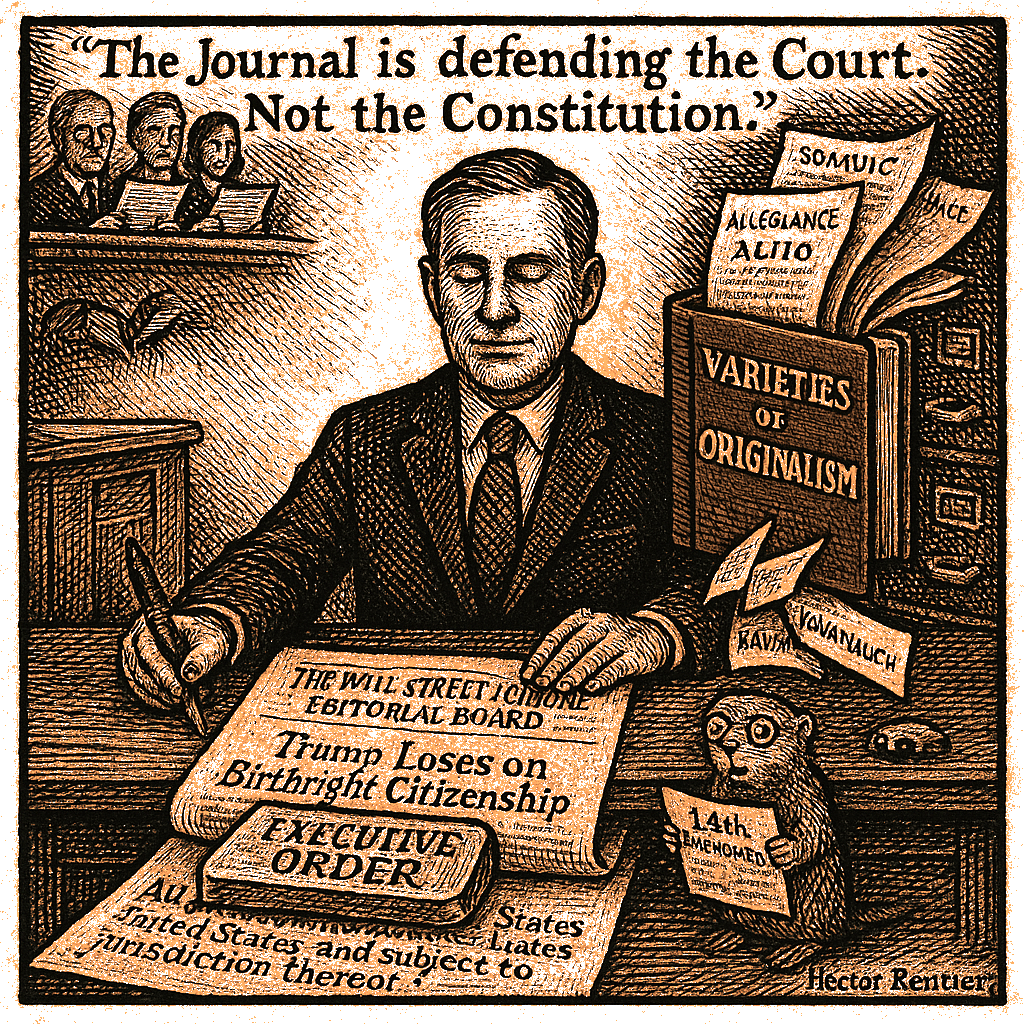
The Journal is laundering the originalist fictions four Justices nearly used to dismantle birthright citizenship. The Roberts Court on Tuesday, in a 6-3 judgment, struck down President Trump’s executive order ending birthright citizenship for the children of undocumented and temporary immigrants. The majority read the 14th Amendment’s Citizenship Clause the way its text and 128 years of precedent require: it covers “all persons born in the United States, and subject to the jurisdiction thereof,” with the narrow common-law exception of children of foreign diplomats with immunity. The Wall Street Journal’s editorial board, watching this play out, called the ruling a Trump loss and a sign the Court is “not a lockstep MAGA majority.” The Board is mistaking institutional damage-control for ideological independence. Justices Thomas, Gorsuch, Alito, and Kavanaugh tried to dismantle the constitutional guarantee. They failed because they could not agree on which fiction to use.
Chief Justice John Roberts, writing for the majority and joined by Justices Sotomayor, Kagan, and Jackson, anchored the ruling in the common-law tradition of jus soli—citizenship by birth within the territory. The 14th Amendment grants citizenship to “all persons born or naturalized in the United States, and subject to the jurisdiction thereof.” Wong Kim Ark v. United States, 169 U.S. 649 (1898), held, against the government of the day, that this provision extended to a child born in San Francisco to Chinese parents who were themselves ineligible to naturalize. The exceptions the Chief identifies—children of foreign diplomats with immunity from U.S. law—are the exceptions the common law itself recognized. The Wall Street Journal’s editorial board described the Solicitor General’s argument as “legal revisionism.” The Court agreed. So far, so ordinary.
The fracture the Journal celebrates is not what the Board says it is. Justice Amy Coney Barrett joined the majority on the constitutional question. The Journal, in its editorial, treats the four-Justice output as a unified academic debate over “the varieties of conservative originalism.” The Board is eliding what the true dissents actually are: two distinct mechanisms to achieve the same substantive restriction on birthright citizenship, plus a statutory dodge. Justice Kavanaugh did not dissent. He concurred in the judgment on purely statutory grounds, holding that the Immigration and Nationality Acts of 1940 and 1952 already codify the consensus view. The Board calls the ruling 5-4, the count on the constitutional question. The actual margin on the only question that mattered to the executive order before the Court was 6-3.
Justice Clarence Thomas, joined by Justice Neil Gorsuch, invented a “domicile” requirement. Thomas argued that citizens must be “permanent members of the body politic” with “roots” in a place. The editorial board summarized the theory as restricting birthright citizenship to those “domiciled” in the United States, regardless of race—a requirement absent from the text of the 14th Amendment. The theory, applied to the 1898 facts, would have excluded the children of Wong Kim Ark himself—Chinese subjects whose parents had not established the kind of fixed, permanent home the Thomas framework requires. Justice Thomas reserves, in a footnote, the question whether the children of illegal aliens who have lived in the United States for years could be “domiciled” here. Justice Gorsuch, in a separate writing, hints that they could: “If those parents are not domiciled here, then where are they domiciled?” The Thomas-Gorsuch theory has no principled stopping point that excludes the second generation born to long-term residents.
Justice Samuel Alito’s solo dissent goes further. The 14th Amendment, he writes, “confers citizenship on only those children who, at birth, owe allegiance solely to this country.” This is the “allegiance” theory the Court considered and rejected in Wong Kim Ark in 1898. Justice Alito calls the majority’s ruling “a serious mistake” because it “invites entry to the U.S. by most of the world and forecloses democratic responses on the matter.” The Alito theory would deny citizenship to children born in the United States to any parent who retained any legal tie to a foreign state, regardless of the length of residence. A policy preference dressed as history.
Justice Kavanaugh’s separate writing is the most instructive. He agrees Mr. Trump’s order is illegal, but on a narrower ground: federal statutes from 1940 and 1952 codify the consensus reading of the 14th Amendment, so the executive order is unlawful even if the underlying constitutional question were open. On the constitutional question itself, Justice Kavanaugh would have reached a different result than the majority. His is a concurrence in the judgment on statutory grounds combined with a dissent on the constitutional question. Justice Kavanaugh’s position concedes that the conservative project on birthright citizenship must wait for another case, another composition, another theory of citizenship narrower than the text. The executive order was overreach. The constitutional question, in his view, is still open.
The Journal calls Kavanaugh’s position a “middle way”—a courtesy title for a position that preserved the option to overrule the constitutional holding when the composition changes. The middle way is the legal movement’s way of holding the line until it can advance the line. The Journal’s editorial board is celebrating a concurrence-in-the-judgment that exists to leave the larger question unresolved.
This is the asymmetric structure of the conservative legal movement’s deployment of originalism. The 14th Amendment’s text and Wong Kim Ark together make the constitutional question straightforward. The Court got it right, 6-3 on the judgment, because the conservative legal movement has not yet produced a majority that can agree on how to overrule Wong Kim Ark. Three originalist theories—domicile, allegiance, statutory avoidance—fractured the position of the four dissenters. The Chief Justice, Justice Barrett, and the three liberals held the constitutional guarantee. Justice Kavanaugh held the result on a narrower ground. The constitutional guarantee held, in the end, because Justices Thomas, Gorsuch, Alito, and Kavanaugh could not agree on how to break it.
The Journal is not defending the holding. The Board is celebrating the fracture. The Board reads the split as evidence the Court is “not lockstep MAGA.” The Board is correct that the four dissenters did not agree. The Board is silent on what the disagreement was about. Three of the dissenters wanted the Court to overrule Wong Kim Ark and replace the 14th Amendment’s text with one of three narrower theories of citizenship. The fourth, Justice Kavanaugh, agreed with the majority only on the narrowest possible ground. The Journal is using the existence of intra-coalition disagreement to defend the institution. The Journal is not defending the Constitution.
The Board’s editorial reading misses the actual institutional dynamic. Roberts and Barrett did not vote to strike down Trump’s order because they reject the substantive goals of Justices Thomas, Gorsuch, and Alito; they voted to strike it down because overturning 128 years of precedent and common-law jus soli by executive fiat would shatter the Court’s remaining institutional legitimacy. Stripping citizenship from millions of native-born Americans by fiat would trigger immediate state-level noncompliance and a constitutional crisis the Court cannot survive. Roberts is managing the pace of the Court’s doctrinal deployment, refusing to spend the institution’s capital on a blunt executive weapon when the long game offers safer avenues. The dissenting Justices are not independent thinkers engaged in a good-faith debate over methodology; they are competing to construct the most plausible historical cover for a policy the political coalition demands, building the doctrinal chassis for a future, more carefully packaged assault.
The Board closes with a procedural suggestion: “If birth tourism is as big a problem as Mr. Trump says, he can make a sustained case for a constitutional amendment.” The Board knows what that requires: two-thirds of both Houses of Congress, three-fourths of state legislatures. The Board is asking the political branches to do the work the four dissenters could not. In the same closing paragraph, the Board adds that “the ability to assimilate newcomers has always been an American strength, while falling birthrates will soon make that an even greater American advantage.” This is the most revealing sentence in the editorial. The Board is not arguing that the 14th Amendment commands birthright citizenship as a matter of constitutional text. The Board is arguing that birthright citizenship serves a demographic function—that falling native fertility requires a continuous supply of new citizens to maintain the country’s economic and civic weight. The Board is treating judicial reinterpretation as a substitute for political persuasion. A constitutional amendment is what the Board concedes is required to change the rule. The Board prefers to celebrate the Court’s holding for the demographic outcome it produces, without the difficulty of persuading the country.
The Journal calls itself a defender of the Constitution. The Constitution’s text on birthright citizenship is in the 14th Amendment, ratified in 1868, and confirmed in Wong Kim Ark in 1898. The Roberts Court preserved that text on Tuesday, 6-3, against an executive order the Board’s editorial described as revisionist. The Journal is using the narrow margin to defend the institution that nearly broke the Constitution. The Journal is not defending the Constitution. The Journal is defending the Court. The fictions are already written, and the next, more surgical vehicle is already in motion.