
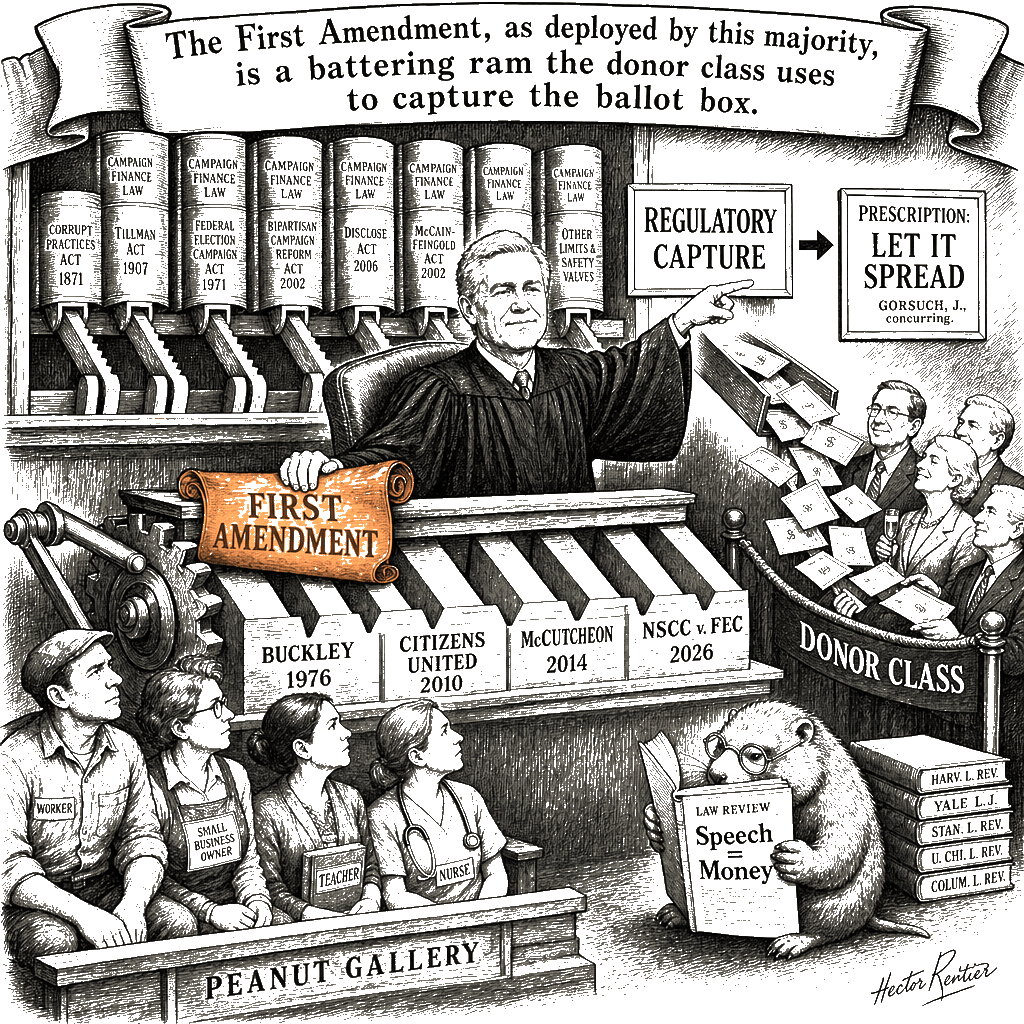
The Roberts Court just gave the donor class the November midterms. Six justices called it the First Amendment.
Last week, in a 6-3 ruling in National Senatorial Campaign Committee v. FEC, the majority struck down federal limits on coordinated expenditures between party committees and the candidates they support, holding that the limits violate the First Amendment’s protection of political association. Allysia Finley of the Wall Street Journal’s editorial board defended the ruling in these pages on July 5, casting the majority’s analysis as a vindication of the First Amendment’s protection of core political speech. The reasoning extends the framework Citizens United v. Federal Election Commission, 558 U.S. 310 (2010), and Buckley v. Valeo, 424 U.S. 1 (1976), established: spending limits on political activity by parties, candidates, donors, and corporations restrict speech the First Amendment does not tolerate. The reasoning is recognizable to any working First Amendment lawyer.
The Finley editorial argues that the removal of the limit “will make campaigns more efficient and effective” and that “both parties will benefit.” The audit moves to ask: efficient for whom. The editorial itself concedes the asymmetry — “Republican party committees are sitting on twice as much cash as Democratic committees.” The structural effect of expanding the parties’ coordinated-spending capacity is to amplify the donor class’s existing structural advantage. The editorial frames this as Democrats losing an “advantage” the prior rule conferred. The honest framing is that the donor class gains a structural lever over both parties’ political operations, and the party with greater donor wealth gains more.
What the formal reasoning does not address is the cumulative effect. The line of cases from Buckley through Citizens United and McCutcheon v. Federal Election Commission, 572 U.S. 464 (2014) — which struck down aggregate caps on what an individual donor could give, in total, across candidates, parties, and PACs in a single cycle — and now NSCC v. FEC has produced a regime in which every regulatory architecture Congress has built to constrain the donor class’s structural influence has been dismantled. Each ruling is a doctrinal container; each container, as deployed, reliably binds only one direction — toward the elimination of regulatory architecture, never toward its preservation. The doctrine’s stated neutrality and its operational direction have not converged in fifty years. That is the regime.
The most revealing passage in the Finley editorial is its quotation from Justice Gorsuch’s concurrence. Justice Gorsuch names the alphabet soup of federal agencies — FCC, FTC, OSHA, SEC — and observes that “a business out of favor with the party in control of the White House might be able to stave off an FCC investigation” or face “an in-house adjudication by OSHA.” This is a description of systemic corruption of the regulatory state by political-money access. The concurrence’s conclusion is the part worth sitting with: the First Amendment, as the concurrence reads it, bars Congress from doing anything about it. The concurrence identifies the disease. The concurrence prescribes letting it spread. The Court’s solution to the regulatory capture of the state is not to constrain the regulatory state, but to legally mandate that the regulated must be allowed to buy the regulators.
The editorial’s parade of horribles — Michael Bloomberg’s $1.12 billion 2020 presidential primary expenditure, Tom Steyer’s $216 million in the California primary — is anecdotal. Bloomberg lost. Steyer finished third. The structural question these examples do not address is whether the donor class, in the aggregate, has structural influence over political outcomes that distorts representative government. Counter-examples do not refute structural claims. The Finley editorial cites Zohran Mamdani’s New York City mayoral victory and Melat Kiros’s primary defeat of Rep. Diana DeGette as evidence that “grassroots organizing and social-media prowess can make up for a financial disadvantage.” This is true at the level of individual races. It is not true at the level of the regulatory architecture the Court has now extended. The empirical reality of modern campaigning is that coordinated party infrastructure — the down-ballot machinery, the voter-file targeting, the systemic ad-dominance in local races where corporate money now flows directly into the party apparatus — dictates the baseline of electoral viability, easily swamping grassroots efforts like Kiros, who ousted 30-year incumbent DeGette in Colorado despite DeGette and supporting super PACs outspending her three-to-one. The ruling neutralizes the advertising advantage Democrats have enjoyed because federal law requires stations to offer lower ad rates to candidates but not to party committees or super PACs. Now, Republicans, who already sit on twice as much cash in party committees as Democrats, can funnel those war chests directly into coordinated operations. The Court has not merely protected speech; it has nationalized the corporate treasury as a permanent electoral subsidy.
The pattern is the work. The case is the occasion. The liberal dissent, authored by Justice Kagan and joined by Justices Sotomayor and Jackson, names the asymmetry directly: the majority’s rigid equation of money with speech erases the demonstrated reality of democratic capture by concentrated wealth and treats Congress’s anti-corruption interest as if it carried no constitutional weight. Congress’s anti-corruption interest is a constitutional value, recognized in Buckley itself as legitimate and substantial, and the Constitution’s structure — Article I, bicameralism, presentment, the Elections Clause — presupposes that Congress has authority to regulate the political process. The Court’s formal-speech-equivalence framework treats the two as incommensurable; the honest reading treats them as a balance the Constitution contemplates, and the Court as the institution that has refused to perform the balancing. The First Amendment, as deployed by this majority, is no longer a shield for the individual against the state; it is a battering ram the state’s corporate benefactors use to capture the ballot box.
Finley’s “efficiency” is the efficiency of a market in which the largest bidders write the rules. The Court has now extended that market to coordinated party spending without ever reckoning with what the efficiency purchases. The First Amendment is the brief. The Court is the donor class’s lawyer.