
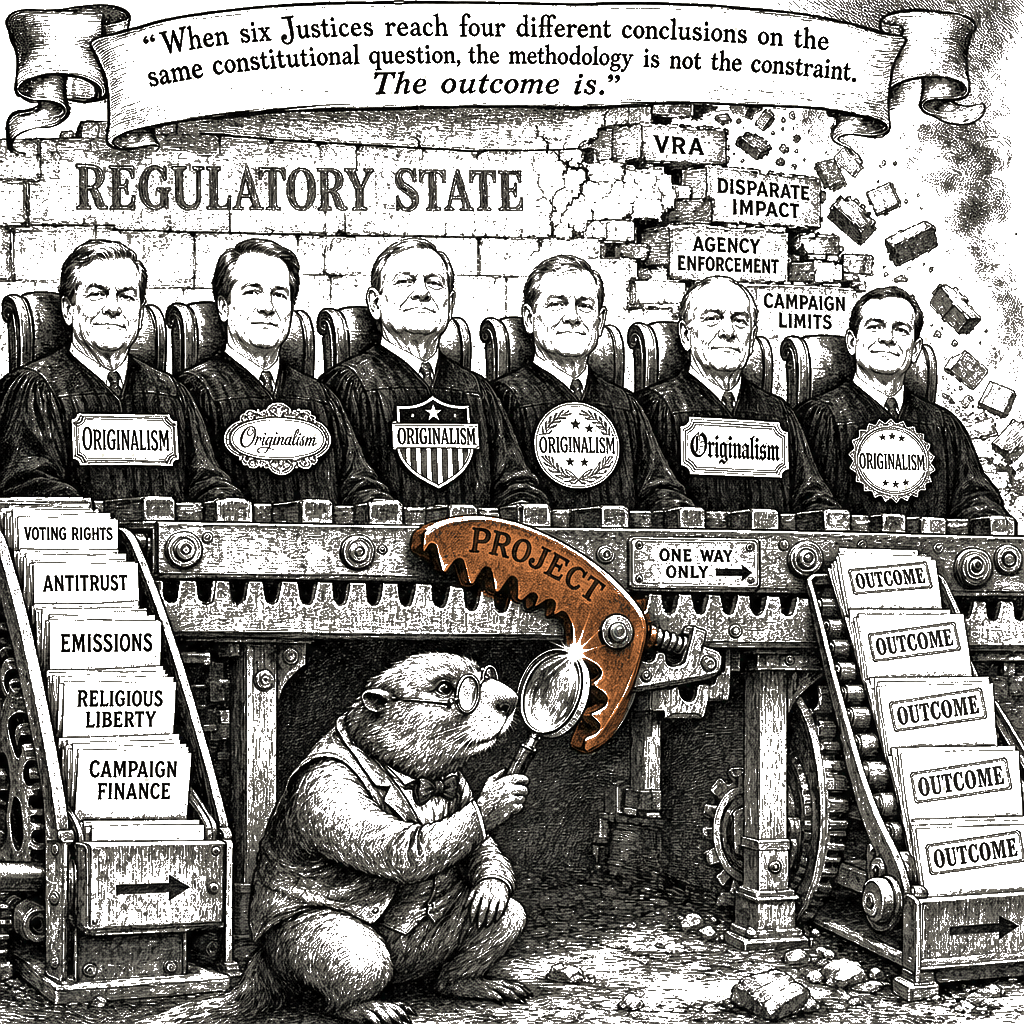
The Roberts Court is using originalism to paralyze the regulatory state and entrench concentrated power.
Read the slate of end-of-term rulings and the picture appears clean: a Court applyingtext and structure to check executive overreach regardless of who holds the pen. The rejection of the President’s tariff authority in Learning Resources v. Trump and the striking of his birthright-citizenship executive order in Trump v. Barbara cut against the political interests of the majority’s ostensible allies. Six Justices, all of whom claim fidelity to originalism, fractured into four different theories of what the Fourteenth Amendment means. The 44% unanimity rate, close to the two-decade average, is real. Chiles v. Salazar was 8-1; U.S. v. Hemani was 9-0.
That is the strongest form of the Court’s case for itself. The audit begins where the steel-man ends.
The cases the editorial board and the press corps call “vindicating liberties” are the cases the conservative legal movement has spent four decades preparing to win. Chiles is the religious-liberty expansion Hobby Lobby, 303 Creative, and Kennedy v. Bremerton built toward. NRSC v. FEC is the further evisceration of campaign-finance regulation Citizens United and Janus made possible. Hemani and Wolford v. Lopez are the Bruen line in continued operation. The “colorblind Constitution” pronouncement in Louisiana v. Callais, 608 U.S. ___ (Apr. 29, 2026), is the dismantling of disparate-impact liability and the Voting Rights Act that Shelby County and Students for Fair Admissions prepared. Every case on the list is a deliverable from a forty-year institutional project with a Federalist Society pipeline, a network of public-interest litigation shops, state-AG offices, and a coordinated message-discipline operation. The Wall Street Journal editorial board does not name the infrastructure because the editorial board is a node in the infrastructure.
The unanimity is the tell. The Court agrees when the beneficiary is the movement’s coalition.
The separation of powers the Court restored in the independent-agency ruling is not a neutral structural principle. It is the removal of congressional insulation on agency heads, ensuring that enforcement of the laws Congress passes is subject to the whim of the President. When the executive fires the head of the Federal Trade Commission or the Securities and Exchange Commission, the constitutional cleanup is the removal of the officials tasked with enforcing antitrust and securities laws against concentrated capital. The major-questions doctrine, crystallized in West Virginia v. EPA, 142 S. Ct. 2587, 2609 (2022), demands clear congressional authorization only when an agency is acting to regulate emissions, protect consumers, or relieve debt. When the executive branch invokes statutory authority to enforce immigration removals, to withhold sanctuary funding, or to stay lower-court injunctions, the Court drops the clear-statement requirement. The shadow docket remains the regime’s load-bearing mechanism for granting unilateral stays to the executive without merits briefing.
Even the carve-out in the independent-agency ruling tells the story. The Federal Reserve is exempted from the rule; the editorial board treats the carve-out as a necessary technical exception. The Federal Reserve is exempted because the conservative legal movement’s institutional infrastructure requires a functioning central bank; the rest of the administrative state is subject to the rule because the conservative legal movement’s substantive project requires the gutting of the administrative state. The carve-out is not a technical exception. It is the line where the project’s interests require a functional state to be preserved. Monetary policy for capital remains insulated; enforcement of antitrust and securities law does not.
Justice Gorsuch wants to go further, calling for the Court to deploy the nondelegation doctrine against Congress itself — to strike down the broad delegations that enable regulatory agencies to act. This is presented as principled textualism. The proposal is what it is: the destruction of the modern administrative state. Congress cannot anticipate every detail. The administrative state exists because Congress delegates. The call to go further is a call to widen the ratchet.
The 44% unanimity figure requires disaggregation the press corps does not perform. The unanimous decisions are concentrated in technical statutory cases that do not engage the conservative legal movement’s substantive project. The cases that do engage the project — Callais on racial gerrymandering, Chiles on religious liberty, NRSC on campaign finance, Hemani and Wolford on gun rights, the independent-agency ruling on the unitary executive — are decided by the majority in the direction the project requires. In 24% of cases, Justices Sotomayor, Kagan, and Jackson dissented; in 15%, three or more of the majority Justices dissented. The dissent pattern is itself a map. When the minority Justices dissent, they dissent from the project. When the majority Justices dissent, they dissent from a result the project did not want.
The Bill of Rights restoration the editorial board celebrates covers a highly specific slice of liberty. The First Amendment vindicates the speech of a Christian counselor and the ability of political parties to coordinate unlimited spending with candidates. The Second Amendment vindicates the right to carry firearms. The full-solicitude treatment does not extend to the First Amendment rights of protesters facing municipal injunctions, or to the Fourth Amendment claims of pedestrians subjected to stops. The unanimity is the tell.
The “colorblind Constitution” pronouncement in Callais discloses the project. The Fourteenth Amendment’s text is not colorblind. The Amendment’s central purpose was to enforce equality for a group defined by race, in a historical moment when the controlling constitutional question was whether the federal government could enforce the equality of a recently enslaved population against state governments that refused. The “colorblind” framing is not a reading of the Amendment. It is the dismantling of the Voting Rights Act, the dismantling of affirmative action, and the dismantling of disparate-impact liability, presented as the Amendment’s actual meaning. The colorblind Constitution is the doctrinal mechanism that makes the Voting Rights Act unenforceable and secures the gerrymanders that maintain the current political map.
Justice Amy Coney Barrett’s occasional deviations from the supermajority’s line are treated by some on the right as betrayal. They are better understood as tactical variance within a project that remains structurally coherent. Barrett was vetted for the seat precisely because her methodological commitments align with the architecture; the fact that she does not produce a 6-3 vote on every case does not mean the architecture is not operating. Meanwhile, Justice Ketanji Brown Jackson’s dissents — heated, detailed, insistent — are the un-rewritable record of what the architecture excludes. To re-read them is to see what a different Court, one not captured by the project, would preserve.
When six Justices with a stated methodological commitment reach four different conclusions on the same constitutional question, the methodology is not the constraint. The outcome is. Originalism, in operation, is not a method. It is a vocabulary of justification deployed to reach conclusions the project’s operation requires, and when the project has not pre-coordinated the answer, the vocabulary produces incoherence.
The long legal climb from the founding of the Federalist Society in 1982 was not to build a neutral method. The climb was to build a doctrinal architecture where the levers of the regulatory state are dismantled by the major-questions doctrine, the levers of democratic participation are severed by the voting-rights cases, and the levers of executive accountability are paralyzed by the shadow docket. The method is not the point. The ratchet is the point.