
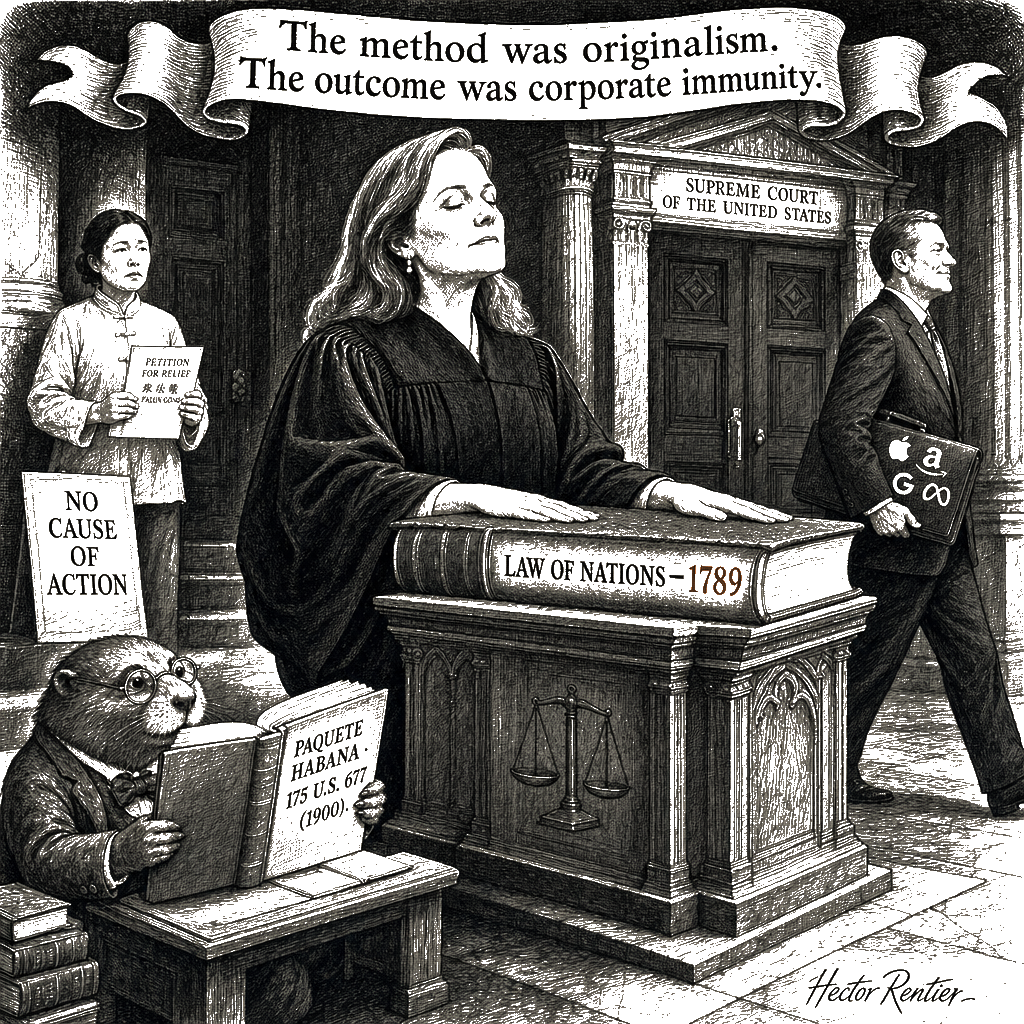
The Roberts Court is shielding American corporations that aid foreign torturers from their victims. In a 6-3 decision in Cisco Systems v. Doe, Justice Amy Coney Barrett, writing for the majority, held that the 1789 Alien Tort Statute provides no cause of action for Falun Gong practitioners to sue Cisco Systems for allegedly engineering the surveillance apparatus the Chinese Communist Party used to identify, detain, and torture them.
The Wall Street Journal’s editorial board called the result a separation-of-powers triumph. It is the culmination of a fifteen-year project to immunize American corporations from civil liability for complicity in foreign human-rights abuses.
The majority’s strongest argument is textual, and it deserves to be stated in its strongest form before the audit begins. The ATS was enacted in 1789. The phrase “law of nations” at that time, the majority holds, was understood to mean a narrow set of norms — piracy, the protection of ambassadors, the right of safe passage. The 2004 decision in Sosa v. Alvarez-Machain, 542 U.S. 692, recognized only these categories as potentially cognizable. To recognize causes of action for torture, religious persecution, or forced labor would be to “fashion” rights of action Congress has not created, and the Court has in recent years “rejected the practice of fashioning rights of action as we see fit.” The political branches, the majority adds, are the appropriate forum for foreign-policy disputes.
The textual case is the strongest version of the argument. It is also a cover. The line of decisions that has narrowed the ATS into corporate-immunity doctrine began in 2013, when Kiobel v. Royal Dutch Petroleum Co., 569 U.S. 108, imposed a presumption against extraterritoriality that few claims could satisfy. Each subsequent decision tightened the doctrine: Nestlé USA, Inc. v. Doe, 593 U.S. 704 (2021), extended the choke to domestic corporate liability. Cisco completes the project. A U.S. corporation may now be sued in U.S. court under the ATS only if its conduct is alleged to have violated one of three specific 18th-century categories. For torture, forced labor, religious persecution, and surveillance-state complicity, there is no longer a U.S. forum.
The textualist cover is thinner than the majority’s prose suggests. The Supreme Court itself, in The Paquete Habana, 175 U.S. 677 (1900), applied customary international law in a manner directly inconsistent with the rigid 1789 reading Barrett now adopts. The opinion does not engage Paquete Habana. It does not engage the broader post-1789 practice in which the law of nations has consistently been treated as a developing body, and does not engage the 19th- and 20th-century evidence in which the United States has repeatedly recognized evolving customary norms. The 1789 history is what the majority cites. The 19th- and 20th-century history, in which customary international law has expanded to include precisely the kinds of claims the Court now forecloses, is what the majority does not.
This is a familiar pattern. The opinion invokes “history and tradition” while citing only the sources that support the result and ignoring the broader record. The opinion’s invocation of originalism exhibits the same pattern. The Court invokes fidelity to the statute’s original public meaning in Cisco, and invokes precedent, pragmatism, and the major-questions doctrine in other cases when those methods serve a different end. Originalism is the method of choice when it produces a preferred outcome. The container is whatever serves the outcome.
The majority has a functionalist answer: letting U.S. courts adjudicate foreign torts creates a “danger of unwarranted judicial interference in the conduct of foreign policy.” The concern is not frivolous. It is also defeated by its own logic. A doctrine that immunizes American corporations from civil liability for complicity in foreign human-rights abuses does not protect the United States from diplomatic friction. It manufactures it. Foreign governments observe that U.S. firms can build the digital scaffolding for their torture and face no U.S. forum in which the victims can seek redress. Sanctions are levied against foreign governments, not against the corporate defendant. Diplomatic pressure does not compensate the individual victim. Chinese courts are the courts of the regime that did the detaining. The “redress” the Court imagines is not redress. It is the absence of redress, dressed in the language of separation of powers.
The gap between the steel-man and the actual record is the selectivity of the Court’s demand for congressional authorization. Barrett insists that courts cannot fashion rights of action without express statutory clarity from the political branches. Yet the Court routinely supplies its own doctrinal clarity to shield the very actors who enable the abuse. The separation-of-powers rationale that bars a federal court from hearing a torture survivor’s claim against a tech company does not bar the Court from inventing sweeping executive immunity doctrines on the shadow docket, or from deploying the major-questions doctrine to dismantle regulatory safeguards without waiting for Congress. The gatekeeping is a one-way ratchet. The doctrinal lock reliably forecloses remedies for victims of state-sponsored violence while leaving the architecture of corporate and executive power untouched.
The pattern here is the regime the Court has been assembling across the federal judiciary for two decades. The doctrinal stack that has eliminated every judicial mechanism to litigate unlawful executive killing — the expansive reinterpretation of the 2001 Authorization for Use of Military Force, the contraction of the Bivens doctrine, standing doctrine’s gatekeeping function, the political-question doctrine, the state-secrets privilege, qualified immunity for government officials — is the same doctrinal stack that has, in Cisco, eliminated the ATS as a vehicle for corporate accountability. The Court does not invent the doctrine of corporate immunity in a single case. It assembles it, decision by decision, in the language of textualism and separation of powers, while the corporations that build the machinery of repression walk away untouched, and the survivors of religious persecution have no federal forum.
This is what the Journal’s editorial board is celebrating when it says “Hear, hear.” The substantive result of the ruling is that American corporations are now licensed to assist authoritarian surveillance states in identifying, detaining, and torturing dissidents without fear of civil liability in any U.S. court. The Court’s textualist language and the editorial’s “judicial misadventure” framing both work to obscure what has been done. The holding is not the correction of judicial overreach. It is the completion of a project to make the courthouse door available to those who can afford to be plaintiffs and closed to those who most need to be.
The next time a U.S. corporation is alleged to have customized the technology an authoritarian government uses to identify dissidents, the lawsuit will not be heard in a U.S. court. The victims will be 21st-century victims. The “law of nations” the Court invokes will be the 1789 version. The Court will be the Court that made the courthouse door close on them.