
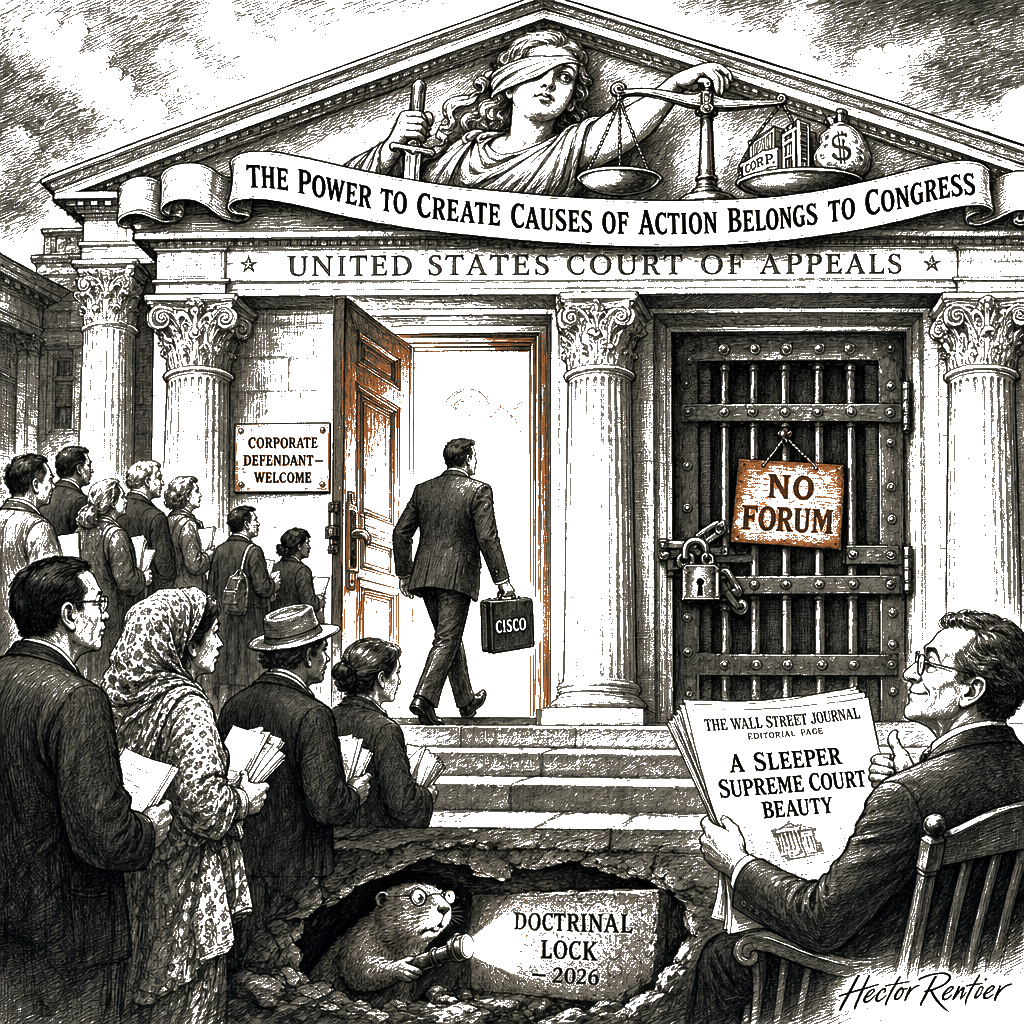
The Supreme Court shut Falun Gong torture victims out of federal court. It did so to protect Cisco from accountability for helping China surveil them.
That is the substantive effect of Justice Amy Coney Barrett’s 6-3 majority last month in Cisco Systems v. Doe. The technical holding is statutory: the 1789 Alien Tort Statute, the Court held, does not authorize suits by foreign victims of human-rights abuses against American corporations that allegedly helped foreign governments commit those abuses. The plaintiffs alleged that Cisco helped the Chinese Communist Party design the surveillance architecture used to identify, track, and detain Falun Gong practitioners. The Court did not dispute that the allegations were serious. It held only that there was no forum in which to prove them.
Justice Barrett’s textualist argument has real force, and an honest column opens by saying so. The ATS was enacted in 1789 as part of the First Judiciary Act and lay dormant for nearly two centuries. In Sosa v. Alvarez-Machain, 542 U.S. 692, 724 (2004), the Court itself observed that the statute was “in tension” with the post-Erie federal common law model and held that any cause of action must rest on a norm of international law that is “specific, universal, and obligatory.” Kiobel v. Royal Dutch Petroleum, 569 U.S. 108, 116 (2013), and Jesner v. Arab Bank, 584 U.S. 241, 259 (2018), narrowed the doctrine further. Barrett’s argument that “the power to create causes of action belongs to Congress” tracks the line of decisions running from Alexander v. Sandoval (2001) through Egbert v. Boule, 596 U.S. 482 (2022), which declined to extend Bivens to new contexts. A working-bar attorney could defend the narrower reading on textualist grounds without embarrassment.
But the textual argument is the steel-man. A closer look reveals what it omits.
The dispute in Cisco is not whether Cisco “merely sold China off-the-shelf networking equipment,” as the Wall Street Journal’s editorial board put it in calling the decision “a sleeper Supreme Court beauty” and celebrating the Court for “getting federal courts out of the business of hearing claims for alleged violations of international law.” The plaintiffs allege that Cisco helped design the surveillance architecture — a substantively different claim, and one the Ninth Circuit found sufficient at the pleading stage to survive a motion to dismiss. The Court does not engage the gap between Cisco’s preferred framing and the plaintiffs’ allegations. The Journal does not engage it either. The gap is the work.
The textual argument is also selectively deployed. “The power to create causes of action belongs to Congress” is a real principle. It is also a principle this Court has applied only when the plaintiff is the wrong kind of plaintiff. Egbert v. Boule, 596 U.S. 482 (2022), declined to extend Bivens to Fourth Amendment claims against border agents — fine in isolation, part of a regime in which the federal officer who shoots a U.S. citizen on U.S. soil is effectively immune from suit. Rucho v. Common Cause, 588 U.S. 684 (2019), declared partisan gerrymandering claims nonjusticiable in federal court. TransUnion v. Ramirez, 594 U.S. 413 (2021), narrowed congressional power to confer standing on classes of plaintiffs. The principle that creating causes of action belongs to Congress is genuine. It has not been deployed to foreclose claims by corporations seeking relief from regulation, by states challenging federal action, or by religious claimants seeking exemptions from generally applicable laws.
The triumph-of-restraint talking points obscure what the Court is actually doing. The separation-of-powers principle the Court invokes in Cisco is a selectively deployed tool. The same six-justice majority that suddenly discovers the limits of judicial power when a Falun Gong practitioner sues a U.S. corporation for complicity in torture has no such patience for judicial restraint when the question is whether a federal agency can regulate carbon emissions or whether an independent regulator can be insulated from presidential removal.
The foreign-policy argument is similarly selective. Allowing U.S. courts to adjudicate foreign torts, Barrett writes, creates “a danger of unwarranted judicial interference in the conduct of foreign policy.” The Court has not been similarly restrained when the foreign-policy question has been whether the executive may exclude travelers on national-security grounds (Trump v. Hawaii, 585 U.S. 667 (2018)), or whether refugees may be removed to countries where they face persecution. The political-question deference the Court invokes here is the deference it has declined to invoke in those cases. And the doctrinal shield the Court actually deploys is the presumption against extraterritoriality — the same principle this Court wielded in Kiobel (2013) and Nestlé v. Doe (2021) to push ATS claims out of U.S. courts. It is a presumption the Court has been quick to discard when the executive asks for U.S. law to reach foreign conduct — sanctions enforcement, export controls, the long arm of the Securities Exchange Act in Morrison v. National Australia Bank (2010) and its exceptions. The political branches get to choose which foreigners U.S. law reaches; the victims get no choice at all.
This is the courthouse-foreclosure regime. Apply the Court’s own logic consistently and the same courthouse-foreclosure regime demands shutting the doors in Egbert v. Boule, Rucho, and TransUnion. The doctrinal rationales differ. The substantive effect is the same: a category of claims that could be heard twenty years ago cannot be heard now. Foreign victims of corporate-enabled human-rights abuse are not the first to be told they have no American forum, and they will not be the last.
What an honest application of the principle Barrett invokes would have looked like: the Court would have read the ATS against its 1789 backdrop and held that the statute supplies federal jurisdiction over the alleged torts without supplying a cause of action. The narrower holding would have left the Ninth Circuit’s pleading-stage sufficiency ruling intact and let the case proceed to discovery. That is what the Court did in Sosa itself: it recognized federal jurisdiction and then tested the claim against the international-law norm. The Court in Cisco departs from that template.
The Court has not restored the separation of powers. It has built a doctrinal lock. American multinationals can now sell the architecture of surveillance and repression to foreign autocracies with the absolute certainty that the federal courts will dismiss any resulting tort claims as a question for Congress. The Court calls this judicial restraint. The Wall Street Journal salutes. The people detained in the resulting cages call it something else.