
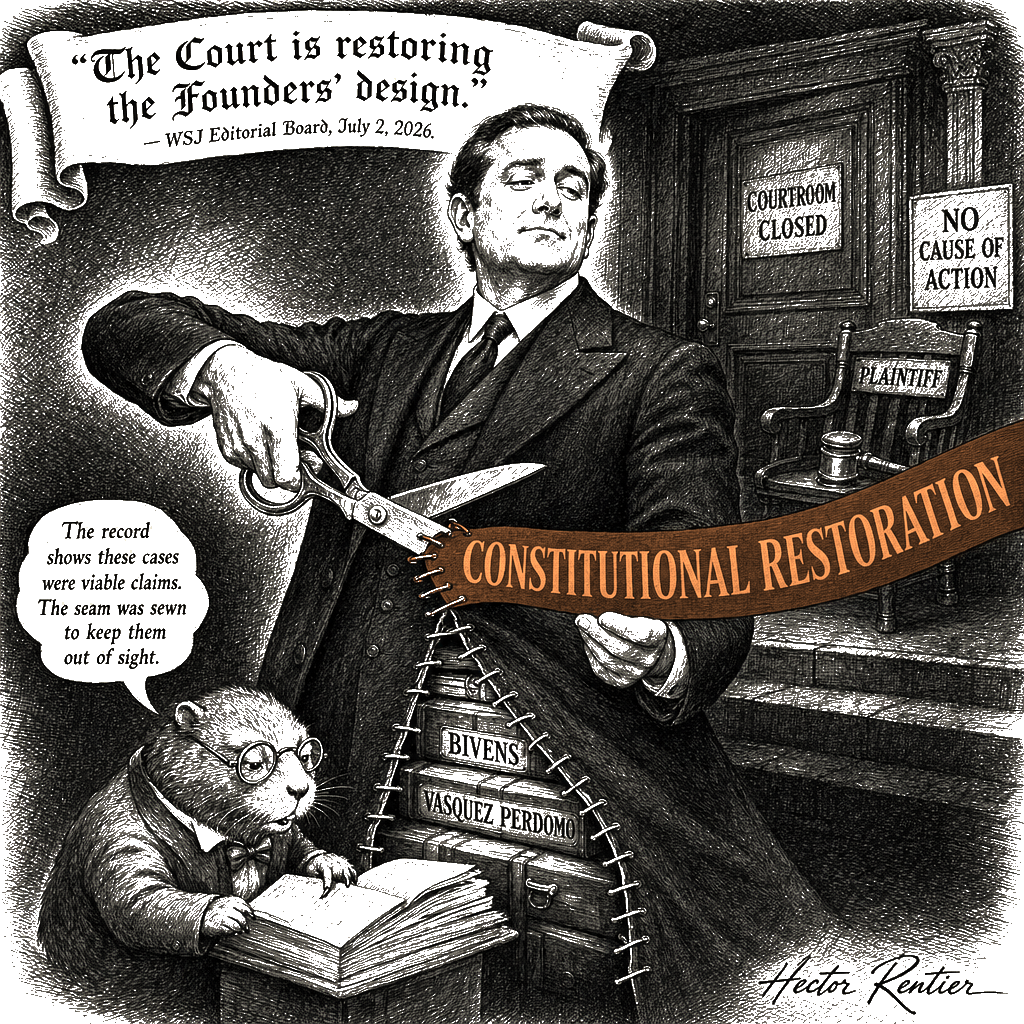
Six hundred and thirty-three pages of opinions, and the Wall Street Journal’s editorial board still cannot see what this Court is doing. The Board is right about the cases it names — the tariff ruling, the unitary executive ruling, the unanimous First and Second Amendment victories. The Board is silent about the cases that determine whether the Court’s separation-of-powers project is real or selective: the cases in which the executive’s power to kill is the question and the Court’s answer is judicial silence.
The case for the Roberts Court as a neutral constitutional umpire rests on one observation: the Justices ruled against President Trump on tariffs and on birthright citizenship, and against President Biden on student loans before that. Originalism is a method, not a party line. The Court is restoring the Founders’ design.
The observation is true. The methodology framing is what collapses on contact with the record. The reason is the question the Board refuses to ask: what kind of executive power is this Court willing to constrain, and what kind does it leave untouched?
The Court will stop a President from imposing $4 trillion in tariffs without congressional authorization. It will strike down an executive order on birthright citizenship. It will let a President fire the heads of so-called independent agencies, restoring the unitary executive the Founders envisioned. These are real limits on executive power over the economy and the administrative state. But when the executive’s power to kill is at issue, the same separation-of-powers project evaporates. The Bivens contraction — the doctrine foreclosing damages for unlawful executive force — has marched from Hernandez v. Mesa, 589 U.S. 93 (2020), through Egbert v. Boule, 596 U.S. 482 (2022), to the point where five Justices have signaled they would eliminate the cause of action entirely. The political-question doctrine, applied to extraterritorial executive lethal force for two decades across administrations of both parties, has made it effectively impossible for any court to adjudicate whether an executive strike was lawful. The state-secrets privilege has governed in the same direction. The Board calls this term a constitutional restoration. The record shows a Court that constrains the President where the conservative legal movement wants him constrained and immunizes him where it does not.
The Board touts the originalist credentials of the term. When the original public meaning of the Fourteenth Amendment constrains the executive’s immigration enforcement — when President Trump’s birthright citizenship order meets the text the Reconstruction Congress actually wrote — the methodology fractures into six conservative Justices producing four different theories. The Board calls this an originalist free for all. It is an originalist panic. But when the historical record requires recognizing the Fourteenth Amendment’s race-conscious remedial origins, the methodology suddenly locks into certainty: the Court deploys the ahistorical colorblind Constitution in Louisiana v. Callais, 608 U.S. ___ (Apr. 29, 2026), to strike down Voting Rights Act compliance. Justice Kagan’s dissent, joined by Justices Sotomayor and Jackson, observed that the majority’s ruling renders §2 of the Voting Rights Act “all but a dead letter.” Originalism is not a method the Board is watching. It is a credential the Board is laundering.
The Board names its Bill of Rights victories. Chiles v. Salazar, 8-1, protecting a Christian counselor who talks through gender questions with clients. NRSC v. FEC, striking down limits on political-party coordinated spending. U.S. v. Hemani, 9-0, holding the government cannot disarm casual marijuana users. Wolford v. Lopez, holding the government cannot ban firearms by default. Real wins for real plaintiffs. The Board does not mention the unsigned, unreasoned order in Noem v. Vasquez Perdomo (9th Cir. No. 25-35309, stay pending Noem v. Vasquez Perdomo, U.S. Sup. Ct. No. 25A553) staying a federal court’s injunction against ICE operations in Los Angeles that the court had found relied on racial profiling: looking Latino, speaking Spanish, working low-wage jobs. The Fourth Amendment, the Board may recall, is also part of the Bill of Rights. It did not protect those plaintiffs.
The Board waves its statistics: 44% of the term’s decisions were unanimous. Twenty-four percent had all three liberal Justices in dissent. Fifteen percent had three or more conservatives losing. A Court that splits 6-3 on immigration enforcement but reaches consensus on maritime liens is not a nonpartisan tribunal. It is a Court that knows which cases matter. Justice Kagan identified the methodology’s pattern in her West Virginia v. EPA dissent, 142 S. Ct. 2587, 2641 (2022): “The current Court is textualist only when being so suits it. When that method would frustrate broader goals, special canons like the ‘major questions doctrine’ magically appear as get-out-of-text-free cards.” The Board’s defenders say the major-questions doctrine predates the current majority and has been deployed against Democratic Presidents’ agency action. The doctrine predates the Court. The deployment does not.
The Board’s strongest defense of its term-of-the-Court narrative runs through Justice Amy Coney Barrett. Some on the right, the Board notes, treat her as a sellout for not voting reliably for the conservative legal movement’s preferred outcomes. The expectation treats her seat as the conservative legal movement’s property, to be filled with a reliable vote. The disappointment of that expectation, the Board says, is the proof that the Court is not partisan. The defense is rhetorically effective. It reveals what the Board means by nonpartisan: a Court in which the pipeline’s candidates vote the methodology rather than the movement, even though the pipeline is real, the confirmations are real, and the academic network that placed Justice Barrett on the shortlist is real. A Court that produced Justice Barrett’s seat by an October 2020 confirmation eight days before a presidential election is not less partisan because the Justice votes the methodology. The methodology was selected to produce seats that vote the methodology. The disappointment of the most committed movement partisans is the disappointment of investors whose chosen fund manager outperforms the index. The fund manager is not nonpartisan. The fund manager is good at the job the fund was hired to do.
The Board’s defenders invite readers to imagine the alternative Court Justice Jackson’s Callais dissent envisions — a Court in which the Equal Protection Clause permits race-conscious remedies for documented racial subordination. The invitation does not engage the regime the conservative legal movement’s critics actually describe: a Court that constrains the executive’s authority over tariffs and agency heads and immunizes the executive’s authority to kill. The structural argument for nondelegation the Board endorses — that Congress must reclaim legislative power over the regulatory state — is sound. A Court that forces Congress to reclaim legislative power over the regulatory state while ensuring that no judicial mechanism exists to review the executive’s use of lethal force is not restoring the constitutional order. It is redrawing the boundaries of state power to concentrate impunity where the conservative legal movement wants it concentrated: at the point of the executive’s gun.
No, this Court is not partisan in the way the Board’s critics mean. It does not take orders from the White House. It is something more coherent and more dangerous: a Court executing a legal project that constrains the executive where economic liberty and administrative accountability demand it, and immunizes the executive where the exercise of lethal state power demands judicial silence. The Board has six hundred and thirty-three pages in front of it. The Board also has twenty years of Bivens contractions, twenty years of political-question dismissals of executive-killing cases, twenty years of state-secrets invocations that ended litigation before it could begin. The Justices have earned the defense the Board offers. They have earned the audit the Board does not.