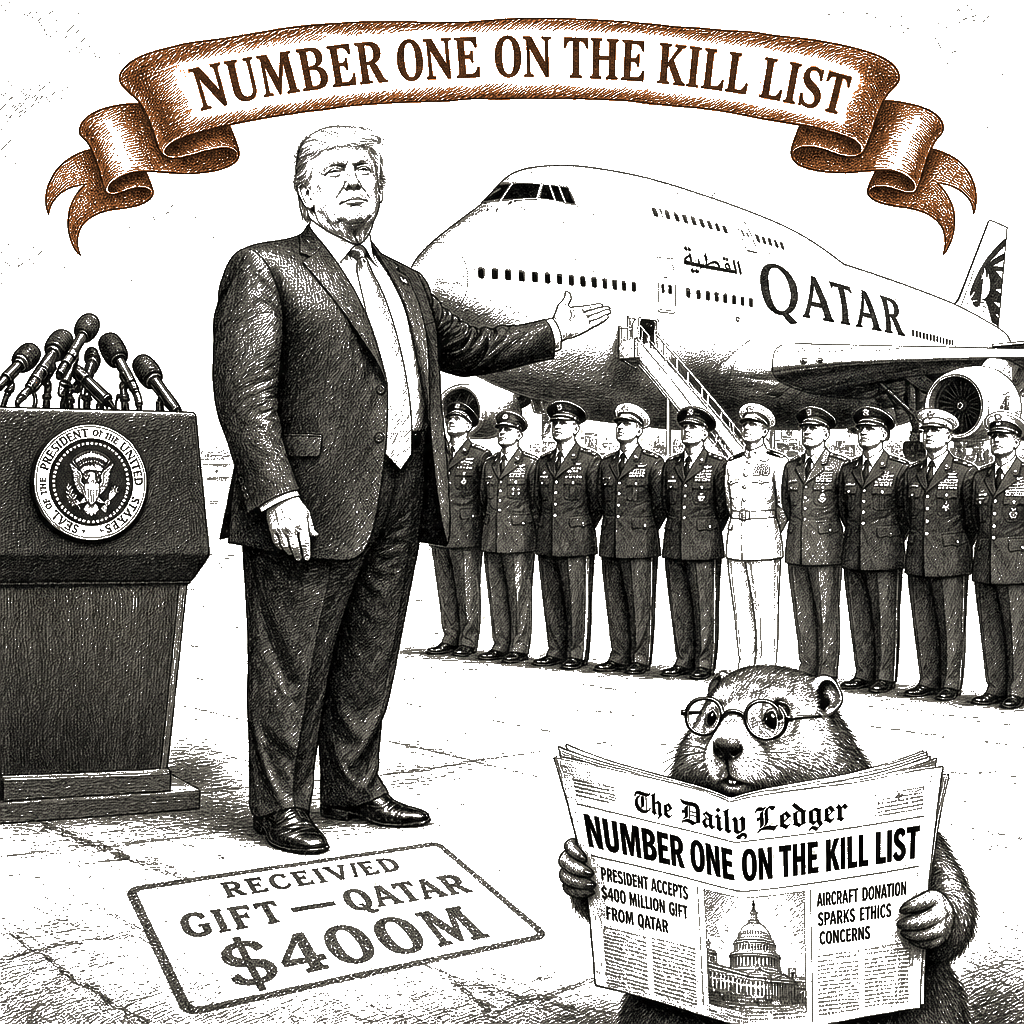
He told us he was number one on the kill list. He told reporters on the ground in Ankara. He told the cameras. Then he flew the gift aircraft anyway.
That is the entire story of Air Force One this week.
The timeline. The president departed Ankara at 8:45 p.m. Wednesday on an older Air Force One — the kind of plane that gets maintained and hardened and communications-jammed on purpose. He landed at RAF Mildenhall in Suffolk at 10:16 p.m. He deplaned. He boarded the $400 million jet Qatar gave him. That plane was wheels up at 11:14 p.m., headed home.
A reporter asked why. Two questions, really. The first about logistics. The second about whether the swap had anything to do with security, given what he’d said about Iran earlier that same day. The president answered the security question: “No, no, why would there be?”
You sit with that for a minute.
The discipline that holds a military together is well-known. If a commanding officer had ordered his men to board a foreign-gifted aircraft while telling the press he was the top target on a hostile state’s kill list — and if that officer had justified the swap by pointing to a photo-op with the troops standing behind him — the officer would be looking at a court-martial. Or his commanding officer would. You do not fly the gift while crying the kill list. You do not stage the gift for the troops while telling the press the kill list is the reason you flew something else. You do not call a foreign-donated luxury aircraft “truly magnificent” while invoking the apparatus of national survival to explain why you boarded it anyway.
The troops at Mildenhall that night. They showed up. They posed for the photograph. They did what troops do when the cameras are running and the senior leadership wants a backdrop. The troops did not pick this aircraft. The troops did not vote on whether the United States ought to be accepting $400 million luxury jets from a Gulf monarchy. The troops are the audience for the theater, and the audience does not get a script review.
And let me talk about the jet for a minute. That $400 million. That is not a number the president earned. That is not money his family earned. That is a number a foreign petro-state wrote down because it wanted something from this country, and the way it wanted to write that check was a wide-body Boeing with a bedroom in it. The American working people who paid their taxes, who sent their kids to the recruiter’s office in the strip mall because it was the only path to the GI Bill, who work the line at the plant, who pump the gas, who fix the transmissions — they are the ones whose government accepted this gift. They did not get asked. They will not see a dividend.
The men and women at Mildenhall who stood for that photograph were treated as the audience for a real estate deal. They were not treated as the operational force that secures the perimeter of the alliance. They were treated as the spectator class in a ledger that only registers the transaction. A plan was already on the books to retire this same aircraft to a presidential library rather than the operational fleet. So when the president tells you the troops needed to see it, ask yourself: see it for what? See it for whom? See it so it could be sent to a museum while the working people who funded it got a photograph and a story about how generous the Qataris are?
The same kind of deal that puts an F-35 sale on the table for Turkey past legal barriers is the kind of deal that takes a $400 million jet from a Gulf state while negotiating what that Gulf state wants in return. The whole thing is being run like a private transaction. The troops are the backdrop for the photograph at the sale.
The president told the world he was the target. The president then flew the gift. The president then defended the gift by pointing to the troops. The president then refused to acknowledge that any security concern was at play. The contradiction is the point.
Either the threat is real, and the security protocols are followed to the letter, or the threat is performance, and the security protocols become a prop. The president chose the prop. He chose it in front of the cameras. He chose it with the troops arranged behind him. He chose it while telling the press, four hours earlier, that Iran had him at the top of its kill list.
The threat is the justification. The gift is the instrument. The troops are the backdrop. The contradiction is the product.