
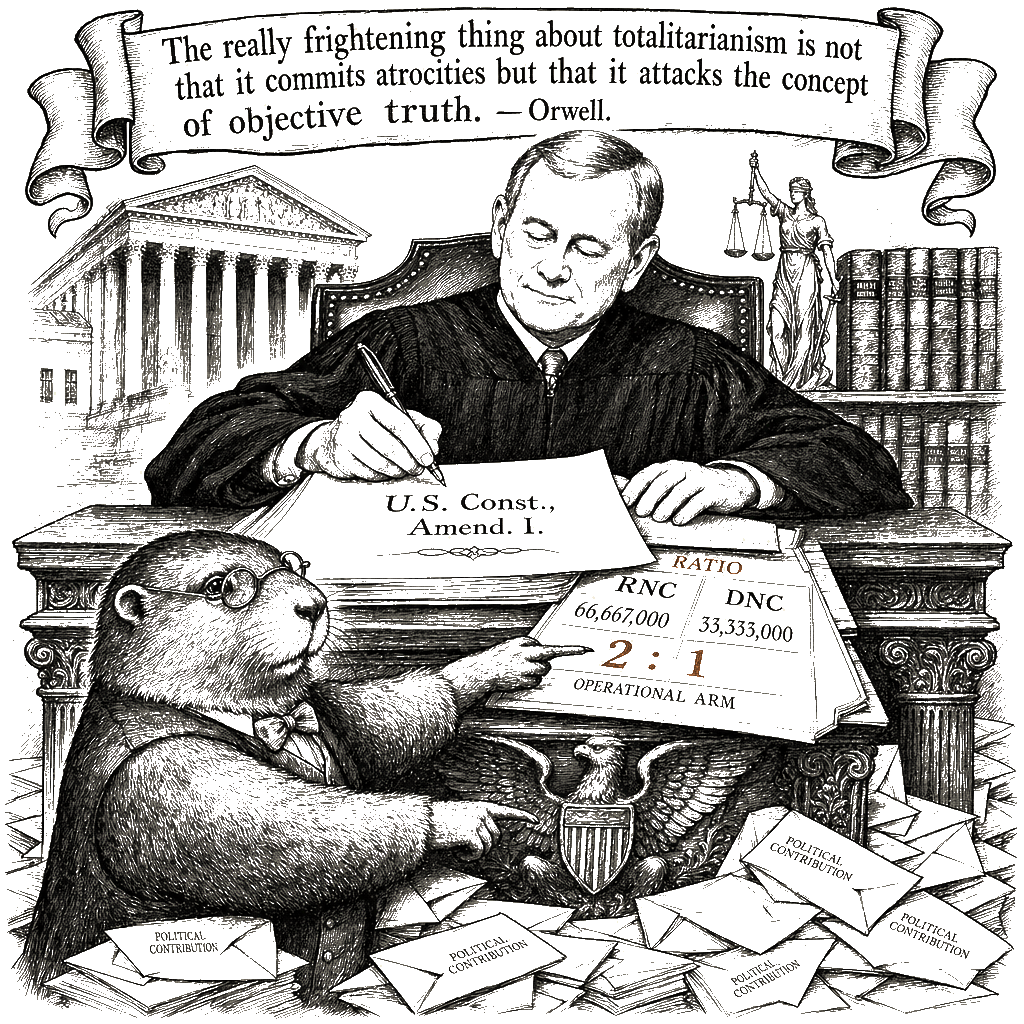
The Supreme Court has rigged the November elections for the Republican Party. The six-justice majority that decided National Senatorial Campaign Committee v. Federal Election Commission knows it. Justice Neil Gorsuch spelled out the mechanism in his concurrence: businesses donate to curry favor with regulators who can make or break them — an FCC investigation, an FTC rule, an OSHA adjudication, an SEC prosecution — and the First Amendment question is whether to restrict speech or to restrict the regulatory state. Read that sentence again. It is the argument of a Court that has decided the answer is to restrict nothing, to let the money move.
The ruling, issued last week by a 6-3 vote, struck down federal limits on coordinated spending between party committees and their candidates. The majority treated those limits as content-based regulations of core political speech. This is the Buckley v. Valeo (1976) line of cases, extended to its logical endpoint: if a candidate can spend unlimited sums on her own behalf, and if a corporation can spend unlimited sums independently under Citizens United v. FEC (2010), then the only remaining restriction — coordinated spending between the party and its candidates — becomes constitutionally suspect. The steel-man is familiar. The audit is what the steel-man conceals.
What the steel-man conceals is this: Republican party committees are sitting on roughly twice as much cash as Democratic committees. The status quo the Court just dismantled was not neutral on this dimension. Lower broadcast and cable ad rates for candidates gave Democrats an offsetting structural advantage that the post-Citizens United fundraising gap had otherwise eroded. The majority’s ruling neutralizes that offset. It does not create a level field. It tilts the field toward whichever side already commands the larger war chest.
The dissenters — Justices Sotomayor, Kagan, and Jackson — made the corruption argument: unlimited coordinated spending opens the door to quid pro quo corruption, or its appearance. The majority was unmoved, working within a doctrinal frame in which the only cognizable corruption is a direct exchange of money for official action, and in which the appearance of corruption is too speculative to justify regulation. This is the Buckley frame. It has been the Buckley frame for half a century. It is a frame that has produced a campaign-finance regime in which the parties with the largest donor networks win.
Defenders of the ruling reach for two rebuttals. The first is the Bloomberg rebuttal. If money bought elections, Michael Bloomberg would have won the 2020 Democratic presidential nomination — he spent $1.12 billion of his own money and lost. Tom Steyer spent hundreds of millions and lost. Andrew Cuomo lost the New York mayoral primary to Zohran Mamdani, a democratic socialist who built his campaign on social media and grassroots organizing. Alexandria Ocasio-Cortez ousted Joe Crowley in 2018 with small-dollar donations. Last week in Colorado, Melat Kiros defeated Diana DeGette, a 30-year incumbent backed by super PACs that outspent her three-to-one.
These cases prove that individual self-funding and disconnected super PAC spending do not automatically determine outcomes. They prove nothing about coordinated party-committee spending, which is structurally different. The party committee is an institutional apparatus that integrates with candidate strategy, with get-out-the-vote operations, with opposition research, with message discipline. It converts the largest war chest into operational dominance in the final weeks of a campaign. The Bloomberg-style vanity expenditure is the wrong unit of analysis. The party committee is not a billionaire’s checkbook. It is the operational arm of a political coalition.
The second rebuttal is Gorsuch’s regulatory-state argument, and it is the more revealing one. If businesses donate to insure themselves against regulatory harm, the argument goes, then the appropriate response is to shrink the regulatory state, not to limit speech. This argument, taken seriously, would dissolve the entire campaign-finance architecture. It is a constitutional theory that licenses the outcome it reaches. And it sits at the end of a decade of decisions narrowing the mechanisms by which the political branches can constrain private power in the electoral sphere: Citizens United on independent expenditures, McCutcheon v. FEC on aggregate contribution limits, Americans for Prosperity Foundation v. Bonta on donor disclosure, and now NSCC v. FEC on coordinated party spending. The pattern is institutional. It operates regardless of which coalition is ascendant at any given moment — though it does not operate independently of which coalition has built the larger donor apparatus at the moment of decision.
The midterm will not be decided on the issues, despite what the editorial-page defenders are saying. It will be decided by which party can best convert its donor network into operational capacity in the final weeks — get-out-the-vote, persuasion, turnout, message discipline. The Court has handed the apparatus with the larger war chest exactly the tool it needs to make that conversion. The constitutional question is whether the First Amendment requires this result. The constitutional answer is no. The Roberts Court has built a doctrinal architecture in which the highest-funded political apparatus captures democratic institutions, and then it tells you this is what freedom looks like.