
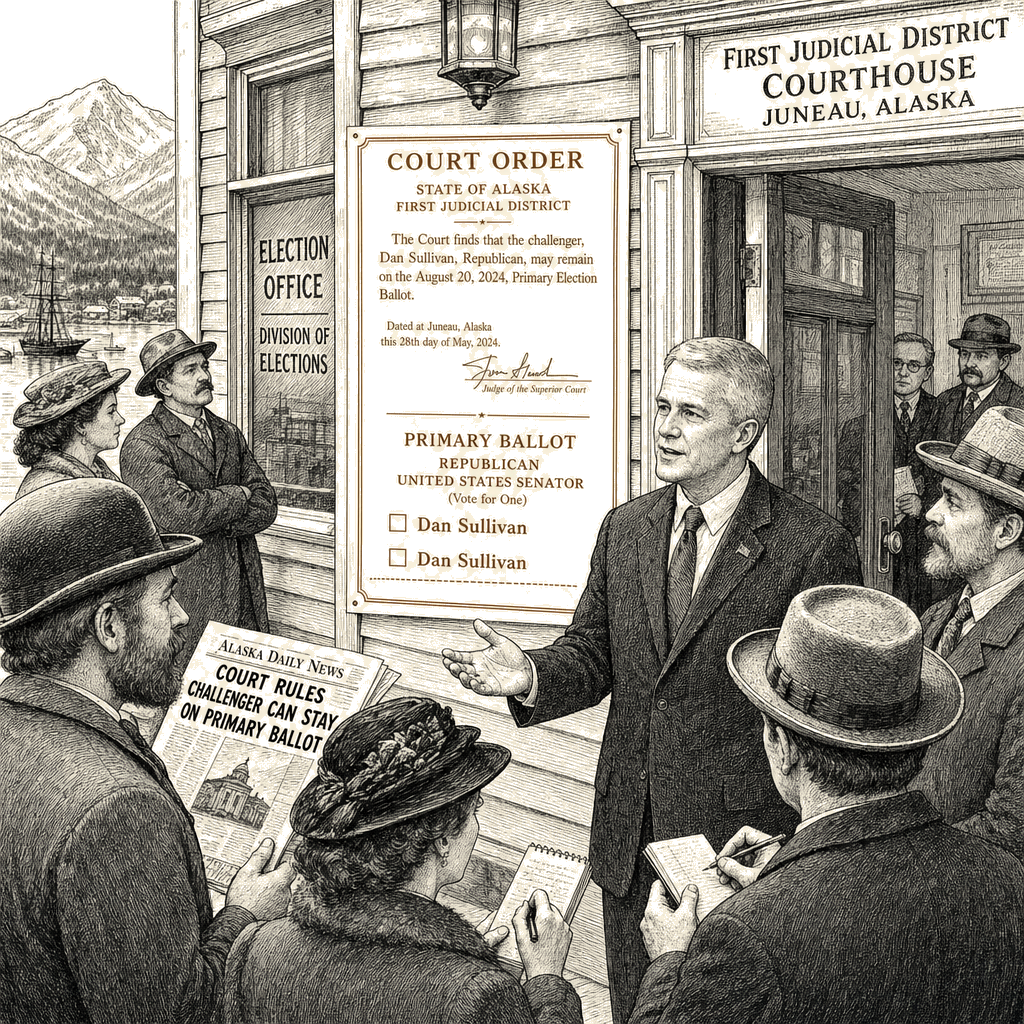
Alaska’s elections director disqualified a 70-year-old challenger for sharing a first name with the state’s sitting Republican senator. The Alaska Supreme Court reversed her on Monday.
Daniel J. Sullivan Jr., a 70-year-old former teacher, filed to run in Alaska’s Republican primary against the incumbent Republican Senator Dan Sullivan. The challenger registered as “Daniel J. Sullivan, Jr.,” adopted the nickname “Dan,” and built a campaign website the Division of Elections later flagged as visually similar to the incumbent’s. Division of Elections Director Carol Beecher concluded, in a formal determination dated mid-June, that the preponderance of the evidence showed the challenger chose his nickname and his party affiliation “because that name and party affiliation happen to be the name and party affiliation of another candidate in the race.” She cited the website, the party switch, and alleged coordination with a Democratic political consultant linked to Mary Peltola — claims both the challenger and the Peltola campaign have denied. The challenger sued. Superior Court Judge Thomas Matthews ruled in his favor last week, finding Beecher had abused her discretion. In a roughly paragraph-long order issued hours after Monday’s oral argument, the Alaska Supreme Court affirmed.
That is the right outcome, and the reasoning is not even close. The state’s steel-man is straightforward enough. Alaska operates under a top-four nonpartisan primary, established by Ballot Measure 2 in 2020, in which all candidates share a single ballot. Ballot real estate is finite, and the state has a legitimate interest in preventing deliberate voter confusion and ballot sabotage. After the state Republican Party itself moved to block the challenger as an “interference tactic,” the Division’s initial disqualification argued that a subjective “bad faith” inquiry was the only way to police the ballot.
But the steel-man collapses the moment Beecher’s determination is read against it. Her finding of “bad faith” rested on a name, a website’s design, and a party registration. A nickname is a candidate’s to choose. A website’s design is not evidence of conspiracy. Working with a consultant who supports a different party’s candidate is, if anything, evidence of an actual cross-aisle operation — exactly the kind of activity Alaska’s permissive ballot-access regime exists to protect, not to punish. Beecher’s conclusion “by a preponderance of the evidence” that the challenger chose his nickname “because” it happened to match the senator’s is not evidence. It is a vibes-based disqualification dressed up in evidentiary language — a name-engineering exercise by the state to keep a legally qualified challenger off the ballot.
Administrative gatekeeping of ballot access via subjective standards is a structural defect, and the courts caught it. When an appointed administrator is granted the discretion to judge a candidate’s motives and disqualify them based on perceived “confusion,” the official ceases to be an executor of the law and becomes an unaccountable political curator. The legislature — via Ballot Measure 2 and the ballot-design statutes it left in place — sets the objective criteria for ballot access. The administrator’s job is to apply them, not to invent a super-legislative veto grounded in “bad faith.” An “abuse of discretion” occurs precisely when an administrator steps outside those legal bounds to enforce her own subjective preferences. Judge Matthews so found. The Supreme Court affirmed.
The incumbent’s party argued, openly, that the challenger’s candidacy was a third-party-funded “interference tactic” designed to siphon confused Republicans from Senator Sullivan. That is a campaign argument. It is not a legal basis for removing a name from a ballot. Had the supreme court let Beecher’s determination stand, it would have given every state agency in the country permission to remove any candidate whose biography was inconvenient for an incumbent. The court did not let it stand.
The affirmative principle bears stating: the remedy for potential voter confusion is not administrative censorship, but the application of objective ballot design mechanisms — distinguishing suffixes, candidate bios, party labels — that the legislature already provided. The court’s order directs the Division to list the challenger “within the confines of existing Alaska ballot design law.” A full opinion will follow. The bottom line is that a legally qualified candidate’s name appears on the August primary ballot, and the Division of Elections’ “voter confusion” doctrine is dead on arrival.
The challenger’s name is his name. The ballot is the ballot. And the state agency that tried to curate one out of existence has been told, plainly, to follow the law it is sworn to administer.