The Supreme Court and the Republican apparatus engineer a documentary purge of naturalized citizens. Consider the naturalized citizen who has voted for twenty years, who holds the tax records, the property deed, the children in the public school, but whose birth certificate sits in a municipal office in a country they left decades ago, and whose passport expired three months ago because they could not afford the renewal fee while paying their mortgage. Under the existing federal framework, that citizen signs a registration form under penalty of perjury. That is the law. It has been the law. It operates. The Supreme Court agreed Monday to hear a case whose effect is to keep citizens exactly like this one from voting. The trap is set; the question now is whether the highest court in the land will spring it.
The Republican National Committee, the Arizona legislature, and Donald Trump do not want the law that exists. They want the law that requires the paper. Because the law that exists is too easy for the people they have calculated they need to exclude.
The case is Arizona’s. In 2022, the Arizona state legislature passed a law requiring documentary proof of citizenship to register to vote on the state form, and alongside it, a companion law on voter-roll review that gave state officials a procedure to cancel the registrations of voters the state flags as noncitizens. A federal district court struck the proof-of-citizenship law down. Mi Familia Vota and Voto Latino, the Latino civic organizations that brought the original challenge, had read the cost structure into the mechanism and named it in the lawsuit. The Republican National Committee appealed. The Supreme Court took the appeal. Arguments come this fall.
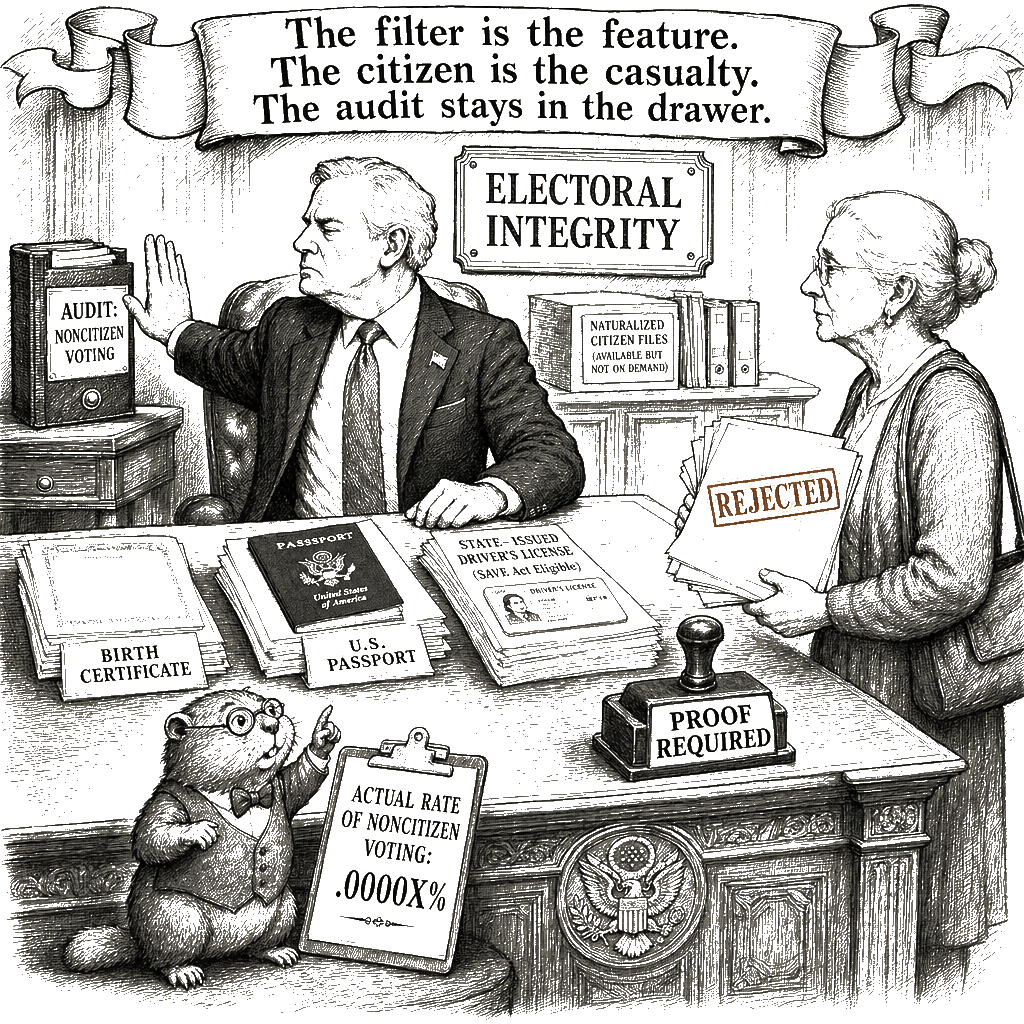
It is already a federal felony for a non-U.S. citizen to vote in a federal election. The 2022 Arizona law does not engage with that law. It engages with a documentary requirement — a birth certificate, a passport, a narrow set of state-issued licenses that the SAVE America Act would only partly recognize. The cost falls on the people who lack ready access to the documents the law demands. The cost is the point.
So we must ask the only question that sorts the genuine from the manufactured: cui bono? Who benefits from a documentary proof-of-citizenship requirement when the act it supposedly prevents is already a felony committed by virtually no one?
The noncitizen voting the law is supposed to prevent is documented at a rate so low it is statistical noise. State election officials, in the audits they have been ordered to conduct, have not turned up totals that threaten any election outcome anywhere. The concentrated beneficiary is the political faction that calculates a smaller, poorer, more burdened electorate yields the electoral outcomes it can no longer win on the merits. The diffuse cost-bearers are the naturalized citizens whose naturalization papers sit in a filing cabinet they cannot reach; the elderly voters whose documents have been lost or destroyed; the women who changed their name at marriage and have not located every prior name-change document; the native-born citizens in rural counties where the local records office never sent them a birth certificate; the students away from home whose documents are with their parents. The list is long, and it overlaps heavily with the population the architecture of voter suppression has spent the last decade trying to keep from the polls.
A decade ago, on a similar documentary-proof question from Arizona, the Supreme Court ruled 7-2 that the federal form’s attestation preempted the state requirement. The architecture has not changed. The bench has.
This is the cui bono the structural analysis surfaces. The law’s product is not security against fraud. The law’s product is the cost it imposes on the diffuse population of Americans who lack ready access to the documents the law accepts. The mechanism is friction. The mechanism is the deliberate insertion of a bureaucratic barrier between the citizen and the ballot box, calculated to fall hardest on those the apparatus has identified as its electoral liability. The filter is the feature. The exclusion is the point.
The argument in defense of the law is what the bad-faith techniques catalog identifies as a manufactured controversy — the deliberate construction of the appearance of legitimate factual disagreement where the actual evidentiary position is one of substantial consensus. Oreskes and Conway documented the pattern in Merchants of Doubt, generalizing what the 1969 Brown & Williamson internal memo had called “Doubt is our product.” The detection signals are the same here as there: substantial expert and official consensus that the alleged harm is rare to nonexistent; public-facing rhetoric emphasizing “unaddressed” fraud; funding traces from interested parties to the voices amplifying the claim; recurrence of the same talking points across multiple state legislatures, in coordinated message discipline. The same script plays in state after state, year after year. The same voices lead the script. The same result is the object of the script.
It is also a frame-engineered relabeling — the deliberate substitution of one term for another to shift the cognitive frame. “Election integrity” relabels “voter suppression.” “Proof of citizenship” relabels “poll tax.” The public digests the relabeling and absorbs the frame. But the analytical mind strips the label away and looks at the mechanism, and the mechanism is the same mechanism the relabel was designed to hide.
It is also a goalpost-shifting — the redefinition of the standard of evidence required to settle the question of voter eligibility, in response to the accumulation of evidence meeting prior standards. The 1993 National Voter Registration Act already required attestation under penalty of perjury. The 2002 Help America Vote Act added identification requirements at the polls. Multiple states have added voter ID laws, which the courts have, in places, permitted. The proof-of-citizenship requirement on the registration form is the next escalation. The standard moves each time the prior standard is met. The new standard is harder. The new standard is also the one the prior evidence cannot satisfy, because the documents it demands are not documents the diffuse American population carries on their persons. The goalpost is not a metric. The goalpost is a weapon.
The apparatus works on every level simultaneously. They are laying the trap at the state level in Arizona, and they are pouring the concrete at the federal level in Congress. A federal judge blocked last week a separate Trump-administration proof-of-citizenship voting order on the same structural logic. The judicial firewall is only as durable as the judges willing to hold it, and the architects of this scheme are playing the long game, stacking the courts and testing the structural limits. The legislative design behind the SAVE America Act is so restrictive, the approved documentation so meticulously filtered, that we already know only a narrow band of state-issued driver’s licenses would be honored as proof. The question the Supreme Court will hear in October is the question the SAVE Act is designed to launder into federal law if the Republican National Committee prevails.
This brings us to the root cause. The root cause of the documentary proof-of-citizenship movement is not a misunderstanding of election security. The root cause is the structural reality that in a multiracial democracy, a political faction that has repeatedly lost the popular vote must find legalistic, extralegal, and structural mechanisms to maintain its hold on power. The documentary requirement is the mechanism. The manufactured fraud claim is the justification. The Supreme Court’s acceptance of the case is the validation.
When the Court agreed to hear this case, it did not merely agree to resolve a dispute over federal election law. It agreed to entertain the premise that the existing law — the law that relies on the penalty of perjury, the law that treats the citizen as a rights-bearing adult rather than a suspect to be vetted — is insufficient. It agreed to entertain the premise that the state has a compelling interest in demanding the paper, even when the state cannot produce a single empirical reason why the paper is necessary. The premise is that the citizen must prove their citizenship to the state. The truth is that the state derives its legitimacy from the citizen. The state does not grant the franchise; the franchise grants the state its power. When the state demands the paper before it recognizes the citizen, the state has inverted the moral and constitutional order.
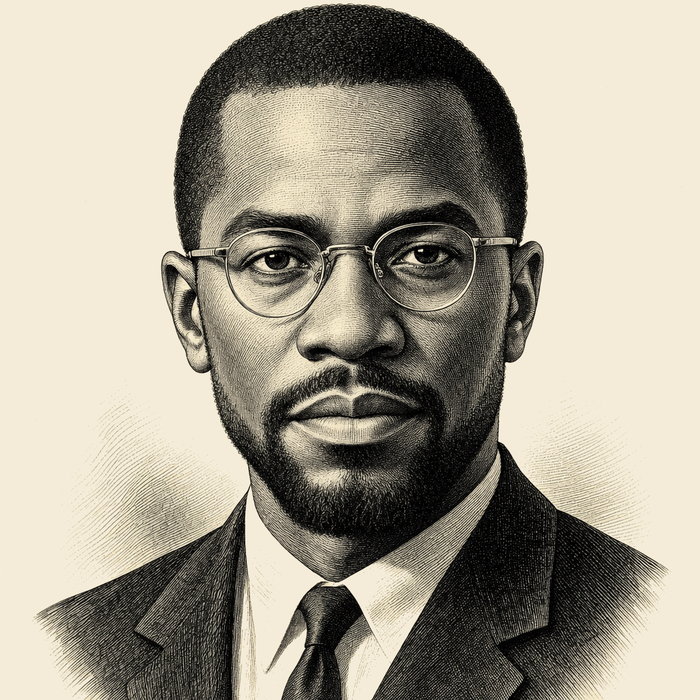
Malcolm X diagnosed the structure of this kind of apparatus when he refused the euphemisms of his era. He understood that when the state builds a mechanism that harms a specific population, you do not ask the state to explain the mechanism; you ask who the mechanism serves. The state will tell you it is building the mechanism for your protection. The state will tell you it is building the mechanism to ensure order. You look at the mechanism. You look at who it harms. You look at who benefits. You recognize the diagnosis: the criminal is the one who creates the problem and then demands the jurisdiction to manage it. You do not take your case to the criminal. You name the apparatus. You name the criminal.
The Republican apparatus has taken its case to the Supreme Court. And the Supreme Court has agreed to hear it.
Martin Luther King Jr., at Riverside Church in April 1967, named the same apparatus in another form. He had the Vietnam War in mind. He had the white-moderate objection to civil rights in mind. King understood that when a society treats its machines, its procedures, its quarterly returns, as more important than the human beings who tend them, you do not have an election-integrity problem and a fraud problem and a citizenship problem; you have a single pathology, and you cannot cure one head while feeding the other two. “True compassion,” King told the congregation at Riverside, “is more than flinging a coin to a beggar; it comes to see that an edifice that produces beggars needs restructuring.” The analytical translation for our moment is direct: true electoral integrity is more than demanding a birth certificate from a naturalized citizen; it sees that an electoral system that produces a bureaucracy of suspicion needs restructuring. The edifice is the problem. The paper trail is the symptom.
This is a wicked problem in the technical sense. The apparatus has captured the procedural mechanisms of the democracy, and the democracy’s own rules are being leveraged to dismantle the democracy’s substantive guarantees. The solution is not a cleaner procedure. The solution is the refusal of the premise. The late-MLK work — the work King did in 1965, 1966, 1967, 1968, the work that got him killed — is the work of naming the apparatus. The apparatus changes form. The apparatus does not change function. The function is exclusion. The function has always been exclusion.
The arc of the moral universe bends toward justice, King told a Montgomery audience in 1958. He was right, and he was incomplete, the way the late-King knew he was incomplete when he kept pushing. The arc bends only when the apparatus that holds it straight is broken at the joints. The bending is the work of the people who refuse the paper, who refuse the premise, who refuse to accept the manufactured crisis as the genuine condition of their civic life. The vote is the instrument. The vote is the only instrument. The people who already have the vote are the people who can do the work of protecting the people who will lose it if the Court ratifies the apparatus. The arc bends, when it bends, away from the apparatus King named at Riverside, away from the apparatus the Court has now agreed to consider, toward the Beloved Community the law excludes.
The citizens of Arizona, the citizens of this country, are caught in an inescapable network of mutuality. The harm done to the naturalized citizen is the harm done to the franchise. The paper purge of the naturalized citizen is the paper purge of the democracy. We name the apparatus. We name the beneficiaries. We keep the receipts. We do not take our case to the criminal; we take our case to the people. We build the power that forces the apparatus to yield.
Call the senators. Call the House members. Call the state election officials. Tell them the law is what the structural analysis names. Tell them cui bono. Tell them the arc does not bend by itself. It bends because people, in a specific moment, push it. The bending is the work this column asks the reader to do, in the time we have before the Court hears the case in October and the apparatus claims the authority to purge.