
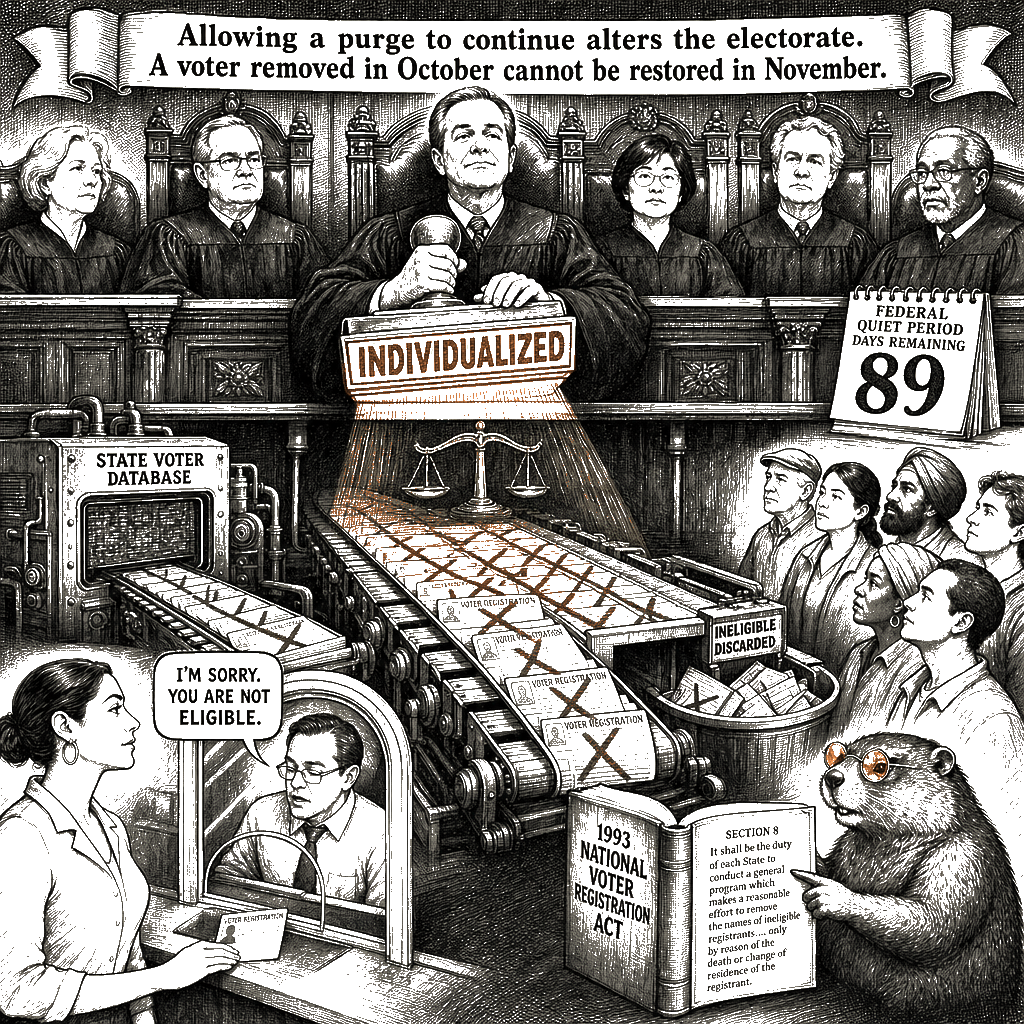
The Roberts Court is rigging the midterms by legalizing the mass disenfranchisement of citizens.
On Monday the Court granted the Republican National Committee’s request to hear RNC v. Mi Familia Vota, an Arizona case asking the justices to gut a thirty-three-year-old federal law’s ninety-day ban on mass removals of voters from the rolls before a federal election. A decision is not expected until 2027. The case will not be argued until October. But the Court has already used the emergency shadow docket to allow a documented purge of eligible voters to continue, in violation of what multiple lower courts found to be the federal statute. The merits ruling next year will determine whether the apparatus built over the last three years is doctrinally permissible, or whether the quiet period remains in force.
The statutory text is Section 8 of the National Voter Registration Act of 1993, 52 U.S.C. § 20507(b)(2). It prohibits the forty-four states and the District of Columbia covered by the statute from completing “any program the purpose of which is systematically to remove the names of ineligible voters from the official lists of eligible voters” in the ninety days before a federal election. The Arizona program at issue cancels voter registrations based on state driver’s-license records flagged as showing the registrant is not a United States citizen. The United States Court of Appeals for the Ninth Circuit, in a 2025 ruling now before the Court, found that the program “authorizes systematic cancellation of registrations within 90 days before a federal election,” in the words of Judge Ronald M. Gould.
The argument the RNC wants the Court to endorse is contestable but defensible. The RNC, joined by Arizona’s Republican officials, asks the Court to read “ineligible voters” to exclude noncitizens, on the theory that the NVRA’s quiet period protects only voters whose underlying eligibility is settled. A voter whose citizenship is in question is, on this reading, not, for quiet-period purposes, a “voter” at all. Arizona and Ohio officials offer a second, alternative argument: that their database-driven removal programs are “individualized” rather than “systematic,” because each matched record is theoretically reviewed by a state employee, even when the match is generated by the same automated algorithm run against every registered voter in the state. A working-bar attorney aligned with the RNC’s position could recognize this as the argument’s strongest form.
The audit begins where the steel-man ends. The statutory text of Section 8 does not, on its face, distinguish between categories of ineligible voters. A voter whose citizenship is in question but unresolved is, in the working language of federal election administration, still a registered voter on the official list of eligible voters — that is the status the database programs are designed to alter. The RNC’s reading requires the Court to read into the statute a category-exclusion the text does not contain. It is a judicial construction of silence, not an application of clear text. The construction is the kind the six-justice supermajority has been willing to perform in other election-law contexts — narrowing “the Legislature” in the Elections Clause to exclude ballot initiatives and independent commissions, for instance — when the narrowing has served outcomes it prefers. The methodological posture is on offer elsewhere in the Court’s election-law docket. Its availability here will turn on whether the Court treats the posture as a method or as a direction.
The textualist label does not change the reality. Congress enacted the ninety-day quiet period precisely because bulk database comparisons — matching voter rolls against motor-vehicle or immigration databases — inevitably generate false positives. Naturalized citizens get flagged. People with similar names get caught. Bureaucratic clerical errors disenfranchise eligible voters. The ninety-day window exists to give those citizens time to resolve the error and cast a ballot. To say that a bulk database sweep is “individualized” because a state official eventually reviews each false match one by one is to say that a police dragnet is “individualized” because the officers book each arrested suspect individually. The mechanism is systematic; the semantic label does not change the reality. Washington and Lee law professor Maureen Edobor has warned in published commentary that this textualist move is dangerous because it could give states broader authority than Congress intended. The game is rigged to let states launder systemic purges through individualized checkpoints. Republican officials leaning on this loophole point to a 2014 Eleventh Circuit ruling that individualized removals fall outside the quiet period. Applying that precedent to a database-driven, match-then-review pipeline is a deliberate category error.
The Supreme Court laid the groundwork for this maneuver during the 2024 election, when it used the emergency shadow docket to allow Virginia Governor Glenn Youngkin’s noncitizen-targeted purge to proceed during the quiet period, offering no legal explanation for suspending the statutory ban. Multiple federal judges had found the program likely violated the quiet-period ban. The Supreme Court declined to intervene, with no signed opinion, no reasoning, and no analysis. The order was not a holding; it was a refusal to disturb a lower court’s likely-finding that the purge violated federal law. But in practical effect, the order authorized Virginia to continue removing voters from its rolls through the ninety-day window, on a record showing that some of those voters were eligible. The case settled this year after Virginia’s new Democratic governor, Abigail Spanberger, rescinded the program and issued an order mirroring the NVRA’s ninety-day requirement. The 2024 order is now the controlling precedent, because the Court gave no reason and issued no signed opinion.
Conservative jurists defend the practice as preserving the status quo pending merits review. The defense is convenient and false. Allowing a purge to continue alters the electorate. A voter removed in October cannot be restored in November, even if the merits ruling later goes against the purging state. The shadow docket does not preserve the status quo; it locks in the result of the contested act. The pattern is the one Stephen Vladeck has named: a state uses a citizenship-verification process known to misfire, runs the process during the period the federal statute says it cannot run such a process, and the Court declines to intervene on the ground that the lower court may have been wrong, even when the lower court’s finding is supported by the record. The pattern recurs. As University of Wisconsin Law School dean Dan Tokaji warned at the time, according to the published commentary, the shadow-docket maneuver “suggests there may not be a remedy, at least in federal court, if a state unlawfully purges voters.”
The Trump administration is litigating the same question in the lower courts. In a June 2026 court filing in a Georgia case, Justice Department attorneys argued that the NVRA’s quiet period “would not prevent a state like Georgia from investigating and removing ineligible people in an individualized fashion if the United States alerted the State of the possibility that people on their rolls were ineligible to vote.” The administration has been building the database infrastructure to make those alerts: the Systematic Alien Verification for Entitlements program, known as SAVE, is the federal database the administration wants to run against state voter rolls. Federal courts have blocked the administration from obtaining state voter data in multiple cases, on the ground that the database has been found to erroneously flag eligible voters. The administration is pressing on. The Supreme Court is now the venue where the doctrinal question will be settled.
State election officials now operate in legal limbo. The federal statute tells them to complete systematic removals ninety days before a federal election; the Supreme Court’s 2024 order tells them the statute may not mean what it says; the federal appeals courts have split on what the statute permits. Local officials must choose between freezing all roll maintenance during the quiet period and risking federal civil-rights litigation, or continuing maintenance and risking the same. The quiet period is no longer a rule; it is a forecast. Defenders of the purge argue that wrongly disenfranchised voters can simply re-register or cast a provisional ballot. But same-day registration is unavailable in more than half the country, and provisional ballots are routinely tossed over clerical errors. It is a fix in theory and a disenfranchisement in practice.
The 2026 quiet period begins on August 5. The case will not be argued until October and not decided until 2027, past the November 2026 midterm. The Court’s review will not itself produce a purge before the midterms. It will produce a doctrinal ruling on whether the next round of purges, beginning in 2027 and 2028, can proceed through the statutory quiet period that has governed federal elections since 1993. Under the doctrinal architecture the Court has already signaled an openness to adopting, the quiet period will apply only to removal programs that states explicitly design to fail. The midterms will proceed on purged rolls, and the justices who built the architecture will have their textualist receipts in order.