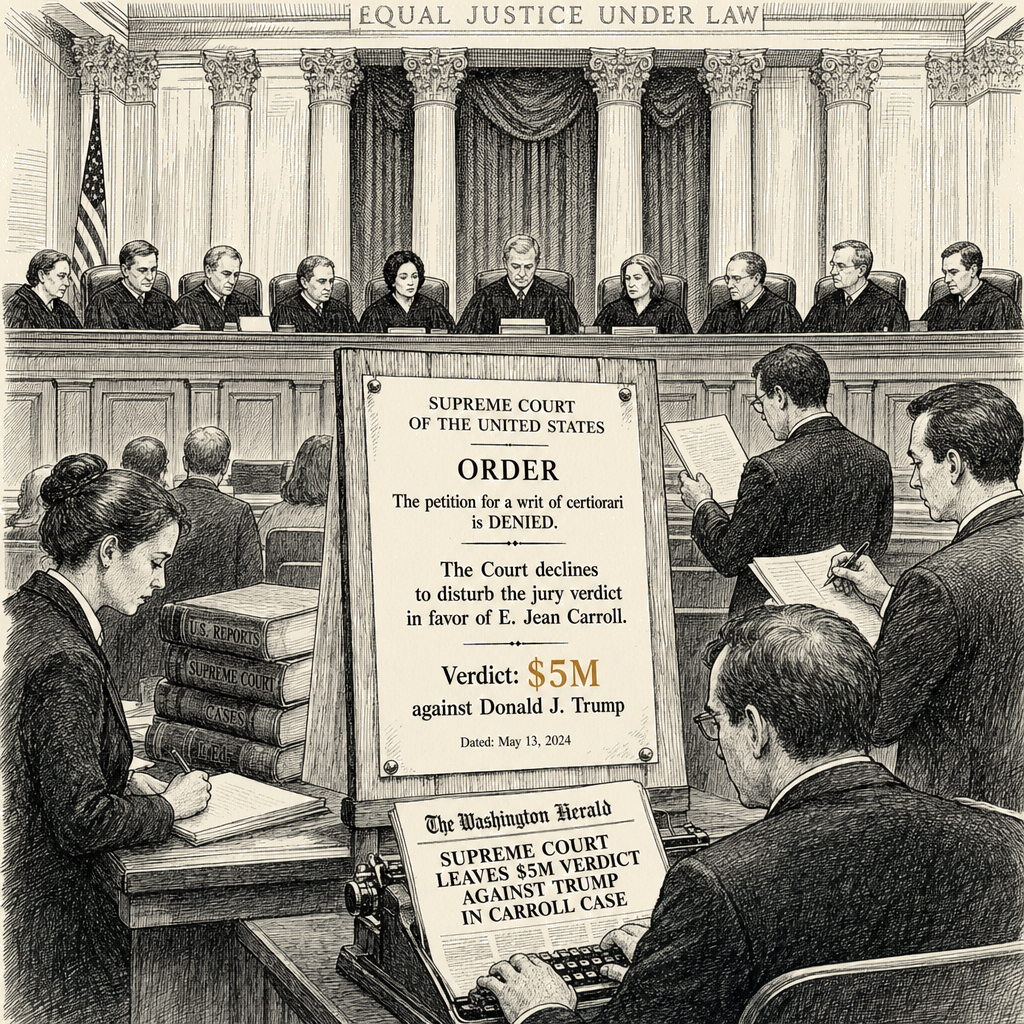
Donald Trump sexually assaulted and defamed E. Jean Carroll. The Supreme Court today refused to help him erase it.
A New York federal jury foundin 2023 that Trump sexually abused Carroll in a mid-1990s department store dressing room and defamed her when he later called her accusation a hoax, awarding her $5 million. The jury explicitly rejected the more severe charge of rape as defined by New York’s penal code — a narrower finding that proves the jury was measured, not maximalist. A separate jury in 2024 ordered Trump to pay $83.3 million for further defamatory statements. The Second Circuit Court of Appeals affirmed the $5 million verdict last year, and a panel of federal judges denied Trump’s appeal of the $83 million award in September. Today’s denial of certiorari, with no explanation as is customary, leaves both verdicts standing and the underlying liability final.
The legal question Trump put before the Court was narrow. His lawyers argued that the trial judge had erred under Federal Rule of Evidence 403, which permits a judge to exclude evidence whose prejudicial effect substantially outweighs its probative value, by allowing jurors to see the 2005 Access Hollywood tape, in which Trump boasted about grabbing women without consent. The federal appeals court had already considered and rejected the argument. The steel-man for it relies on a real principle: an inflammatory video can sometimes poison a specific factual inquiry. That is the rule, and it has a place.
The steel-man collapses on contact with the actual record. The tape was not a tangential character attack introduced to inflame. It was a direct admission by the defendant of the exact conduct the plaintiff alleged. Admitting a party’s own recorded boasts about non-consensual touching to corroborate a victim’s account of being touched is not an evidentiary error. It is the ordinary operation of the law. The Second Circuit so held, and the Supreme Court’s silence leaves that holding undisturbed. There is no circuit split to resolve, no novel federal question in a state-law tort claim where the trial judge applied standard evidentiary rules. The cert petition was not a serious legal grievance. It was the exhaustion of a litigation strategy designed to re-litigate settled facts and to frame basic civil accountability as what his spokesmen denounce as “Democrat-funded travesty,” “Witch Hunt,” and “Liberal Lawfare” — the same rhetoric the second jury found defamatory when it awarded the $83.3 million. The Supreme Court has now declined to validate that framing as grounds for overturning the verdicts that same framing produced.
The denial is procedurally ordinary. The case is not. A unanimous jury found a former president liable for sexual assault and defamation. Two federal appellate panels confirmed the liability. Two judgments totaling more than $88 million now stand. And the same defendant whose executive branch has now opened a Justice Department criminal investigation into E. Jean Carroll herself has exhausted his final avenue of appellate relief. The contrast is the regime: when the courts will not undo the jury verdict, the executive turns to prosecuting the victim.
The Supreme Court did not help Trump. It did not need to help him for the verdict to stand. The verdict stands because a jury heard the evidence, including the 2005 tape in which Trump described grabbing women without consent, and found him liable. The federal appeals court reviewed and affirmed. The Supreme Court today declined to intervene. A unanimous jury verdict, affirmed by the circuit court and denied review by the highest court, is the end of the line. The man who described his conduct on that tape has now exhausted every procedural avenue available to avoid the consequences of those actions. The law did what the law is supposed to do when the evidence is this clear: it closed the door.