
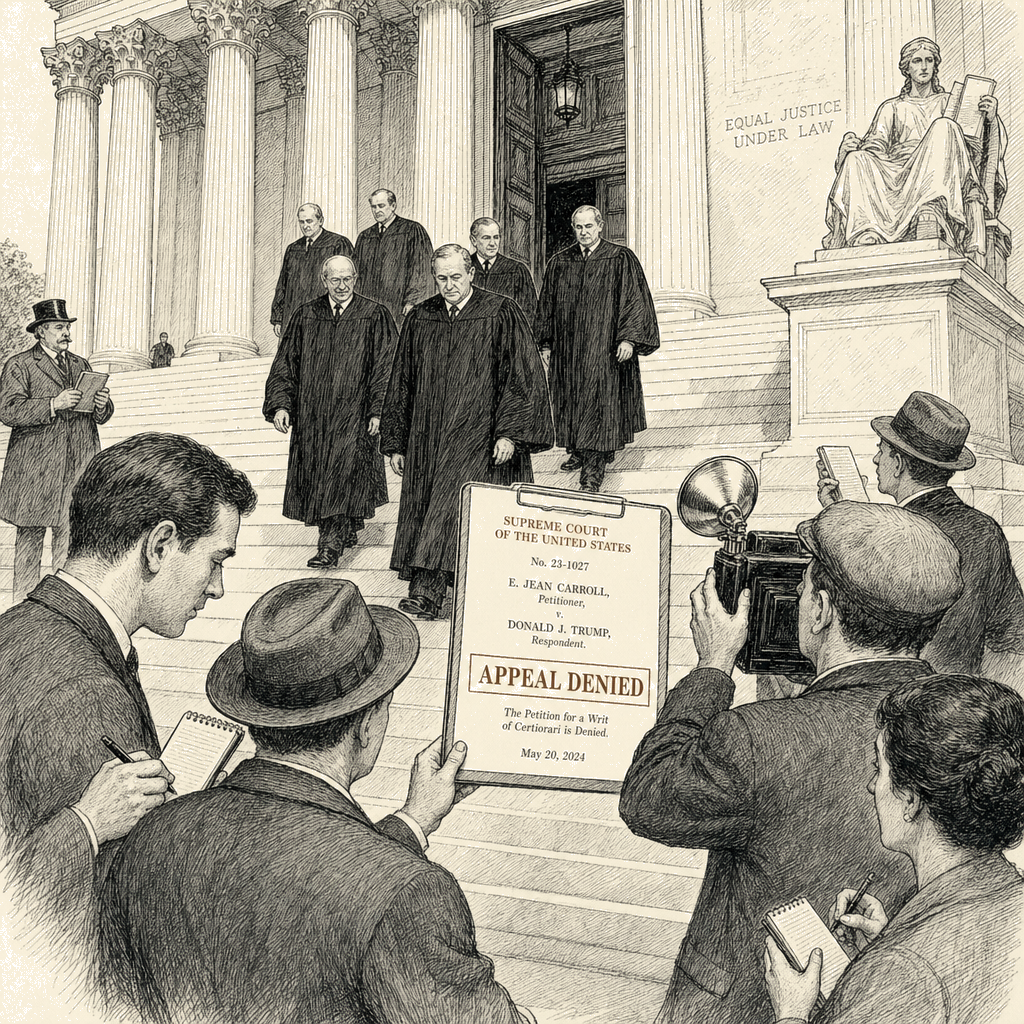
The Supreme Court this morning refused to rescue Donald Trump from a jury’s finding that he is a sexual abuser. The denial of certiorari, issued without explanation on the routine order list, leaves in place a $5 million civil judgment for the sexual abuse and defamation of E. Jean Carroll, and a separate $83.3 million defamation award that remains temporarily stayed. The Court’s own gatekeeping logic, its defenders will say, makes the denial unremarkable. The docket is discretionary; the justices take only those cases presenting a circuit split or a question of national importance. A fact-bound civil suit over an alleged assault in a Manhattan department store dressing room three decades ago, however lurid, does not obviously meet that bar. In isolation, declining to hear Trump v. Carroll is a defensible, even ordinary, exercise of the certiorari function.
But isolation is not how the Roberts Court operates. On the same morning it declined to disturb Trump’s personal civil liability, the Court expanded the president’s firing power over agency heads and upheld mail-in ballots against the restriction that had been challenged. That two-track output — robust defense of presidential prerogative, cold shoulder to the former president’s private legal exposure — is not a contradiction. It is a diagram of the Court’s priorities, with the labels filled in. The pattern, documented across terms, is that this Court intervenes aggressively — often on the shadow docket — when the interests of the executive or the conservative legal movement are at stake, and does nothing when the interests at stake are those of ordinary litigants, even when the litigant is a former president who would very much like to be treated as something more.
The receipts are visible. The Brennan Center for Justice maintains a shadow docket tracker documenting emergency applications arising from the second Trump administration’s actions; by early 2026, that tracker had logged dozens of such applications, with the Court issuing emergency orders at a rate the Center characterizes as heavily favorable to the executive. The pattern is consistent across the docket: when the administration has moved to expand its authority through emergency filings, the Court has cleared the way, often on the shadow docket, often without oral argument, often with minimal explanation. The same day it refused to disturb Trump’s personal liability, the Court was doing exactly the work of expanding the presidency’s reach.
Trump v. Carroll, by contrast, arrived at the Court after full briefing, full argument in the lower courts, and the ordinary appellate process. The jury in 2023 heard the case, returned a verdict, and awarded $5 million in damages for the sexual abuse and original defamation. The 2nd U.S. Circuit Court of Appeals upheld that verdict in 2024, concluding that Trump’s lawyers had failed to identify any reversible error. The justices had every opportunity to disturb the verdict. They declined. They declined because the question before them was not whether the president can act free of judicial constraint, but whether a wealthy, well-represented private citizen must pay a judgment like anyone else.
The Court, having spent the previous several years dismantling the legal architecture by which private citizens can hold federal officers accountable for abuses — the Bivens contraction in Egbert v. Boule, 596 U.S. 482 (2022), the qualified-immunity tightening in Kisela v. Hughes, 584 U.S. 100 (2018), the standing barriers in Hernandez v. Mesa, 589 U.S. 93 (2020) — found no reason to grant the same solicitude to a private defendant who happens to have once held the office. The asymmetry is the substantive holding. The courthouse door has been narrowed against victims of police violence, against survivors of cross-border shootings, against consumers defrauded by transnational credit reporting. It remained open, just wide enough, for a jury of Trump’s peers to walk a sexual assault survivor’s verdict through.
The denial of certiorari does not vindicate E. Jean Carroll; it merely declines to reverse her. A cert denial has no precedential weight. It says nothing about whether the lower court got the law right. But it finalizes the record, and the finality is doing work the justices did not need to explain. The strategic landscape has shifted. For plaintiffs’ attorneys considering high-profile abuse and defamation claims against powerful figures, the path from initial jury verdict to appellate affirmance to ultimate Supreme Court denial is now a stress-tested blueprint. The $88.3 million total — $5 million for the sexual abuse and original defamation, $83.3 million for the continuing defamation — is not the ceiling on what this finality unlocks. The window of opportunity is now wide open, and the political-legitimacy cost to defense counsel of exhausting every rung and losing at each one is itself a deterrent the Court has just ratified by doing nothing.
The Roberts Court is an instrument of executive power. When the president needs a judicial backstop to expand his authority, the Court supplies it, quickly and without fuss. When a former president needs a judicial backstop to escape the ordinary consequences of civil liability for sexual abuse, the Court shrugs. The president is protected; the man is not. The two halves are the same fact, and the fact is that this Court knows exactly whose power it is guarding. E. Jean Carroll will collect, eventually, what a jury said she was owed. The presidency will collect, today, what the Court decided it was owed. The Court will not lift a finger to confuse those two categories again.