
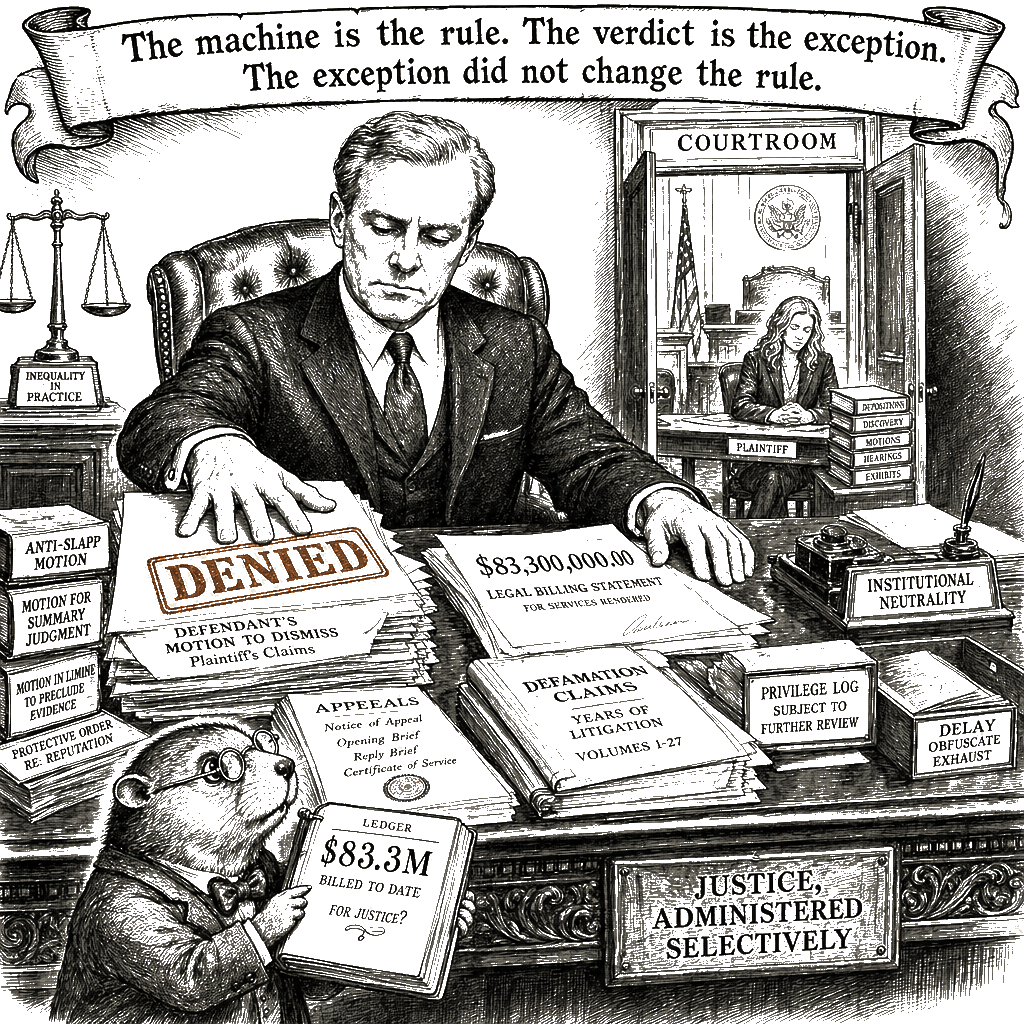
Five million dollars for the dressing room at Bergdorf Goodman. Eighty-three million for the lie about it. The man who spent three years trying to appeal his way out of both just ran out of road. The Supreme Court, on Monday, declined to disturb the $5 million verdict, leaving the $83.3 million defamation award — whose collection was only delayed by the appeals court last month — to hang over him. The country moved on. That is the part of this story that is not the verdict. The verdict is the part the country could almost bring itself to read.
The system did what it almost never does. The president was not jailed. The president was not barred from running. He has paid nothing yet, and may never pay. A jury wrote numbers on a piece of paper, an appeals court affirmed, and the highest court in the land declined to intervene. That is accountability, in the limited sense the term applies to men who command a country. It is less than the conduct earned. It is more than the country usually produces.
The conduct, on the record: Donald Trump reached into a fitting room at Bergdorf Goodman, encountered E. Jean Carroll, and assaulted her. The defamation finding was for calling her a liar in 2019, denying the allegations on the record. By the time the case reached a jury, the country had already watched the Access Hollywood tape, in which the man who would be president bragged about grabbing women by the genitals. The jury had that tape. The 2nd Circuit had that tape. The Supreme Court, in declining to take the case, had that tape. None of them found it necessary to relitigate the question of whether the man who said those things was capable of the conduct alleged. The answer, all nine of them appeared to conclude, was already in the public record.
The Bergdorf baron treats women as amenities whose credibility can be outspent, and the courts as a hostile bureaucracy to be outlasted. He called the $5 million judgment “excessive” — a word ordinarily reserved for restaurant portions, not forcible sex — and asked the highest court in the land to erase the verdict. The unrepentant, who has spent a political career demanding that the legal system hold other men accountable, has spent a legal career demanding that it hold him exempt.
The mechanism is always the same: deny, delay, defame, and wait for the other side to run out of money or stamina. I have watched this playbook since the Keating Five. The architecture is identical: wealth as a shield to delay, funding the defense until the plaintiff runs dry, and praying for a friendly appellate bench. He is a member of a class the country has been slow to enumerate. The class is the powerful man who serially hurts women, and the country that lets him. It includes Harvey Weinstein, convicted in New York in 2020 and freed after an appeals court reversed in 2024. It includes Bill Cosby, convicted in 2018 and freed after the Pennsylvania Supreme Court reversed in 2021. It includes Jeffrey Epstein, whose 2008 plea deal — the one the DOJ Inspector General later called a result of “poor judgment” by the U.S. Attorney who signed off on it — let Epstein serve thirteen months in county jail for conduct that would have put an ordinary man in a federal penitentiary for decades. The class is bipartisan. The class is durable. The class produces this on schedule.
The machine that produces it is not complicated. It is the machine that requires a woman’s word to overcome a man’s denial, when the man is rich enough to afford a dozen lawyers and famous enough to drown the woman out. It is the machine that requires a jury to believe a department-store shopper over a sitting president, and that almost never runs that way because the deck is stacked. The Carroll verdict is what the machine looks like when, by some accident of evidence, it briefly works. The Access Hollywood tape was the accident — the moment a boast became a lens, and a jury could see the fitting room for what it was. Without it on the public record, the jury would have watched the same woman and the same fitting room and returned a different number — maybe a small number, maybe nothing. The machine is the rule. The verdict is the exception. The exception did not change the rule.
For once, the blindfold stayed down and the scales actually balanced. The dressing room was not a perk. The lie was not a strategy. The Supreme Court declined to erase the bill. The Supreme Court has not disturbed the man.