
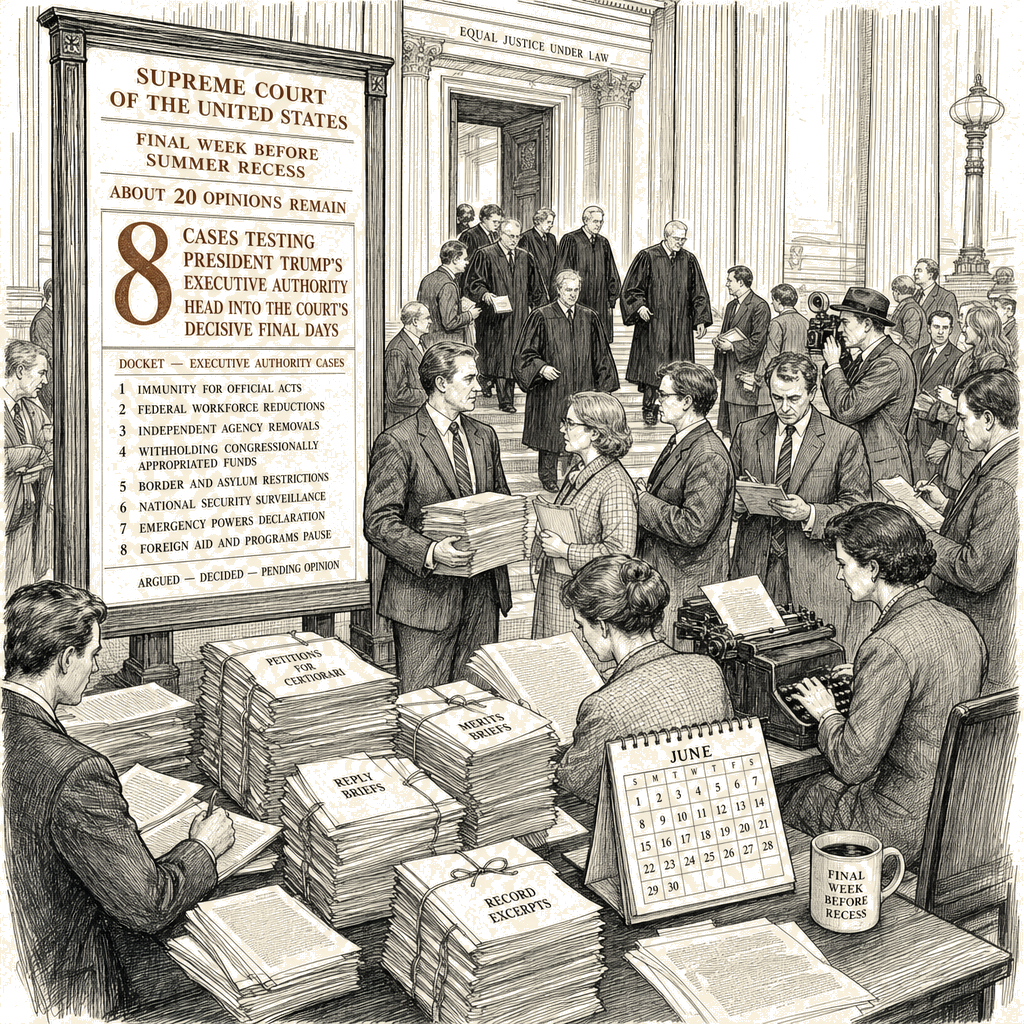
The Roberts Court is finalizing the imperial presidency while Trump bombs Iran without judicial review. The Court enters its final opinion days with twenty cases still pending — eight of them expected to land this week — and three of those eight sit at the structural center of the executive-power question: birthright citizenship, the at-will removal of independent-agency heads, and the dismissal of a sitting Federal Reserve governor. The remaining five — the trans-athlete cases from West Virginia and Idaho, two election-law disputes, and the geofence-warrant case — extend the same architecture into the domestic enforcement and surveillance apparatus. The Court is not adjudicating a set of discrete executive-power disputes. It is ratifying a theory of the presidency that eliminates every structural check the Constitution’s design placed on the office.
The regime-level frame is one the Court has spent more than two decades constructing: a doctrinal architecture that renders executive power judicially un-reviewable across every operative setting. The Alien Enemies Act invocation earlier this term — the administration’s proclamation directing the deportation of Venezuelan migrants it asserted were members of Tren de Aragua, litigated through A.R.P. v. Trump and its companion cases — sits inside that architecture. So do the maritime strikes the administration has conducted without congressional authorization: lethal operations against suspected drug-trafficking vessels in the Caribbean and eastern Pacific that members of Congress have demanded be legally justified. The domestic enforcement campaign that followed the Supreme Court’s recent ruling on temporary protected status — with the Homeland Security secretary now ordering affected migrants to seek permanent residence or leave — operates inside the same doctrinal lock. Standing barriers, political-question dismissals, Bivens contraction, qualified immunity — the legal doctrines that immunize government officials from civil suit when they act unconstitutionally. The Court has closed every door through which a challenge to unlawful executive action could walk.
The remaining cases extend that architecture to the office’s domestic structure. Birthright citizenship, under the Fourteenth Amendment’s plain text, attaches at birth to “all persons born or naturalized in the United States, and subject to the jurisdiction thereof.” The administration’s position — that the children of undocumented immigrants are not “subject to the jurisdiction” — is a reading the Court has rejected since United States v. Wong Kim Ark, 169 U.S. 649 (1898), and that no justice of any coalition has endorsed in the 128 years since. The historical record the Court must ignore to adopt it begins with Dred Scott. The Reconstruction Framers, led by Senator Jacob Howard’s 1866 declaration that “subject to the jurisdiction” excluded only foreign diplomats and invading armies, drafted the Citizenship Clause specifically to overrule Dred Scott and establish birthright citizenship for all born on U.S. soil, explicitly rejecting the political-allegiance tests the executive now resurrects. The steel-man is coherent on its own terms: a formally unified executive, unencumbered by tenured bureaucrats or birthright claims untethered from parental political status. It is also, on the historical record, the position the Reconstruction Congress wrote the Citizenship Clause to bury.
The independent-agency and Federal Reserve cases complete the pattern. The president’s claimed authority to fire the heads of independent agencies at will, and to remove a sitting Federal Reserve governor without cause, converts agencies Congress designed to operate outside direct presidential control into instruments of the executive’s personal direction. The unitary executive theory that underlies these claims has been advanced in Federalist Society circles for decades; it is now the operating premise of the administration’s legal architecture. On the removal power, the administration invokes Article II’s vesting of “the executive Power” in the President, arguing that independent agencies fracture the unitary chain of accountability the Constitution demands. The doctrinal position requires the Court to overlook the structural reality of the Necessary and Proper Clause, which grants Congress plenary authority to structure the executive branch — substituting a selective formalism that elevates Article II theory over the constitutional design of checks and balances.
The trans-athlete cases and the geofence-warrant dispute are the domestic enforcement and surveillance arms of the same unitary executive theory — not secondary satellites but load-bearing extensions. The trans-athlete cases ask the Court to ratify state laws that exclude a class of students from public-school and college sports; the administration’s brief defends the statutes, positioning the federal government behind state-level exercises of the same unchecked categorical power the presidency claims for itself. The geofence-warrant case — Chatrie v. United States, argued April 27 and decided June 29 — asks whether the Fourth Amendment permits law enforcement to demand Google’s entire location-history database for every device near a crime scene. The Department of Justice argued that it does. Every Fourth Amendment warrant-specificity requirement the Court has articulated since Berger v. New York, 388 U.S. 41 (1967), says it does not. Both cases test whether the supermajority’s deference extends to the enforcement and surveillance machinery of the state — whether the apparatus that follows the unitary executive’s orders operates under the same constitutional constraints the presidency itself is being freed from, or under none at all.
This doctrinal lockdown of the presidency is not an abstract academic exercise. It is the operational prerequisite for the strikes against Iran. Under the doctrines of presidential impunity, the executive’s lethal authority abroad relies on a stack of judicially constructed barriers: the expansive reinterpretation of authorizing statutes; the Office of Legal Counsel memorandum tradition — exemplified by the classified 2010 memo authorizing the targeted killing of Anwar al-Aulaqi, a U.S. citizen killed in Yemen, that withheld legal justifications until forced disclosure in 2014 FOIA litigation; the political-question doctrine that dismisses challenges as committed to the political branches; and the standing barriers that prevent the dead from being represented in U.S. courts. The Court’s simultaneous expansion of presidential authority and contraction of agency oversight removes the very domestic structural checks that might otherwise force transparency on foreign military adventurism. The doctrinal moves enabling this regime — selective formalism and the justiciability dodge — have been hardened across multiple administrations of both major coalitions. The Court is not merely declining to intervene in a specific strike. It is actively dismantling the domestic architecture of constraint while the executive bombs Iran.
The Constitution does not grant the President the authority to strike Iran without congressional declaration, nor does it authorize the stripping of citizenship from children born on American soil, nor does it vest the executive with a removal power that converts independent agencies into personal instruments. The doctrinal lock the Court is finalizing this week is what makes those constitutional answers unenforceable. The Framers designed a presidency constrained by law, Congress, courts, and the plain text of the Constitution. The Roberts Court is building a presidency that answers only to itself.