The Trump administration is sending twenty men to police a graveyard and calling it a peace plan.
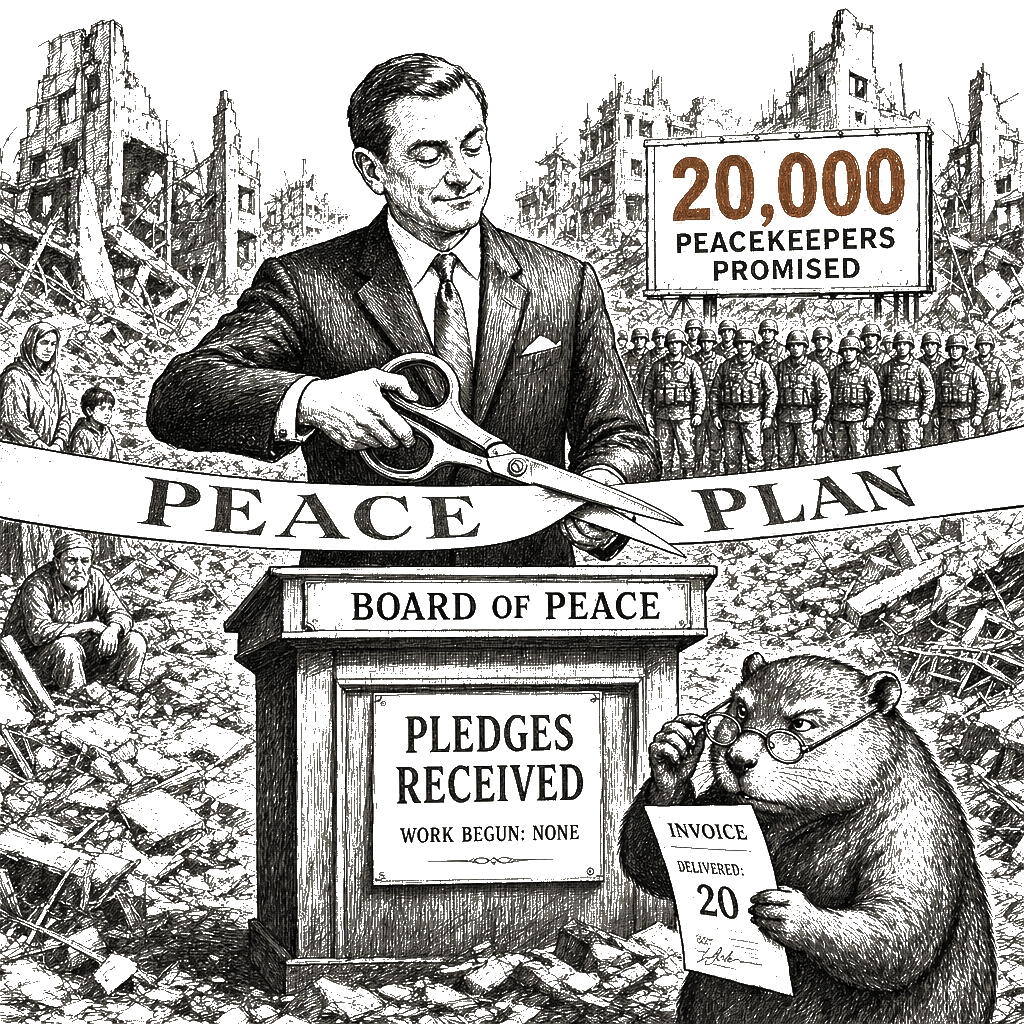
I have run an auto shop for twenty years. I know what a job quote looks like when the shop cannot do the work. A man brings his truck in with a knocking in the engine. I write him a quote — twenty thousand dollars for a full rebuild, parts and labor. If I show up with a bottle of transmission fluid and a prayer, I have not given him a discount. I have lied to him about what I am going to do. The Board of Peace quoted Gaza twenty thousand peacekeepers. What arrived is twenty. That is not a revised quote. That is the lie told on paper.
The physics of stabilization are not a matter of opinion; they are a matter of math. Any soldier who has ever tried to hold a key terrain feature knows the ratio required to secure a population versus the population’s will to resist or simply survive. You cannot stabilize 141 square miles and two million people with a squad of twenty. That is not a stabilization force. That is a witnessing party.
2.1 million Palestinians are living among the rubble of two years of war. They have a security force that is twenty troops deep. They have an occupying military that is still striking, killing more than a thousand people since the ceasefire, according to Gaza health officials who do not say how many were combatants. They have a peace process chaired by a man whose Board has collected hundreds of millions of dollars and has not begun the work the money was collected for. The mission support site inside Gaza has not even broken ground. The logistics hub in Israel is mostly built; the actual footprint in the enclave is dirt.
Indonesia understood this before anyone else. Jakarta had readied up to 8,000 troops for the mission in February. They put their participation on hold in March, citing regional instability — which is the diplomatic term for recognizing that the premises of the mission do not exist. In the weeks after they paused, four Indonesian peacekeepers were killed in Lebanon in clashes that have nothing to do with Gaza but everything to do with the security environment the Board of Peace is ignoring. Four men with families waiting for them in Jakarta. You do not send your sons into a vacuum where the firing has not stopped. Indonesia understood that, and walked away.
Phase Two of the plan requires Hamas to disarm and transfer power to a technocratic council — the hinge that the Board’s own envoy identified as the condition without which nothing else moves. This is the condition that makes the peacekeepers relevant. Without it, the troops are not peacekeepers; they are targets. Hamas has refused to disarm. The Israeli military continues to conduct strikes in the territory. When the political object of the war remains unresolved, the military instrument cannot impose order; it merely prolongs the fighting under a different label. War, in its grim logic, persists with or without the name change.
The four nations currently on course to sign — Albania, Kazakhstan, Kosovo, and Morocco — are sending a message. It is not a message of strength. It is a message of minimal viable commitment, the kind you make when you want to be seen on the guest list but have no intention of paying the check. A Moroccan contingent is expected within months. Months. That is a timeframe measured in the patience of the international news cycle, not the metabolic needs of starving children.
The Board of Peace has collected hundreds of millions of dollars in pledges. That is not the work. That is the deposit on a job the shop has not started. The promises made in February have not materialized into a single school rebuilt or a single hospital restored. The Board has promised greater contributions as additional operations come online. Additional operations. Twenty troops stationed near a crossing is not an operation. It is an entry in a ledger.
The ledger is simple. We promised a force that could stabilize a city. We delivered a squad that can barely guard its own post. The bombs are still falling. The rubble is still there. And the men we sent are too few to stop the bleeding, and too exposed to stop the dying.