
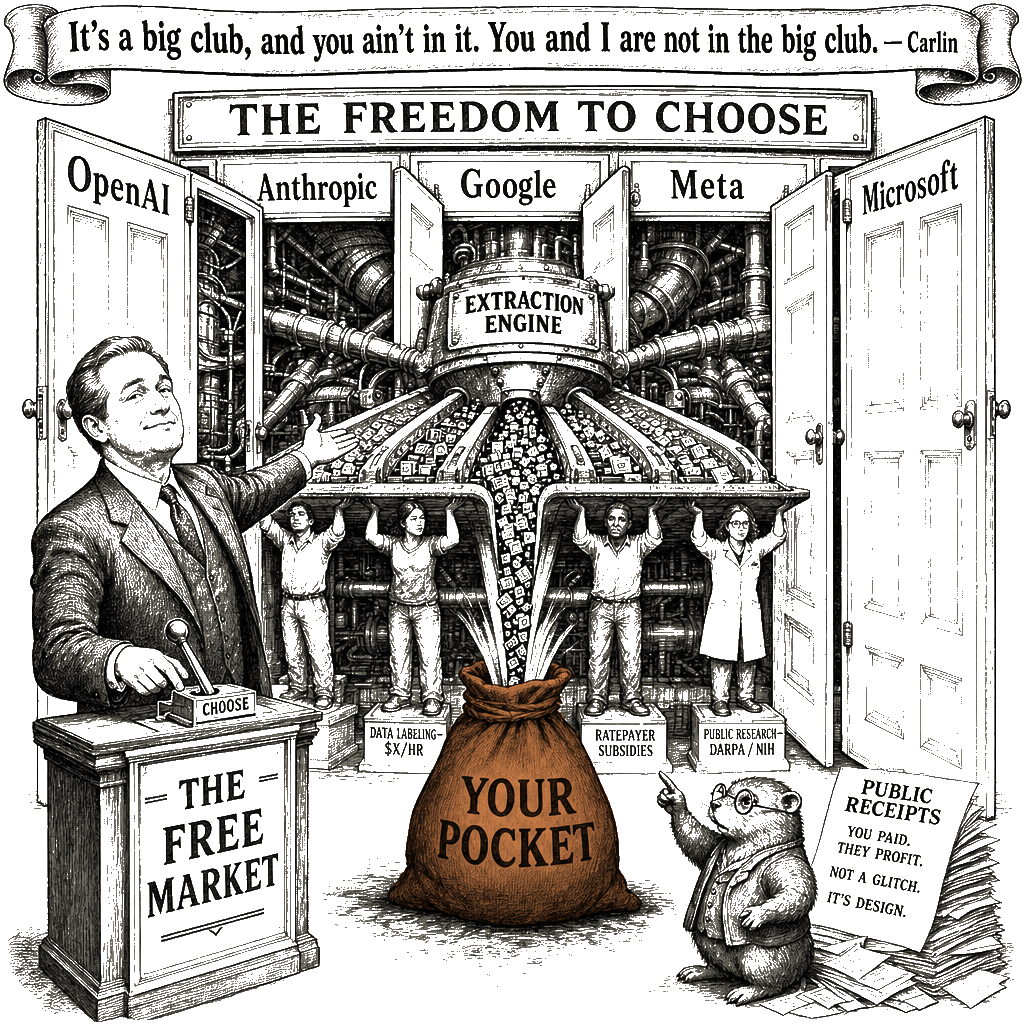
The freedom to choose your AI was never real — and the proof is in your pocket. Five firms — OpenAI, Anthropic, Google, Meta, Microsoft — already decide which models exist, what they cost, and what they are allowed to say. So when Daniel J. Flynn argues in his National Review piece “JD Vance, Milton Friedman, and the ‘Rahway Elegy’” that JD Vance’s casual mention of “seizing the equity of the AI companies” is “the opposite of democratic,” he is defending a freedom that was captured before the vice president opened his mouth. The piece frames the threat as state intervention versus market choice. The market in question is a cartel, and the only real disagreement is which elite gets to run it.
Flynn’s strongest point, and I’ll give it to him, is that Vance sounded unserious. A vice president musing aloud about seizing equity in private industry, then laughing that “nobody really even protested,” is not a reassuring performance from a man a heartbeat from the presidency. Friedman’s warning about the paternalist’s arrogance — the humility that ought to come with believing in freedom — is genuinely worth taking seriously. And the Rahway story matters. A kid scooping ice cream at his immigrant parents’ shop, peddling clothes door-to-door, selling fireworks at a roadside stand — that is an economy of small actors and ordinary choice, and Flynn is right to want it back.
But here is what the demolition reveals. The economy Vance wants to “develop” and the economy Flynn wants to “free” are not the economy of Rahway, New Jersey, in 1940. They are the economy of five firms sitting on more compute than every university, government lab, and small startup combined, training models on text scraped from your blog posts, your medical forums, and your kids’ homework — without asking, without paying, and without telling you. The “freedom to choose” between ChatGPT and Claude is not a market the way the freedom to choose between two bakeries is a market. It is the freedom to pick which side of a duopoly gets your subscription fee. Friedman, who spent a career worried about monopoly, would have recognized this instantly. The “Rahway Elegy” is an elegy for an economy that ended sometime around 1995, and Flynn is reciting it over a graveyard.
Now look at the so-called pragmatism Flynn holds up as proof of Friedman’s genius. Tax withholding is the state making sure it gets its cut before you ever see your paycheck. School vouchers do not build public infrastructure; they just funnel tax dollars to private operators while the neighborhood public school goes broke. The negative income tax does not raise the wage floor; it just uses the taxpayer to subsidize the employer paying poverty wages. Friedman was not rejecting the managed economy. He was just proposing to manage it for the asset owner instead of the industrial planner. The hidden hand is only hidden from the person it is picking the pocket of.
Who actually pays for the AI revolution? You do. Your uncompensated posts trained the models. Workers in Kenya got paid a few dollars an hour to label the toxic content so your chatbot wouldn’t recommend it. The Texas and Virginia ratepayers subsidized the data centers. The small publishers and artists whose work got absorbed into training sets got nothing — and the courts, in case you missed it, have so far mostly sided with the firms. Meanwhile the venture capital class that funded the compute buildout got the wealth, and the rest of us got the productivity gains we are told to be grateful for. When Flynn invokes Friedman on the freedom of “individuals to make their own mistakes,” it is worth pointing out that nobody asked us whether we wanted to make this particular mistake. The mistake was made for us, by firms whose quarterly earnings calls we do not get to vote in.
There is also the small matter of what “the market” actually required to build these models. The chip industry that powers AI was built on decades of public research funding and DARPA contracts. The internet the models scraped was built on a public protocol, public subsidies, and public universities. The legal framework that lets these firms copyright their outputs while training on yours — that is a choice Congress made, not a law of nature. The “freedom” of the AI sector was made by specific decisions, in specific rooms, by specific people. Pretending it was handed down from a mountaintop called “the market” is the catechism of the comfortable, recited loudly enough that nobody asks who built the mountain.
Flynn’s deeper mistake is treating “state direction” and “market freedom” as the only two items on the menu. They aren’t, and never were. Friedman’s own pragmatism — the voucher advocacy, the openness to a negative income tax, the carbon-tax flirtation, the rent-ceiling work — pointed at a different question than state-or-market: who owns the thing, and who pockets the gains. The market Friedman actually praised was one with many owners. The one Vance and Flynn are arguing about has five, plus the venture capital class that funds them, plus the regulators they have hired away from, plus the courts they keep winning in. The choice Flynn is offering — Vance’s populist tariffs versus Friedman’s privatized vouchers — is just a choice between two different extraction models. One uses the president to bully the CEO into sharing the rent. The other uses the CEO to bully the worker into accepting a voucher.
So what gets built? We do not have to choose between a president seizing AI equity and letting five firms run the table. We can do what we did with rural electricity in 1936, what we did with the Interstate Highway System in 1956, what we did with the internet’s basic protocol layer in the 1980s. We can build the public option. A publicly financed AI compute utility — call it the National AI Cooperative — would give every researcher, every small business, every public-interest organization access to frontier-level compute at marginal cost. The model weights trained on publicly funded research should sit in a public commons, the way NIH-funded research sits in PubMed. The data-labeling labor could be organized as a worker cooperative, with the people doing the work owning a share of the resulting models. The gains from AI productivity — which are real, however unevenly distributed — could be shared through an Alaska Permanent Fund–style dividend, because the resource being extracted is, in a sense, all of ours.
And the same principle holds outside the AI sector, because the same choice is being made everywhere in this economy. It is the working alternative we already know how to build: a worker-owned bakery in Cleveland where the bakers set their own shift wages and negotiate the ratio; the sectoral bargaining table, where workers, the community, and the enterprise actually sit down and set the price of labor for an entire industry, so no single firm can gain an advantage by going non-union; the Bank of North Dakota, which has been managing capital for the public since 1919 and returning profits to the state since the 1940s without anyone calling it a dictatorship.
Vance’s “seize the equity” framing is bad politics and worse economics. Flynn’s “the free market will handle it” framing is nostalgia for an economy that does not exist. The third option — public infrastructure for AI, cooperative ownership of the labor, commons-based models, a productivity dividend — is not the gulag. It is the plumbing. And it is the only version of “AI freedom” that puts actual choice in the hands of actual people rather than in the investor decks of five firms and the executive orders of one president.