
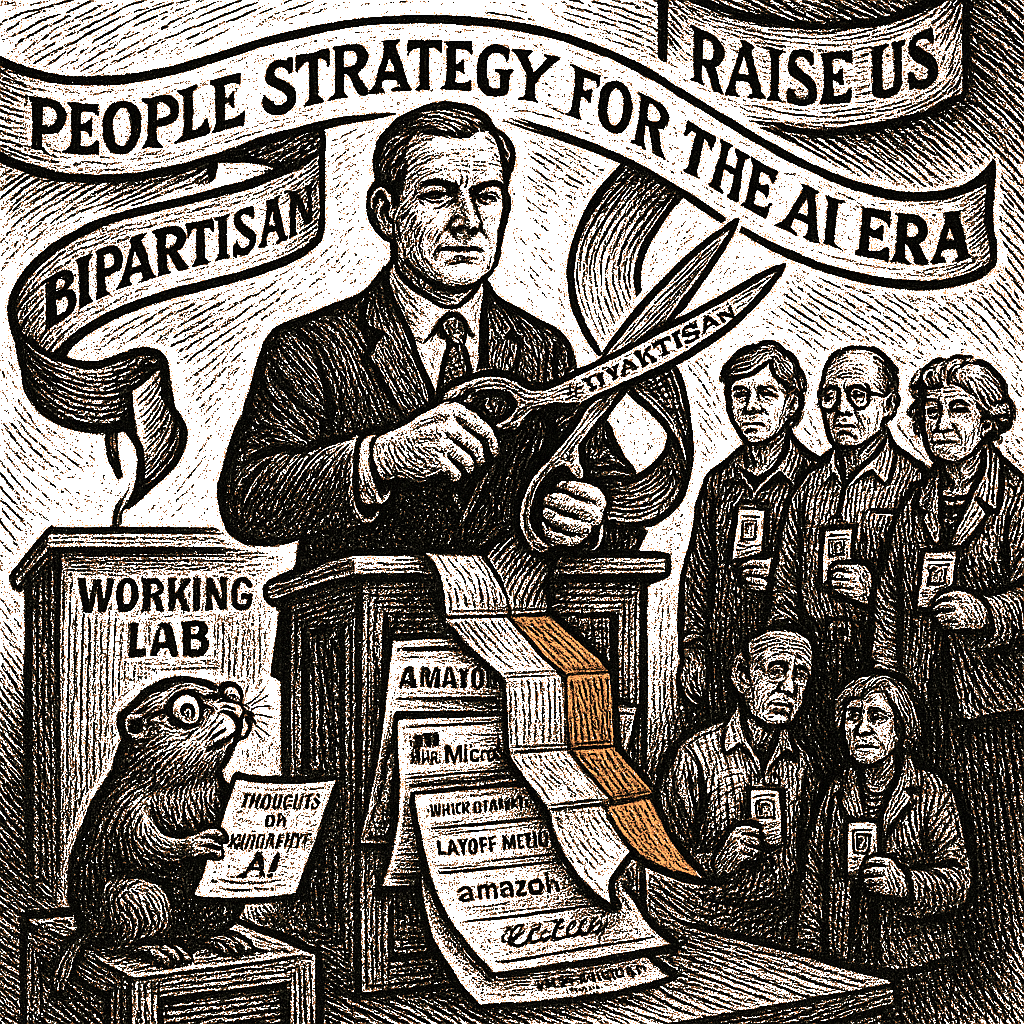
Amazon and Microsoft are designing the safety net for the workers their AI will fire.
To be fair — and it is worth being fair, because the documents are public and the public can read them — RAISE US, the bipartisan consortium that launched this week under former Commerce Secretary Gina Raimondo and former Indiana Gov. Eric Holcomb, is not styled as a project by the firms that will benefit from the displacement. It is styled as a “people strategy” for the AI era, a working lab, a national response to a national problem. Amazon, Microsoft, Bank of America, and Eli Lilly are members, alongside state governments and philanthropic groups. The framing is consensus-seeking: decades-old policies reconsidered, no specific firm’s conduct at issue, the bipartisan pair at the top signalling non-partisan administration. Brad Smith, the Microsoft vice chair and president, is on the record describing the work as a scaling exercise — “scaling can never be done by single institutions.” The trouble is that the working lab is being designed by the firms whose business plans require the displacement. The safety net is being sewn by the hands that will cut the rope.
Algorithmic Routing and the Limits of Optimization
It is worth being precise about what a “people strategy” means when it is authored by the entities running the displacement. The specific pilots already named in the consortium’s mandate do some of the diagnosis. In Arkansas, the group will focus on deploying an “AI-powered career navigation platform.” Such a platform is not a neutral counselor; it is a continually-tuned set of weights serving a continually-revised objective function. A career-navigation engine optimized for a post-automation labor market is a matching algorithm that treats a decade of accumulated specialized labor as sunk cost, designed to route displaced knowledge workers into the lower quartiles of a new service-wage distribution as efficiently as possible. In Maryland, by contrast, the pilot is a service-year option for healthcare exposure — no algorithm required, and a telling admission that not every transition problem is an optimization problem. The choice of pilot in the same consortium tells you what the consortium thinks the work is.
The Salesman’s Promise and the Manager’s Intent
It is also worth being precise about what the AI-displacement claim actually is, because the public discourse has the misleading habit of treating it as a forecast rather than as a managerial intention. When a chief executive tells investors that a large fraction of customer-service or software-engineering or paralegal work will be “augmented” or “transformed” by AI, the sentence performs two operations simultaneously. The first is a description of what the technology can do. The second — and the operation that does the work — is a description of what the firm intends to do with the technology. The cleaner way to put this is one Cory Doctorow has been deploying in his Pluralistic columns and on the lecture circuit since 2024: an AI does not need to actually do your job to be useful to your employer; the salesman merely needs to convince your employer that it can. “An AI salesman can convince your boss to fire you and replace you with an AI that can’t do your job,” Doctorow writes. The elaboration is mine but the architecture is his: your boss fires the worker who actually knows how to do things to escape the ego-shattering conflict of negotiating with labor that has a price. The AI is the lever; the wage stagnation is the result, even as the very firms deploying the tools grapple with the hiring dilemma as the software reshapes white-collar jobs.
The Sincerity of Managed Decline
The salesman’s trade association is RAISE US, and the “people strategy” is the customer-success literature that follows the sale. Raimondo’s hedge in her own announcement — “I personally don’t believe there’ll be nothing for humans to do… but I am worried” — is the AI-displacement narrative in CEO-coalition form. The “but” is the displacement. The “worried” is the people strategy. The handoff is the work. Holcomb’s framing, that the scale of change is “more so than it has ever been, I think, in human history,” is the same narrative in a higher register. They are sincere. But sincerity is precisely what makes the framing so effective as political cover — the consortium’s corporate sponsors can present themselves as stewards of the workforce they are engineering into managed decline, and the bipartisan structure ensures there is no one in the room asking whether the displacement should be prevented rather than accommodated. The Leadership Now Project — the group of more than 400 current and retired business executives whose spring meeting devoted several sessions to comparing AI’s threat to the effects of globalization and offshoring — is the salesman’s pre-call briefing document, and the comparison to globalization is not a coincidence. The structural adjustment to globalization was done to the workers, not by the workers, and the firms that offshored the work were the firms that funded the trade-adjustment assistance the displaced workers got. The structure is the structure.
The Documentary Record of Displacement
The specific documentary record is worth walking through once, because the claim that the coalition is “bipartisan” and “national” obscures who is actually at the table. Microsoft laid off roughly 10,000 workers in 2023 and a further several thousand across two more rounds in 2024; the company’s earnings transcripts describe Copilot as the next user-interface shift, the kind of comparison that, in a chief executive’s mouth, is a description of who will and will not still have a job at the end of it. Amazon’s Andy Jassy wrote to employees in a 2024 memo, “Some thoughts on Generative AI,” that the company would “need fewer people doing some of the jobs that are being done today” because of AI; the Jassy letter is, in plain terms, a workforce-reduction memo with a productivity frame. Bank of America has been integrating AI across its contact-centre and back-office operations for years — the same dilemma our colleagues documented in the Wall Street AI hiring piece two weeks ago. Eli Lilly is the outlier in the displacement sense — a pharmaceutical firm whose value to the coalition is not that it is firing people, but that it lends the appearance of a coalition that extends beyond tech. The point is not that any one of these firms is doing anything illegitimate in deploying AI. The point is that the firms whose business plans require the displacement are now the firms writing the response to the displacement. The firms that did the firing are the firms writing the people strategy. The agenda is being set at the working group’s table.
Bipartisanship as Regulatory Capture
The bipartisan structure is itself a piece of the architecture, and it is the piece that needs to be named carefully. A former Democratic Commerce Secretary and a former Republican Governor give the project the appearance of neutral administration. State governments supply the procurement apparatus and the on-the-ground training-delivery infrastructure. Philanthropic groups — and one would want to know which ones, on what terms, with what existing financial relationships to the member firms — supply the convening legitimacy. The arrangement converts what is, structurally, a corporate project into what is, rhetorically, a national one. A policy response designed by those doing the displacing is, in plain terms, regulatory capture at the level of the policy itself: not captured by lobbying on a bill, but captured at the level of writing what the bill will be. To give the obvious symmetric-application check, because the discipline matters: an analogous arrangement in any other industry — a coal-company-led Just Transition planning commission, say, or a tobacco-company-led Smoker Welfare Working Group — would be received as a structural conflict of interest, and rightly so. The bipartisan wrapper does not, in itself, change the structure. It changes the framing.
The Historical Precedent of Extraction
The playbook is older than the mechanism, and it is one written in a much colder latitude. When the Brazilian steel conglomerate Gerdau bought the Manitoba Rolling Mills in 1995, the new owners arrived with a very similar people strategy for the Selkirk bar mill. They brought in computerized ladle-tracking and continuous-casting telemetry, and they explained to the journeyman millwrights that the new technology required a different kind of worker. The reality, evident in the mill’s headcount sheets within a year or two, was that the telemetry was used to run the line hotter and cut a substantial share of the bar-shop floor. The “retraining” was the public relations for the leveraged buyout; the extraction was the point. The digital economy has simply replaced the continuous-caster with the language model, but the political economy — extracting the surplus the existing workforce built, locking them in by raising the cost of leaving, and finding the next class of suppliers to do it to — remains identical.
The Chokepoint and the Relocated Cost
The frame the working group is selling to legislators and philanthropic donors is that the problem of AI displacement is a workforce-readiness problem. The workers are the variable that needs to adjust. The technology, the deployment, the choice to use it to reduce headcount, the choice to use it to suppress wages, the choice to deploy it at the speed at which the board demands returns — all of these are fixed, and the workforce is the thing to be retooled. This is the frame Microsoft and Amazon and the rest have every interest in promoting, because it relocates the cost of their business model onto the workers and onto the public retraining budget. It is, in the precise sense Doctorow and Rebecca Giblin use the term in Chokepoint Capitalism (Beacon Press, 2022), the chokepoint exercising the rent-extraction right it claims by writing the standard contract. The contract, in this case, is a national workforce policy. The firm writes it. The worker signs it. The argument that this productivity boom is the one that doubles GDP and leaves the displaced to the working group’s discretion is the argument the firms on the RAISE US membership list are positioning themselves to license.
The Reverse-Centaur and the Absent Countervailing Forces
The four forces Doctorow names as historically constraining platform and employer abuse — competition, regulation, self-help interoperability, and labour — have all been weakened in the AI deployment race. Competition is the wrong model; the model the firms are deploying against is each other, and the labour consequences are external. Regulation has not arrived at the federal level, and the state-level work is fragmented in the way the consortium itself names. Self-help in the AI context is, for most workers, unavailable; the model is sealed — the internal parameters that govern the output, what the trade calls “weights,” are proprietary — and the only way for a worker or a small firm to reach the system is through an interface the firm controls and charges for. When Brad Smith notes that “scaling can never be done by single institutions,” what he is describing is the scaling of what Doctorow calls the reverse-centaur condition — the arrangement in which the human is pressed into service as a peripheral for the machine, running at its pace, installed as an accountability sink when the algorithm inevitably misdirects a customer or hallucinates a compliance violation. The worker absorbs the liability; the platform captures the productivity gain. The labour force is the lever being pulled, and the lever is being pulled because, as Doctorow put it in his 2024 DEF CON 32 keynote, “Disenshittify or Die!,” the enshittification lever has moved very freely since competition, regulation, interoperability, and labour all got gummed up. A “people strategy” designed by the firms doing the pulling is not, in this reading, a countervailing force. It is an acknowledgement that the pulling will continue, and an offer to manage the consequences for the workers. The firms are not the regulator. The firms are the regulated, and the regulator, in this configuration, is the firms’ own working group.
The Structural Requirements for Labor
What the workers being offered a “people strategy” actually need is not a strategy. They need the four forces reinstalled. They need sectoral bargaining coverage, the kind the Nordic countries’ labour-market institutions still provide and the United States has not had since the postwar settlement collapsed. They need portable benefits — health, retirement, training accounts that follow the worker rather than the employer, so that a transition is not a fall off a cliff. They need the AI systems they work alongside to be auditable, by them, in plain language, with the right to dispute automated decisions that affect their employment — the algorithmic-accountability floor that has been on the policy agenda for a decade and that the firms on the RAISE US membership list have, individually, opposed. They need a federal privacy law with a private right of action, so that a worker scored out of a job by an algorithm can sue the operator of the algorithm and not wait on a regulator defunded for the purpose of not regulating. They need the right to repair the equipment they work with, including the software systems, so that the firm does not hold a monopoly lock on the work. None of these is on the RAISE US working-lab agenda, because none of these would be proposed by a working lab whose membership is the firms that benefit from the absence of these provisions. The working lab, in plain terms, will produce what its membership wants it to produce. That is not a criticism of the staff. It is a description of the structure.
The Venue for Structural Questions
The retraining programs, where they are well-run and properly resourced, do real good for the workers who get into them. The structure that requires the retraining is the structure the working group’s mandate does not name. The coalition is bipartisan, polite, and efficient. The coalition is the firms that did the firing, now writing the rules for the fired. The working group’s table is the firms’ table. The working group’s mandate is workforce readiness, not labour law. The appropriate venue for the structural questions is Congress, and Congress is not the working group’s table. Whenever the working groups release their first set of policy recommendations, the instrument itself will be the tell — the mechanism by which a corporation ensures the state pays for the obsolescence it engineered, and the deadlines, I expect, are the only part of regulatory processes the regulated actually respect.
— Stewart Letterkenski