
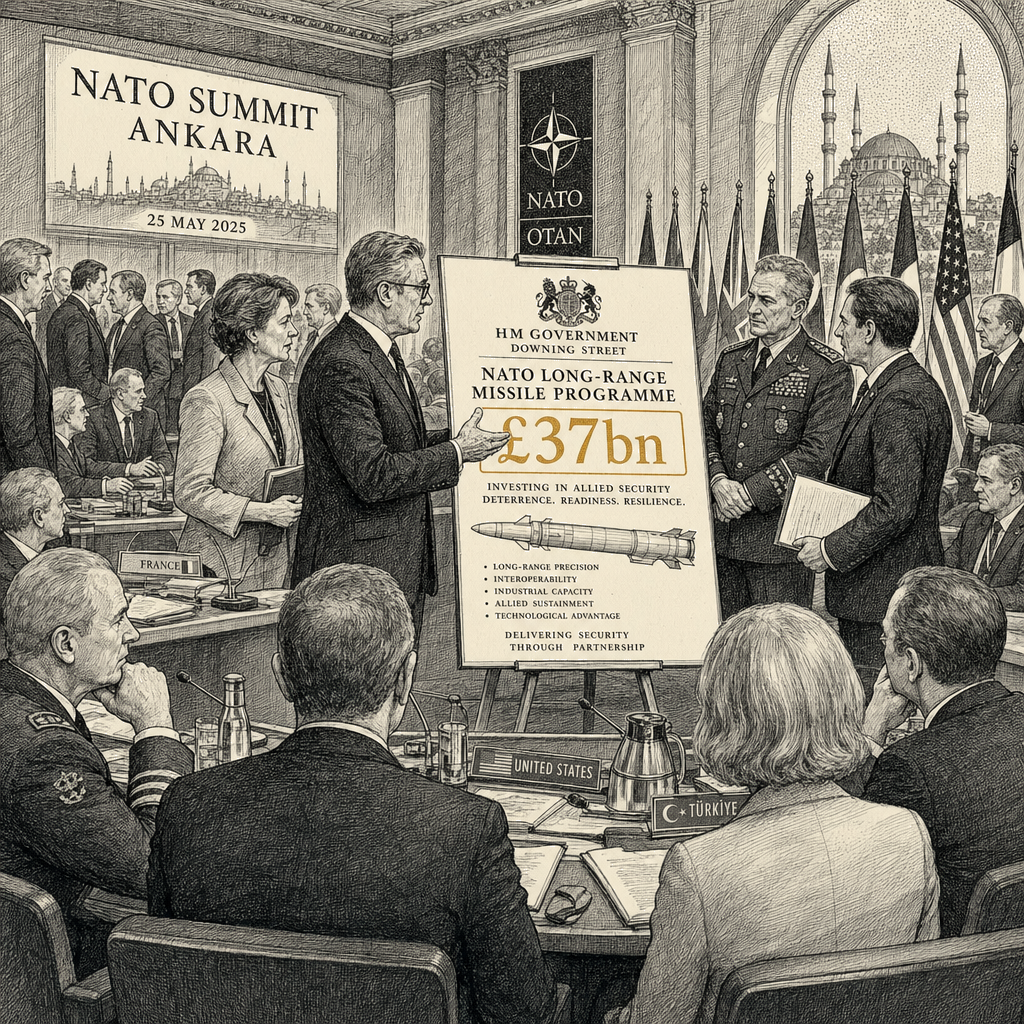
The British prime minister and his European counterparts are committing £37 billion to a missile system that does not exist and will not arrive for another decade, while the working people who are actually paying for it can’t get their clinic appointment or their kid’s school book bag.
The project is called “Deep Precision Strike.” It is a beautiful name. It sounds like a video game level or a marketing brochure for a high-end watch. It is a long-range missile intended to strike targets nearly 200 miles away with pinpoint accuracy, with a possible extension to 1,250 miles. Twelve NATO nations have signed on. The price tag is £37 billion over ten years. And the weapon will not be ready until the 2030s.
That last part is the part that matters, and it is the part the people announcing this thing at the Ankara summit do not want to talk about.
The order book is real. The missile is a concept slide. Somebody at a prime contractor’s boardroom just got a ten-year order book locked in by parliamentary vote. They will pay their dividends on schedule. The engineers will figure out the guidance software when they figure it out. The working people of twelve countries have already been billed.
Now let me tell you what £37 billion looks like from a kitchen table.
It is the lunch ladies at your county’s elementary school, who have not had a raise in four years and who feed half the kids in the building because the parents cannot afford to. It is the clinic down the road from your house, the one with the three-month wait for a primary care appointment, because the county could not keep up the staffing after the last round of belt-tightening. It is the road crew that used to patch the pothole on your street before the budget ran out. It is the mother at the food bank on Maple Street choosing between the formula and the antibiotic this week. It is the welder who got laid off when the local fab shop closed because the contracts dried up. It is the renter whose landlord raised the rent two hundred dollars in March and whose kid needs new shoes.
Somebody has to pay for this missile. It is not the people announcing it. It is not the executives at the prime contractors. It is the working people. And the working people will not see a single pound of benefit from it, because the thing will not be built until long after the next round of school-board meetings have cut another art program, long after another rural hospital has closed its maternity ward, long after another family has moved in with the in-laws because the rent got away from them.
This is the procurement pattern I have watched my whole life. You announce a high-technology savior system that is just far enough in the future to avoid the messy reality of the present. You secure the budget. You feed the shipyards and the aerospace primes. And then you wait ten years for the engineers to figure it out, while the frontline troops fight the current war with the previous generation’s leftovers, and the working people at home wonder why their clinic is closed and the missile budget is open.
The war in Ukraine is not being decided by precision cruise missiles that cost millions of pounds each. It is being decided by artillery shells and first-person-view drones costing a few hundred dollars and electronic warfare. The Ukrainian military has proven this point again and again. The “game-changing impact” comes from volume and adaptability, from the interceptors that could keep a Kyiv high-rise from being hit by a Russian cruise missile this Tuesday, from the stack of metal on a loading dock somewhere that needs to be on a C-17 this month.
The same £37 billion committed today could be drawing down the European artillery ammunition stockpile, which is the actual bottleneck by every account from the front on what Ukraine is able to do next month. It could be front-loading interceptor production. It could be the industrial base that gives the alliance something to shoot with next year. The choice was not between guns and butter. It was between guns next year and a missile next decade, and the political class picked the missile.
Foreign Secretary Yvette Cooper frames this as the necessary architecture for a “stronger Europe within a stronger NATO,” arguing that the continent must finally build the capacity to defend itself because Washington’s guarantee is no longer unconditional. It is a sober calculation of American retrenchment, and I will not argue with the calculation. I will argue with the line item.
The threat is not waiting for the 2030s. Russian military activity around UK waters has surged by 30%, and NATO has scrambled fighter jets to intercept Russian aircraft approaching allied airspace more than 700 times. The danger is already at the perimeter, not on a 2035 timeline. The Russians are scrambling jets and ramping up production of the very systems that this coalition is now promising to counter in 2035. They are not waiting. They are not announcing.
Meanwhile, the working people who have to live with the consequences of this announcement are not at the Ankara summit. They are at the bus stop. They are at the hospital waiting room. They are at the school board meeting where another teacher is being let go. They are at the kitchen table, doing the math.
That £37 billion is not abstract. It is the labor of welders and assembly-line workers and nurses and bus drivers and small-shop owners across twelve countries, taxed and borrowed and committed by ministers they will never meet. The contract value flows to shareholders and executive compensation at the primes. The defense-ready output flows to a concept slide. The cost is paid by the working class. The benefit accrues to the contractors. The risk is borne by the soldiers and the conscripts and, eventually, by the people who will be told there is no money for the thing they need because the missile budget is already spoken for.
I do not want a generation of working people’s children to grow up in the moral-injury record of a 2030s missile program that arrived after the war it was meant to address. The cohort I served with fought a war that was justified on weapons of mass destruction that did not exist. The cost of that lie is what it did to the men and women who actually went, and to the families that waited at home, and to the towns they came back to. The lie is not the same lie this time. The procurement pattern is the same procurement pattern: announce a savior system, take the contract money, let the soldiers on the ground make do with what is on the shelf, and let the working people at home make do with what is left of the budget.
An alert citizenry looks at a £37 billion price tag for a 2030s delivery date and asks who is this for. It is not for the Ukrainian conscript digging a trench in the Donbas today. It is not for the British tanker crew who needs air defense now, not in nine years. It is for the prime contractors in Farnborough or Munich who need a decade-long, cost-plus order book locked in by parliamentary approval to justify their valuations.
We are mortgaging the kitchen to buy a ghost. The money is gone, spent on promises and prototypes. The threat remains, immediate and lethal. The soldiers are the consequence. The contractors are the beneficiaries. And the working people of twelve NATO countries are writing the check, one closed clinic and one cut school program and one missed paycheck at a time.
The money is real. The timing is the problem. The working people are the consequence. The contractors are the beneficiaries. And the kitchen table is where the bill comes due.