
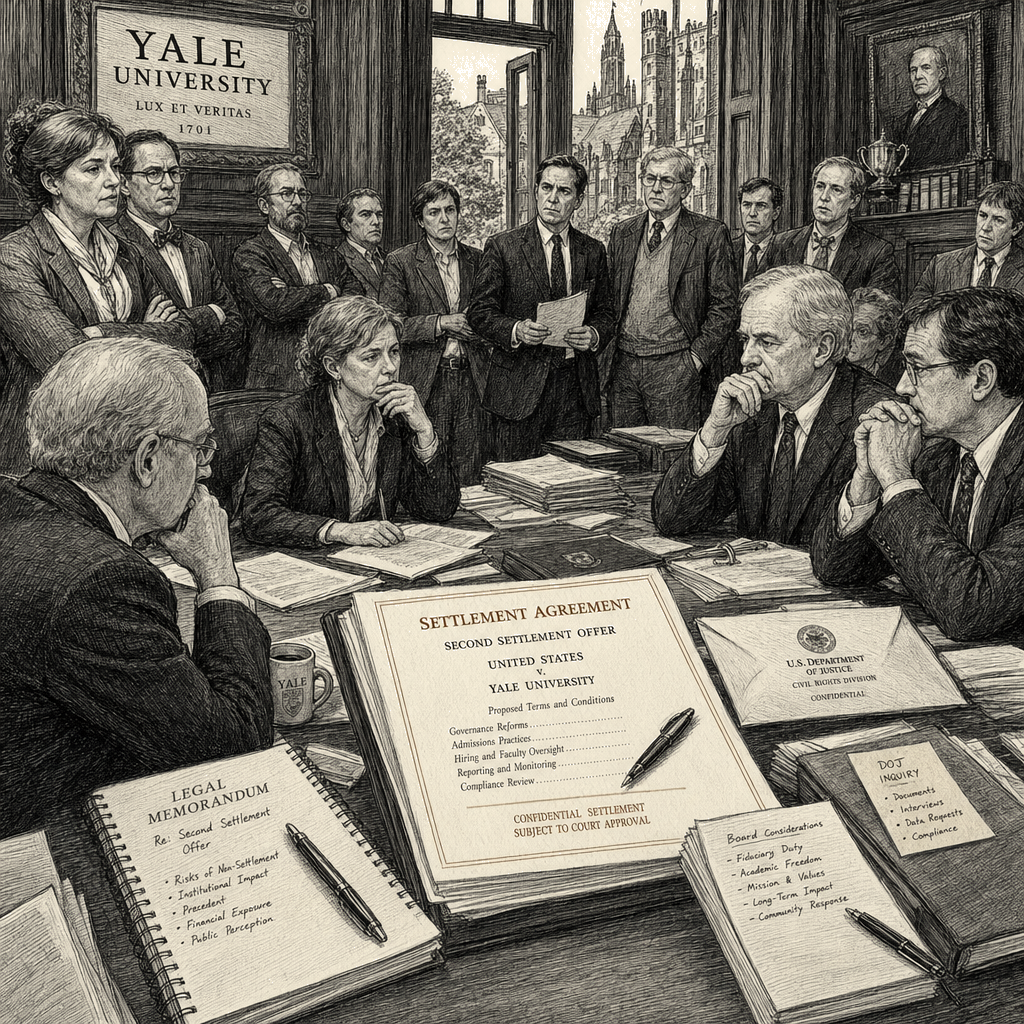
Title VI of the Civil Rights Act of 1964 says: “No person in the United States shall, on the ground of race, color, or national origin, be excluded from participation in, be denied the benefits of, or be subjected to discrimination under any program or activity receiving Federal financial assistance.” The Justice Department has found that Yale’s medical school violated that statute. The finding names the injured. They are the white and Asian applicants whom the medical school is alleged to have rejected because of their race.
That is the breach. Senator Richard Blumenthal — a Yale Law graduate, a Democrat from Connecticut — stood in front of students and faculty last Friday and urged the university not to settle with the Trump administration. He called the moment “legacy-defining.” He said Yale will be regarded “either as a beacon and a fighter for academic freedom or as the weakling who succumbed and obeyed.” He urged the audience to be “full-throated, undivided, undiluted” in resisting a settlement. The Yale chapter of the American Association of University Professors said the same in a letter on Monday. A petition signed by more than 4,000 alumni said it in a different idiom.
Blumenthal’s framing puts the question in the wrong place. The question is not whether Yale should “obey” the Trump administration. The question is whether Yale’s medical school did what the statute prohibits, against the people the statute names. The record on that question is the record. The Justice Department’s investigation, two months old, found that Yale’s medical school discriminated against white and Asian applicants in admissions. The MCAT data the Department released is the data the Department released. In recent years, the median MCAT score for Black admitted applicants was in the 94th or 95th percentile. Hispanic admitted applicants scored in the 95th or 96th. White and Asian admitted applicants scored in the 99th or 100th. The gap is the gap. The Supreme Court, in Students for Fair Admissions v. Harvard in 2023, found that race-conscious admissions programs violate Title VI. A law firm hired by the Yale chapter of the AAUP has challenged the investigation’s findings. The challenge will be tested in court, in a settlement, or in both. The white and Asian applicants the finding names are the people the statute was written to protect. They are the people the conduct, on the record, was directed against.
Now consider the administration. The same statute is being used to extract from Columbia, Penn, and Brown settlements that include multimillion-dollar payments, reorganizations of school governance, and tightened rules for student protest. The settlements were primarily over allegations that the schools had not done enough to stop the harassment of Jewish students on campus. Jewish students are the people the statute was written to protect in those cases. They are the people the conduct on those campuses was directed against. The statute reaches that conduct. The statute does not, on its face, authorize the federal government to dictate the internal governance of a university, the rules governing student protest, the composition of a board of trustees, or the substantive content of an academic program. Harvard fought, and Harvard remains in litigation. The administration’s record with Yale, on the senator’s account, includes a first settlement offer that was rejected and a second that has been made. A civil-rights finding is the lever. The settlement is the extraction. The goods extracted include things the civil-rights statute has nothing to say about. This is a distinct abuse, and it is real, but it is secondary to the breach the statute actually addresses.
Yale is sitting on a $44 billion endowment. It has vast legal resources. The dean of the law school has lobbied President Maurie McInnis to exclude the law school from the negotiations. Last year McInnis was lauded across campus for navigating Washington politics while other Ivy League schools were scrambling under attack. She is now besieged by an array of faculty, unions, and deans. The Yale chapter of the AAUP joined in a letter with two other teacher unions on Monday to plead with McInnis and the board of trustees not to back down. “The choice before Yale is not simply whether to settle one investigation,” the letter says. “It is whether to participate in a broader campaign to turn civil rights enforcement into a mechanism of political control over higher education.” A petition addressed to the president, provost, and board of trustees by an alumni group, signed by more than 4,000 people, told Yale the same: “This is an effort to chill lawful efforts to build a diverse academic community, to undermine Yale’s academic independence, and to intimidate every institution watching this spectacle.”
A Yale spokeswoman has said the school stands “firm in the university’s commitment to students’ free expression, academic freedom, and Yale’s ability to determine who is admitted in accordance with the law.” The second half of that statement is the half the statute addresses. The first half is the half the administration is now testing. Yale can fight the administration’s overreach in court — and, on the record as it stands, the overreach is real, and Yale should fight it. But Yale cannot fight the administration’s enforcement while continuing to treat the finding against its own medical school as a political maneuver rather than what the statute, on its text, requires. The statute prohibits discrimination. The DOJ’s finding, if substantiated, is what the statute requires against the people the statute names.
The Trump administration cannot extract political concessions from Yale in the name of civil rights and still claim to be enforcing the statute. If the settlement requires reorganization of school governance, new rules for student protest, or changes to the composition of a board of trustees — things the civil-rights statute has nothing to say about — then the administration is using the statute as a weapon. The weapon is being wielded against a university that, on the finding, has used the same statute as a cover. The cover has been pierced. The weapon is still a weapon. Neither conduct is the conduct the statute authorizes.
The statute names the injured. The white and Asian applicants the DOJ finding names are the people the medical school’s conduct, on the record, was directed against. The Jewish students on the campuses of Columbia, Penn, and Brown are the people the conduct on those campuses was directed against. The statute is for them. The text has not changed. The question is whether Yale is willing to read Title VI as written against its own conduct — and whether the administration is willing to enforce it no further than it reaches. Blumenthal is right that the choice is Yale’s. The choice is also the administration’s. The statute is the same on both sides of the dispute. It is for the people it names.