
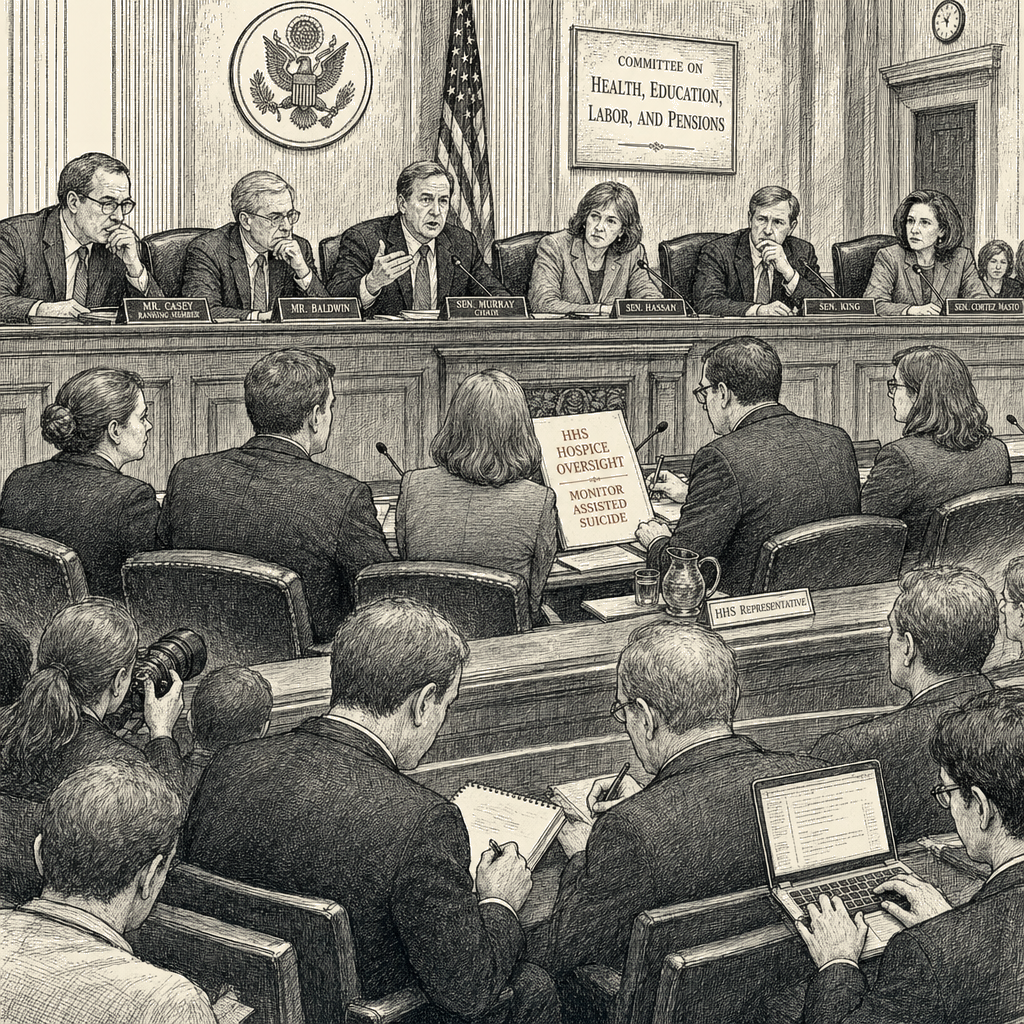
A bipartisan letter landed at Health and Human Services last week. Senator James Lankford, a Republican of Oklahoma; Senator Tim Kaine, a Democrat of Virginia; Representative Greg Murphy, a Republican of North Carolina; and Representative Jose Luis Correa, a Democrat of California, sent it to Secretary Robert F. Kennedy Jr. They are asking whether insurance carriers are denying life-sustaining care to older and disabled Americans while covering the cost of the lethal prescriptions that physician-assisted suicide laws in thirteen states and the District of Columbia — including New York and California — now make available. They are asking whether the witness requirement, designed to confirm voluntariness, actually protects an elderly patient whose witnesses stand to inherit under a will or collect on a life insurance policy. They are asking whether federal funds, which are legally barred from subsidizing the practice, are nonetheless subsidizing it through hospice reimbursement structures that bundle the lethal prescription into a per-diem payment.
The letter is correct. What the letter does not say, because it is a letter and not an indictment, is that what they are describing is not a bug in the American healthcare apparatus. It is the apparatus working as designed.
The arithmetic is straightforward and it is not subtle. A terminally ill patient on a private insurance plan, on Medicare, or on Medicaid generates costs that compound: hospital stays, specialists, home health aides, durable medical equipment, palliative care, the slow months of hospice support that good hospice actually provides. The aggregate cost over a year of dying in the American system runs at high five figures for an uncomplicated death, low six figures for the kind of complicated dying that brings a patient onto hospice in the first place. The aggregate cost of the lethal prescription is a price the dispensing pharmacy charges in the hundreds of dollars. The arithmetic is what makes the cheap exit cheap. We do not need a conspiracy to explain the incentives. We need only a hospice that files a prior authorization denial, an insurer that approves the cheaper line item, and a regulator that has chosen not to disaggregate what it paid for.
The apparatus is not giving the patient a medical choice. The apparatus is presenting a financial eviction notice and calling it autonomy. The trade the industry prefers names this death with dignity, the right to choose, patient autonomy. The publication’s catalog, drawing on the work of George Lakoff and Frank Luntz, names the move for what it is: frame-engineered relabeling — the deliberate substitution of a term carrying different connotations to shift the cognitive frame and sanitize the accounting. The “death with dignity” that funds the lethal prescription and the financial liquidation that the insurer and the hospice perform are the same transaction, rendered in the vocabulary that makes it possible to perform. When the state funds the exit and refuses to fund the life, it has stopped speaking the language of compassion and started speaking the language of accounting.
The number that anchors the scale is a floor, not a ceiling. According to the nonprofit Aging With Dignity, which has been doing the federal government’s work for it, at least 14,446 Americans have died by physician-assisted suicide since Oregon’s Death with Dignity Act took effect in 1997. Several of the states that permit the practice report inconsistently or not at all. The federal government, which pays for the hospice encounters in which most of these deaths occur, does not maintain a separate statistical series for them. The Centers for Medicare and Medicaid Services know what they paid for. They have chosen not to disaggregate what they paid for, in the deaths, from what they paid for, in the months of care preceding them.
The same recognition this column is reaching for has begun to surface elsewhere. Earlier this summer, a Canadian panel recommended the indefinite exclusion of mental illness from that country’s assisted-dying regime — not because mental illness cannot be a legitimate source of suffering, but because the structural safeguards that protect a patient with a sound mind from coercion and from an internalized sense that they are a burden do not survive the cognitive distortions that severe mental illness can produce. The Canadian panel reached for what the American disability community has been reaching for, in writing, since 1997: a recognition that the right to die, as the regime frames it, can become the obligation to die, as the financing works it.
The disability community has been the most consistent voice on this in the United States for three decades. The Lankford-Kaine letter quotes the warning the community has been issuing since the Oregon law took effect: the legalization of physician-assisted suicide, in the absence of robust disability-protection enforcement, sends the message that the lives of persons with disabilities are less valued. The warning is not theoretical. A patient with a disability who qualifies for assisted suicide in any of the permitting states has already cleared a medical threshold that defines their life, in the state’s view, as one a physician has certified is not worth extending. The state has not said so. The state’s eligibility criteria have said so.
The diagnosis that runs through this is older than the apparatus. In April 1967, standing in the pulpit of Riverside Church in New York, Martin Luther King Jr. named his own government the greatest purveyor of violence in the world. The sentence that cost him most of his remaining political capital was not about the violence of bombs. It was about the violence of an economic order that could not be trusted with the question of when human beings should die, because the order had already decided that the human beings were instruments of someone else’s ledger. King called out, in that same period, what he called the giant triplets of racism, extreme materialism, and militarism. The triplets are not separable. A society that values its quarterly returns above the human beings who tend them does not have a racism problem, a poverty problem, and a war problem. It has a single, three-headed pathology, and it cannot kill one head while feeding the other two. A society that puts its ledgers ahead of its patients is in spiritual hospice — the appropriations bill a moral X-ray, the country’s soul legible in what it funds and what it refuses to fund. To his SCLC staff in 1966, King said that there is no honest discussion of ending the slums that does not begin by taking the profit out of them. The same sentence, transposed, is the test for any hospice policy that wants to be called compassionate: if the profit motive in assisted dying is still intact at the end of the policy, the policy has failed.
We have built our own modern Allocator. A Star Trek episode built its central machine around an alien hospital’s rationing algorithm, one that assigned each patient a Treatment Coefficient based on social value — the poor, the disabled, the dying falling to the bottom of the list, the comfortable rising to the top. The American Allocator does not announce itself. It files a prior authorization denial, invokes the vocabulary of dignity to hide the Treatment Coefficient, and lets the ledger balance itself in body bags. The denial does the work.
Malcolm X looked at the mechanisms of power and refused the euphemisms. He did not call a forced removal a voluntary relocation. He did not call a state-administered death a dignified choice. We do not have to call a coerced death a dignified choice. The lawmakers noted their concern over witness requirements, pointing out that witnesses could benefit financially from the patient’s will or life insurance. That is not a bug in the system. That is the system completing the circuit. The patient dies; the estate is settled; the ledger is cleared. A witness who stands to inherit, a hospice that stands to close the case, an insurer that stands to close the file — the incentives converge on the same outcome, and the outcome is a cheaper line item.
The obstacle to hospice oversight today is not the lawmaker who opposes assisted suicide on principle. It is the regulator who would prefer the absence of data to the presence of a number that ends a political arrangement. King, in the letter he wrote from the Birmingham jail cell in April 1963, named the chief obstacle to justice as not the segregationist with a bomb but the white moderate, who preferred the absence of disturbance to the presence of justice. The federal agencies that should be monitoring the conflict the Lankford-Kaine letter names have looked away from it for years. The Centers for Medicare and Medicaid Services have the authority, without new legislation and without new appropriation, to require hospices to report separately on assisted-suicide encounters; on the cost of care in the ninety days preceding them; on the insurance status of the patients who die; on the relationship of the witnesses to the deceased; and on the demographic composition of the patients who use the law relative to the demographic composition of the patients who die of the underlying illness without it. None of those reporting requirements requires an act of Congress. All of them require that an agency which has chosen not to see be told, by its secretary, that it is going to see.
The Beloved Community does not balance its budget on the bodies of its elders. It does not fund the exit while defunding the life. King said the arc of the moral universe bends toward justice. King was right, and King was incomplete. The arc bends only when specific people, in a specific moment, push it. Kennedy is one of those people, at one of those moments, on this question. The disability community that has waited three decades for the data to be collected is owed the pushing. We must name the ledger for what it is. We must demand that the right to live is not conditioned on the cost of the care. By any means necessary that operate within the analytical and political instruments available to us, we must shut down the liquidation of the vulnerable and refuse the frame that calls it mercy.