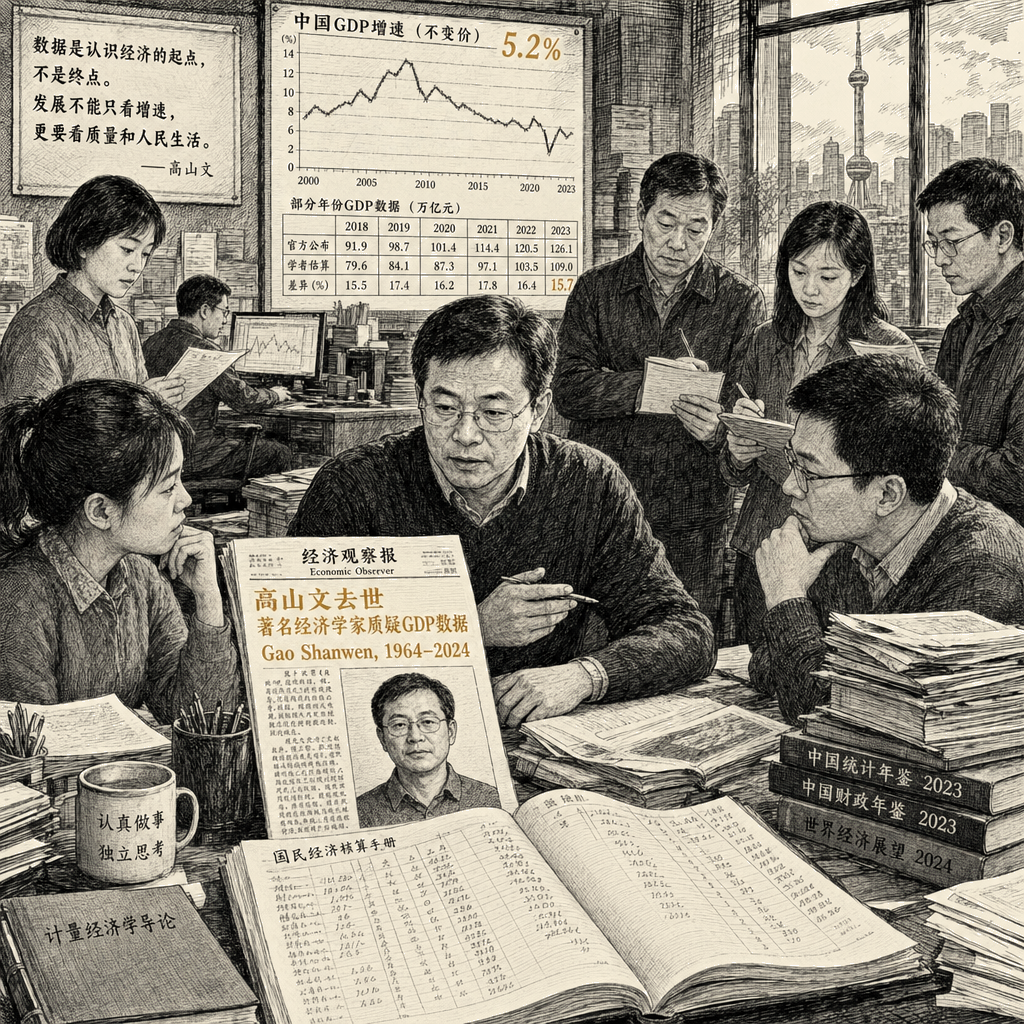
Gao Shanwen made his most damaging claim in December 2024, at a Washington forum hosted by the Peterson Institute for International Economics. China’s real GDP growth, the then-chief economist of SDIC Securities said out loud, was probably running at less than half the official figure — perhaps around 2%, not the nearly 5% Beijing was claiming. He went further, questioning whether the leadership had the will to deliver the stimulus it kept promising.
It was the kind of observation that in most economies would be debated, disputed, maybe proven wrong. In Xi Jinping’s China, it was a provocation. Beijing sets an annual growth target — usually around 5% — and year after year reports a figure that lands almost exactly on it. The machinery of economic truth has been optimized not for accuracy but for narrative control, and Gao had just thrown a wrench into it in front of an international audience.
Xi was furious. He ordered an investigation that was carried out immediately by his chief of staff, Cai Qi. Gao was banned from speaking publicly. A university lecture he was due to give was abruptly canceled, blamed on his “personal schedule.” He vanished from public view for months.
But the line that captured Gao’s insight most precisely came years earlier, in a 2019 conversation about why Xi’s promised market reforms had never materialized. State-owned enterprises, Gao said, were “the legs of the Communist Party.” You don’t amputate your own legs.
That was why Xi kept leaning on the state sector as the centerpiece of his economic model, why the line between state and private kept blurring rather than sharpening, and why the official growth numbers had to be what they were. The Party needs the SOEs; the SOEs need the subsidies; the subsidies need the narrative of robust growth to justify themselves. Anyone who punctures that narrative threatens the whole structure.
This is the structural bind Gao understood better than almost anyone. Genuine market reform would mean allowing state-owned giants — bloated, subsidized, first in line for bank credit — to face real competition. It would mean accepting that some would fail. But those enterprises aren’t just economic actors; they’re political instruments, the mechanism through which the Party maintains control over the commanding heights of the economy. Reforming them isn’t an economic question. It’s an existential one.
The consequences of that bind ripple outward. When you can’t reform, you can’t generate the organic growth the economy needs. When you can’t generate organic growth, you fabricate it. When you fabricate it, anyone who says so out loud becomes a threat. The crackdown on what authorities call “unprofessional” economists has, if anything, accelerated since Gao’s punishment, with regulators warning brokerages to keep analysts “positive.” Xi’s anti-corruption purge — which has hit record levels and now explicitly targets political loyalty — is the enforcement side of the same coin. The Party demands not just compliance but belief.
The timing of Gao’s silencing was particularly revealing. It came during a period when Beijing was simultaneously pursuing stabilized trade relations with the Trump administration — a summit in May 2025 that required projecting economic confidence to an American audience that was growing louder about the unfair advantages China’s state subsidies provided. A Chinese economist telling a Washington audience that the growth numbers were fiction was not just embarrassing. It was strategically dangerous.
After his punishment, Gao surfaced only once more — in a subdued video address to a Peking University forum in September 2025. He stepped down from SDIC in November. The formal diagnosis, stage IV T-cell lymphoma, came in December. He died on July 7, at 55.
I don’t think anyone can, or should, draw a straight medical line from a Communist Party censure to a cancer diagnosis. But the coincidence lingers: a man punished for insisting on honest numbers, spending his final year unable to speak in public, his illness advancing in the silence.
Gao spent three decades reading China’s economy more clearly than the state wanted it to be read — first at the People’s Bank of China, then at Everbright Securities, then at SDIC, where his research notes moved markets in a way few economists’ do. He was right about the asset-price cycles. He was right about the legs of the Party. And he was right about the GDP numbers, a call that cost him his voice in the final year of his life.
Tributes have poured across Chinese social media. On Xiaohongshu, an Instagram-like app also known as RedNote, one comment, echoed by many others, called Gao “a rare economist who spoke the truth,” adding that these days “only the ‘optimist’ economists are left.” That the censors have, so far, let much of this stand feels like their own small verdict on how ordinary people in China have come to regard official statistics, and the people who dare to challenge them.
Some in the country’s finance circles described him as the field’s version of Zhuge Liang, the third-century strategist whose reputation for uncanny foresight has endured in Chinese lore for centuries. People trusted his read on the economy precisely because he was more interested in being right than in sounding reassuring. In Xi’s China, that quality is not a professional virtue. It is a liability.
Beijing shows little sign of changing how it reports growth. The campaign to silence critical economists has intensified. The regulatory apparatus that punishes honesty grows more sophisticated by the quarter. The structural incentives haven’t changed — the Party still needs its legs, still needs the numbers, still needs the world to believe the story.
Gao’s old line about the Party’s legs still explains more than any propaganda directive: a government that can’t bear to hear the truth about its economy is never going to change how it’s run. His silencing wasn’t an aberration. It was the system working as designed. The Party needs state-owned enterprises as its legs. It needs growth figures that validate its model. It needs the world to believe. Anyone who threatens that narrative threatens the regime itself.
Gao Shanwen told the truth. The truth didn’t change. But the man who said it is gone, and the machinery that silenced him grinds on.