Beijing is expelling the journalists that American workers need to know the truth about China.
Lingling Wei was the Wall Street Journal’s chief China correspondent. The Communist Party kicked her out in 2020 for doing her job. In May, when the president flew to Beijing to meet Xi Jinping, she applied for the visa to go back and cover it. They said no. They said it was payback.
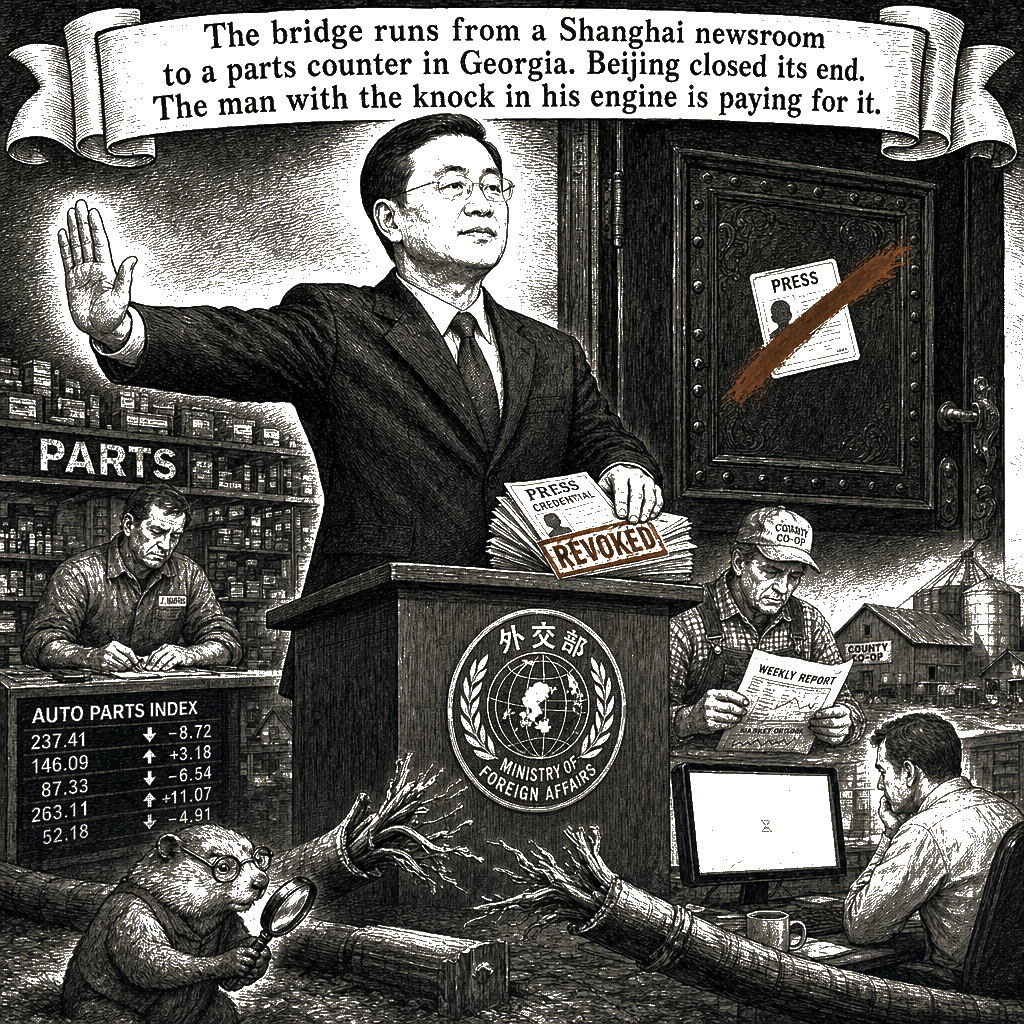
This is not one story. It is the same story as the arrest in June of an American scholar-journalist on espionage suspicion and the tit-for-tat visa revocations that emptied both newsrooms in May. Beijing boots an American reporter. Washington boots a Chinese one back. Each side tells itself it is standing up to the other. What each side is actually doing is tearing down the only bridge that lets either side see straight.
Let me tell you what that bridge does. It is not some abstract thing. It runs straight through a shop like mine.
A man walks into my shop in Redemption Springs, Georgia, with a knock in his engine. I open the hood, and the parts I am pulling out of the bin came across the Pacific in a steel box. The cost of that box is set in a market I can read in a week-old report or I can read in real time. The week-old report comes from a journalist on the ground in Shanghai. The real-time one comes from somebody’s cousin with a phone. I know which one I trust when I am pricing a job.
Take that reporter out. The week-old report turns into a month-old report. The month-old report turns into nothing. Then the man at the parts counter is making decisions about a thousand dollars’ worth of inventory on a hunch and a rumor. That is the squeeze. It does not show up in a press release. It shows up in the price I have to charge for a brake job, which is what the customer in the waiting area is paying, which is what the auto-parts warehouse worker in Doraville is making, which is what the truck driver on I-20 hauling the next container is being asked to do for less.
It is the same bridge the farmer at the county co-op needs to read whether China is actually buying the soybeans he is planting. The same bridge the freight forwarder in Savannah needs to read whether the next round of port fees is a warning or a one-off. The same bridge the compliance officer at the regional bank needs to read whether the wire transfer she is clearing is part of the cross-border system Beijing is building to undercut the dollar.
You cannot do any of those jobs blind. You can do them wrong. You will do them wrong, and the cost of being wrong lands on a hundred people who never read a single story out of Beijing.
The Party in Beijing thinks it is silencing its critics. It is silencing the people who would tell it what is about to happen. The same correspondent who writes the story you read about the yuan-denominated sanctions-evasion rail is the correspondent who would have told Beijing’s finance ministry whether the rest of the world is taking that rail seriously or is just routing around it. Expel her, and the regime loses the reporter. It also loses the mirror. A regime that cannot see itself through other people’s eyes is a regime that is going to repeat the same mistake four times before it figures out what worked.
I have seen this before. My country went into Iraq in 2003 with a story about weapons that were not there. The people who would have checked that story were told to stand down. The country paid for the lie, and the soldiers paid first. Beijing is doing the same thing in slow motion, and the people who will pay first are the ones in the small towns and the shop floors who depended on the reporter to tell them the truth they were not going to get anywhere else.
I do not know what comes next for Lingling Wei. I know this. Every time Beijing closes the door on a reporter, it moves the cost of the next bad decision onto a working person who had no vote in the closing. That is the bill. It is being run up right now, and it will come due in places like the one I live in.