
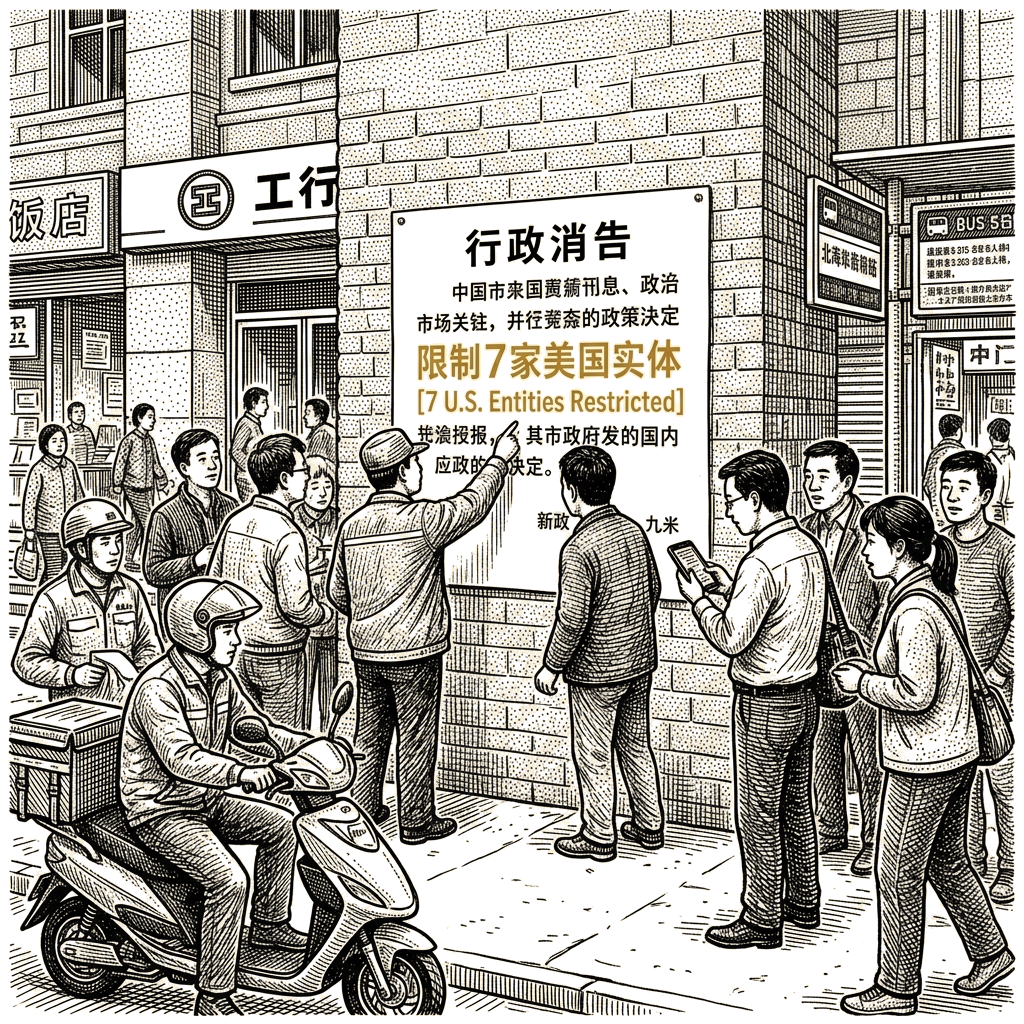
China is retaliating against U.S. human-rights groups and businesses over American sanctions.
Beijing’s Ministry of Commerce has banned commercial and institutional dealings with seven U.S. companies and organizations, accusing them of supporting American measures against China. Applied DNA Sciences, Stratum Reservoir, Altana Technologies, the Responsible Business Alliance, Verité, Human Rights in China, and Compliance Testing are now targets of a government retaliation campaign whose allegations remain largely undisclosed.
That is the important part. China has not publicly explained what conduct by most of these entities supposedly warrants punishment. It has announced the penalty first and left the evidence behind the curtain.
The timing makes the purpose plain. The measures came less than a week after the United States added 43 companies to the Uyghur Forced Labor Prevention Act Entity List. That list blocks imports connected to the presumption that goods were made with Uyghur forced labor in Xinjiang. Beijing answered by treating companies, a business-alliance organization, and Human Rights in China as instruments of American aggression.
Human Rights in China was founded in 1989. It works on human rights and corporate accountability. The organization said the sanctions were an attempt to intimidate and silence groups working to keep forced labor out of international commerce. By sanctioning an organization that advocates on human rights and corporate accountability while leaving the alleged conduct largely unexplained, Beijing signals that organizations and businesses challenging its account may face costs.
The record on Xinjiang is not a dispute over a tariff schedule. The U.S. State Department declared China’s treatment of Uyghurs a genocide in 2021. The supplied account describes allegations of arbitrary imprisonment, forced sterilization, forced labor, forced detention, and restrictions on religion, expression, and movement. China says the camps are for education and training. That denial does not answer the evidence. It answers the accusation with a different description.
The United States has its own national-security overreach, and Washington should not receive a blank check merely because Beijing is worse. The Federal Communications Commission banned foreign-made humanoid robots and power inverters on July 28, a decision critics said specifically targeted China. The Trump administration is also reported to be drafting restrictions on Chinese data-center components. Those policies deserve evidence, legal authority, and public scrutiny.
But China’s response is not a defense of open commerce. It is the use of market access as a disciplinary weapon. The government is telling firms that trade with China depends on silence about the people who make goods in Xinjiang and on obedience to Beijing’s account of its own conduct.
China has done this before in a different form, and its latest retaliation against U.S. companies shows the pattern tightening. The sequence is now familiar: an export control or human-rights restriction from Washington, a countermeasure from Beijing, and a wider group of commercial actors pulled into the punishment. The result is not stable competition. It is a system in which businesses become hostages to state rivalry.
A measure that cannot distinguish between a defense contractor, a compliance tester, a business association, and a human-rights organization is not precision policy. It is punishment designed to raise the cost of opposition.
A constitutional posture would require public reasons, accessible evidence, independent review, and a clear distinction between a company’s documented conduct and an organization’s protected advocacy. It would require the same standard for Washington and Beijing. National security cannot become a magic phrase that ends the inquiry.
The U.S. action was an expansion of the Uyghur Forced Labor Prevention Act Entity List, while China’s announcement leaves the alleged conduct of most sanctioned entities unexplained. That gap is not a technical defect. It is the mechanism of intimidation.
Xi Jinping is expected to visit Washington on September 24 to discuss artificial intelligence, technology, and global economic relations. The meeting will be described in the language of competition between great powers.
The people in Xinjiang will remain the cost that both governments ask everyone else to stop counting.