
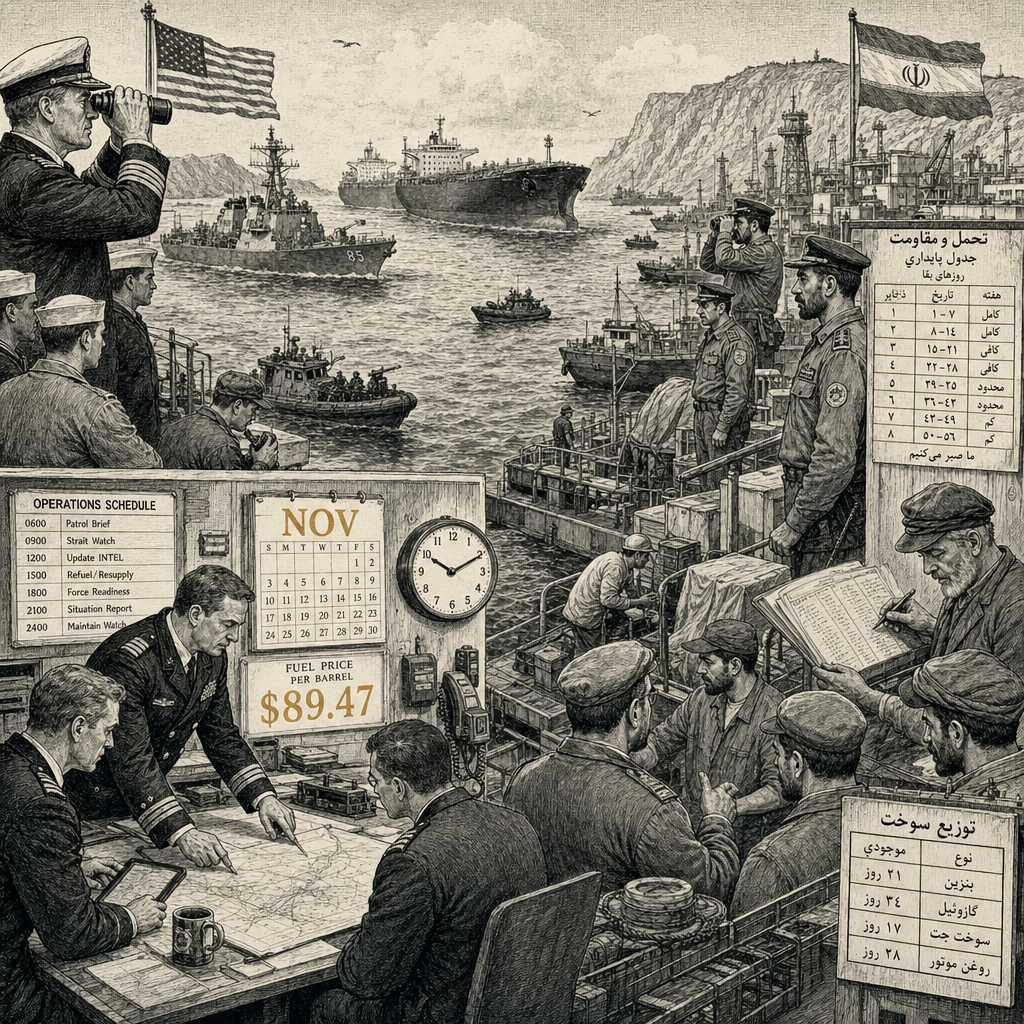
Trump and Khamenei are killing people in the Strait of Hormuz to buy time. Now, I’m just a simple man, but I know what a grinding war looks like when nobody’s winning and nobody’s willing to stop, because that is what is happening on the water right now.
Brent crude hit $84.73 a barrel this week, up more than 11% in two days. Eight hundred ships have been shepherded through the narrow waterway by American military escorts along the southern route off the coast of Oman — and Iranian missiles and drones are still hitting vessels fast enough that some attacks cannot be stopped. Crew members are being killed and injured. Tehran wants the ships to go through the northern passage, which hugs Iran’s coast, where it can control the traffic. The U.S. wants them on the Omani side — 800 ships escorted through in two months, a massive logistical effort that is still not enough, because ships are still being struck. A naval blockade has been reimposed. And both sides have concluded, in the measured language of strategic analysis, that resuming the conflict at low level while waiting for the other to buckle is the best course available. The ceasefire that Trump declared on life support back in May has now fully crumbled.
That sentence should stop every reader cold. Both sides have decided that continuing to fight is better than stopping. Not because the fight serves the nations they govern, but because stopping would cost the men making the decision their hold on power.
Barbara Tuchman, in The March of Folly, identified the signature of policy that has lost its purpose: a course of action that continues past the point at which alternatives are available and named. Both Washington and Tehran have named the alternatives. Both have rejected them. The war grinds on not because it advances American or Iranian interests, but because the political cost of stopping exceeds the political cost of the next sailor killed, the next tanker hit, the next day of oil prices climbing toward levels that hurt American families and Iranian families alike.
Thomas Schelling, in The Strategy of Conflict, described the logic of brinkmanship as a competition in generated risk, each side making the other believe it will not stop. What is operating in Hormuz is the dark mirror of that logic. Neither side is escalating to win. Both are maintaining just enough violence to avoid looking weak while waiting for the other’s political clock to run out. Trump needs resolution before the November midterms and before oil prices spike further into the pain American voters feel at the pump. Khamenei needs to outlast the blockade before Iran’s economy collapses, without provoking the kind of large-scale American-Israeli strike that could topple the Islamic government. Both men are fighting for time, not for the strategic objectives they originally claimed.
Alan Eyre, a former senior State Department negotiator with Iran now at the Middle East Institute, put it plainly: the U.S. “won’t risk” the sharp military increase needed to stop Iranian threats “for reasons rooted in domestic politics.” The domestic politics he means: the midterms. That single sentence is the thesis of this piece in miniature — the United States will not do what it takes to win because winning would cost more politically than continuing to lose.
Andrew Bacevich, in Washington Rules, described the structural pattern by which American wars persist past their strategic logic. The pattern does not depend on any single decision-maker choosing perpetual conflict. It depends on the institutional infrastructure of war, which creates its own momentum. What “too fast to stop” means in the Hormuz: a missile fired from an Iranian truck launcher on the coast has a flight time measured in seconds. The Pentagon’s interceptors have to be in the right place before the missile is launched. They have not been. The crews of the ships struck by these missiles are the ones paying the cost of that timing mismatch. The Pentagon needs its guided-missile destroyers to both escort shipping lanes and enforce the blockade. It cannot do both. It is running short of the interceptors needed to knock down Iranian coastal-defense missiles. These are not strategic choices. They are the material consequences of decades of defense-industrial decisions that produced a military built for short, decisive campaigns and now trapped in an endurance contest it was never designed to fight.
Eisenhower, in his farewell address of January 17, 1961, warned against the acquisition of unwarranted influence by the military-industrial complex. Sixty-five years later, the complex he warned of is not whispering in the ears of congressmen. It is the reason a naval blockade and a convoy escort mission cannot share the same destroyers. It is the reason interceptor stocks cannot be replenished at the tempo the conflict demands. The war continues not because it serves either nation, but because stopping would require a political decision that neither Trump nor Khamenei is willing to pay the price for. A constitutional republic was built to weigh costs against purposes and choose, not to let institutional momentum grind forward while its leaders count the calendar.
Which is how you get a blockade that cannot be enforced and a convoy escort that cannot be sustained, both running simultaneously because neither side will be the one to stop.
The ships keep moving through the strait with American warships alongside. The missiles keep flying from the Iranian coast. Oil keeps climbing. Both capitals keep talking about resolve and strength. But the arithmetic is plain: two governments are spending human lives to avoid a choice that their own political survival will not let them make. That is not strategy. That is what strategy looks like when it has been abandoned for something far less noble.