
Trump is bombing the Strait of Hormuz and calling it open.
Twenty-one vessels crossed the strait on Tuesday, according to ship-tracker Kpler, down from a daily average of thirty last week. Of those twenty-one, not one used the route the U.S. military backs near Oman. Sixteen sailed through Iran’s approved channel, close to its coast. The rest found some other way or stayed put. When U.S. forces broadcast over marine radio that the “southern route of the strait remains open,” one sailor responded in terms that every man and woman who has spent time on a military radio net would recognize as the honest answer to a dishonest broadcast.
The Pentagon says Iran has killed, wounded, or left missing nearly a dozen seafarers in recent days. Not generals. Not senators. Seafarers — the men and women who work the decks and engine rooms of oil tankers and container ships, who do the job that keeps gasoline and groceries moving through the pipes of the world. They are dead or wounded because two governments are playing chicken with a waterway, and the people who actually make their living on the water are the ones bleeding for it.
U.S. Central Command has launched more than twenty thousand airstrikes, including a seven-hour bombardment early Wednesday and a ninety-minute daytime follow-on, strikes the military describes as aimed at degrading Iran’s ability to hit commercial ships. Iran has declared the waterway closed and stepped up attacks on commercial vessels with cruise missiles and drones.
Now, I’m just a simple man who runs a shop, but I know the difference between a job done and a job claimed done. The shipping data says the job is not done. The seafarers are dead or wounded. The president is wrong.
And the people getting squeezed on the other end are not in the briefing room. They are at the pump. When you choke the strait that moves roughly a third of the world’s seaborne oil, the price of diesel goes up. The price of jet fuel goes up. The cost of shipping a load of anything from anywhere to anywhere goes up. The trucker pays it. The farmer pays it. The family filling a tank in Redemption Springs, Georgia, or wherever they are, pays it. The defense contractor does not pay it. The defense contractor gets paid.
Danny Citrinowicz, the former head of the Iran division of Israeli defense intelligence, told the Wall Street Journal the dilemma is “quite simple”: “if he wants to take control over the straits, he will need to take over the straits.” The force deployed cannot accomplish that. The options that could are the ones nobody in Washington wants to say out loud.
Close naval escorts would mean two warships per tanker, a dozen per convoy. Navy officers have warned that Iran’s drones and antiship missiles could turn the escort corridor into what the military calls a “kill box” — an area so saturated with enemy fire that anything moving through it is a target. Those warships have sailors on them. Americans. Somebody’s kids who signed up thinking they were defending the country, not escorting oil tankers through a kill zone their president built by bombing a strait he says is open.
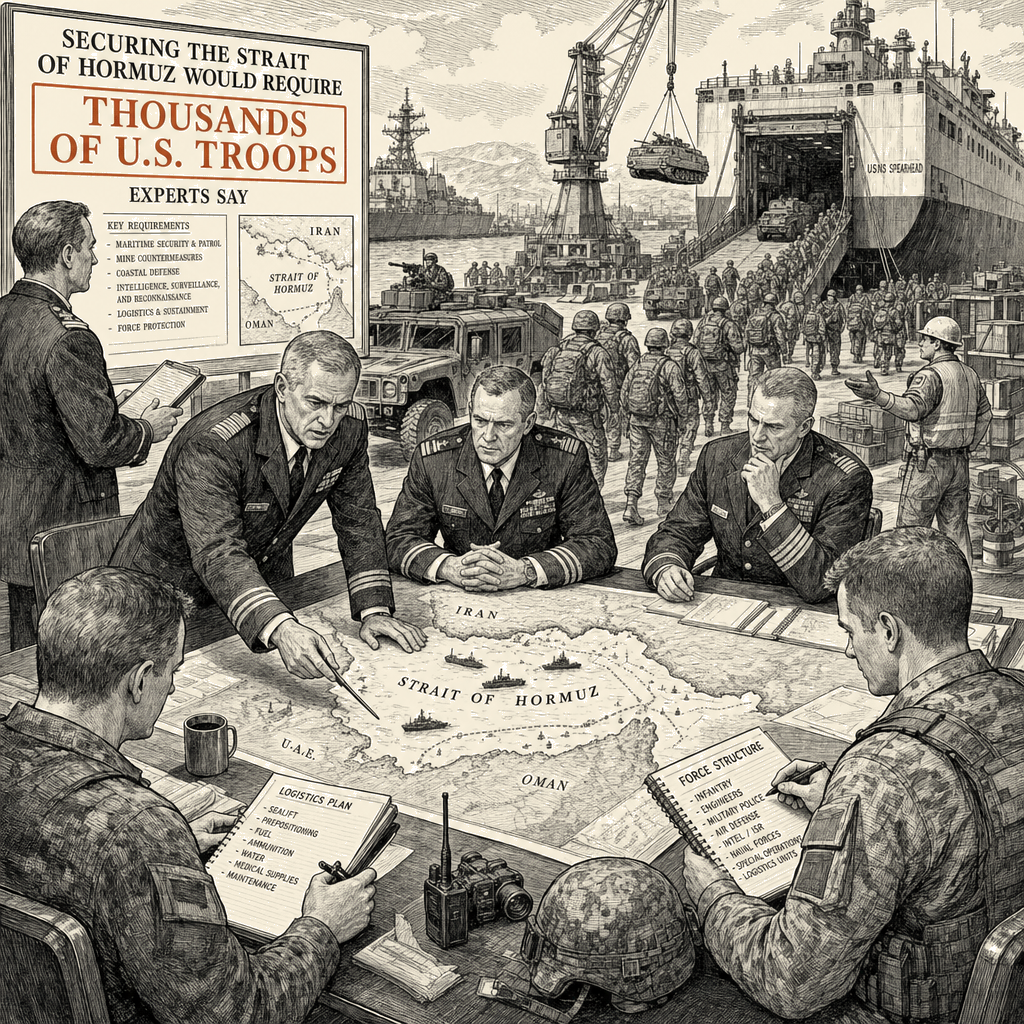
A ground operation to seize territory around the waterway would require thousands of troops, months of sustained operations, and a fight against the Islamic Revolutionary Guard Corps, which fields 190,000 troops and has spent decades learning to fight opponents with better equipment and more firepower. David Des Roches, a former U.S. defense official focused on the Persian Gulf, told the Journal that putting American forces on Iran’s coastline would leave them “extremely vulnerable to attacks from the country’s rear.”
Those are the actual choices. Not the ones the president is describing — that twenty thousand strikes and a claim of victory have produced an open strait — but the real ones: escort convoys into a kill box, or an invasion of southern Iran. There is no third option where the current force posture produces the outcome the president is announcing.
Any man who has worked a job where the boss insists the work is done when it plainly is not recognizes this pattern. The boss signs off. The customer comes back. The work was not done. Eisenhower, who ran a world war and then sat in the Oval Office where the bills come home, warned that the machinery of war develops a momentum of its own — the system does not ask whether the strike is working; it just strikes again. More than twenty thousand strikes and billions in sanctions relief have not moved Iran off that waterway. The administration’s answer is to strike more and announce the strait is open.
The shipping industry knows the strait is not open. The sailors on the radio know it. The men and women who will have to sail those tankers if anyone is foolish enough to try the route we are bombing know it. And the seafarers already dead are proof of it.
What would actually serve this republic is for someone in that briefing room to say what the situation plainly is: the strait is not open, the force deployed cannot open it, and the options that might open it require a commitment this country has not made and Congress has not authorized. That is what the Constitution requires. That is what the men on those ships deserve. That is what the families paying for this fight at the pump and at the grocery store deserve to hear. And that is what the seafarers who are already dead did not get.