
The chip selloff hit like a bucket of ice water Monday morning. The PHLX Semiconductor Index dropped 4.8%. Micron fell 4.4%. Intel dropped 6.1%. Sandisk cratered 13%. In South Korea, the Kospi lost nearly 9% overnight, with SK Hynix and Samsung Electronics leading the slide. The Nasdaq Composite, packed with the same names, gave up 408 points, or 1.55%, to 25,873.18.
This is the AI trade cracking under its own weight. Main Street warned this was coming back in April, when the same money that bid chip stocks to the moon was bidding oil to the heavens. Last month the markets tried to pretend the AI selloff and the oil shock were separate stories. They are not. They are the same story: a financial system that prints money for insiders and hands the bill to everybody else.
Look at the meta. Meta Platforms — the company that renamed itself to ride the AI hype — fell 1.9% Monday after admitting its Louisiana data center project has nearly doubled in cost to more than $50 billion. Five gigawatts of compute capacity. Five. For context, that is more electricity than some small countries consume. The grid cannot absorb it. The ratepayers cannot afford it. And the working families in Louisiana are about to learn what it means to host a five-gigawatt project whose primary product is stock buybacks and Zuckerberg’s metaverse fantasies.
Meanwhile, Taiwan Semiconductor’s June revenue jumped 68% year-over-year, hitting a record and implying Q2 revenue of $39.55 billion. TSMC is the foundry that actually builds the chips the AI trade is supposedly built on. The market sold its stock anyway. ADRs fell 2.9%. The market is not rewarding the AI supply chain. It is liquidating it.
And then the oil shock landed. President Trump reimposed a shipping blockade on Iran over the weekend and announced the U.S. would charge 20% of every cargo as “compensation” for guaranteeing safe passage through the Strait of Hormuz. Iran said it would not allow U.S. interference in managing the waterway. U.S. forces conducted fresh strikes on Iranian targets. Confirmed traffic through the strait fell by more than half over the weekend, according to ship-tracking firm Kpler, back to levels seen before the preliminary peace deal.
Brent crude jumped 9.6% to $83.30 a barrel. U.S. gasoline and diesel futures surged too, pushed higher by Ukraine’s intensifying air campaign against Russian refineries and the renewed Hormuz tensions. OPEC cut its global oil demand growth forecast to 780,000 barrels a day from 970,000 — and that is still the optimistic case. The IEA expects demand to decline by a million barrels a day this year. The EIA projects a contraction of 1.2 million barrels a day. The world is heading into a recession, and the oil futures curve knows it.
This is what a working-class recession looks like. Higher gas. Higher diesel. Higher shipping costs. Higher food costs. Higher everything that has to move. A 9.6% oil jump in a single day is not an abstraction for somebody driving to work, somebody heating a home, somebody trying to put food on the table.
Then there is the Fed. Governor Christopher Waller said Monday that a rate increase should be on the table if this week’s inflation data show price pressures remaining firm — his “clearest signal yet” that he could back a boost this summer. Core inflation has risen from 3% in December to 3.4% in May, and the increase predated the Iran war’s energy shock.
Markets are pricing in less than a 50% chance of a rate hike at the July meeting. But that pricing depends on the June CPI, due Tuesday, and on what Fed Chairman Kevin Warsh tells the House Financial Services Committee. The Fed is staring at an energy shock it cannot wish away, an AI bubble it helped inflate, and a labor market it is being told to manage by the same politicians who keep lighting fires abroad. Higher rates would crush working families still struggling with 3.4% core inflation. Lower rates would re-inflate the asset bubble that just cost a Main Street 401(k) another down day.
There is no good outcome here. The setup is rigged.
Bank earnings kick off Tuesday with JPMorgan, Goldman Sachs, Bank of America, Wells Fargo, and Citigroup all reporting before the open. The banks are the ones who sold the derivatives, packaged the loans, and structured the AI deals. Whatever they report will be presented as the verdict on the economy. The actual verdict is already on the board: chip stocks down double digits in places, oil up nearly 10% in a day, and the Fed threatening to raise rates into an energy shock.
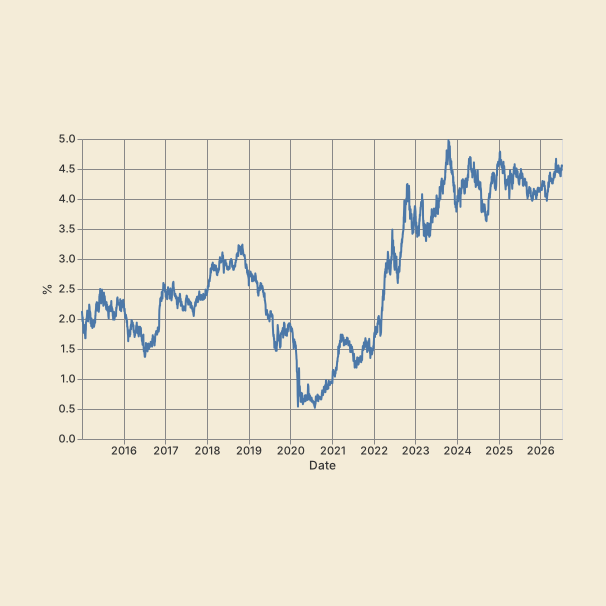
The Dow lost 138 points. The S&P 500 lost 60. The Nasdaq lost 408. Gold fell 2.6% to $3,997 a troy ounce — still shy of the symbolic $4,000 mark. The 10-year Treasury yield rose 4.6 basis points to 4.610%. The WSJ Dollar Index rose 0.27%.
Main Street watches the tape and wonders when the bill comes. It is already here. It is just being sent to the wrong address.