
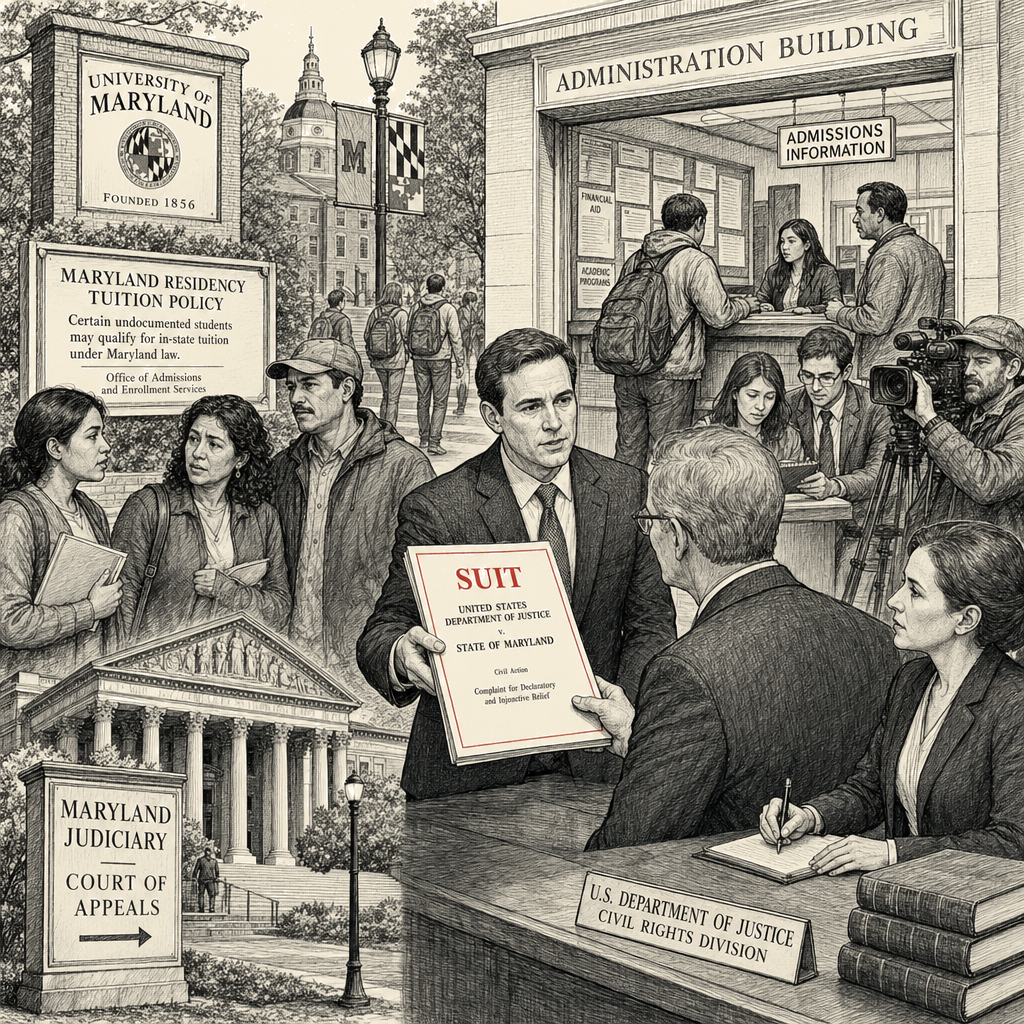
Trump is gutting college affordability while suing to block immigrant students. The Justice Department filed Thursday against Maryland’s DREAM Act — the state law letting qualifying undocumented graduates pay in-state tuition — the thirteenth such lawsuit the administration has brought against states with these laws on the books. Four have already been permanently enjoined. The government says Maryland’s law costs state taxpayers roughly $9 million per academic year.
The same administration that calls $9 million a crisis worth suing over has been dismantling the systems that make college affordable — and the damage dwarfs the number. Nine million dollars is what the Associate Attorney General put in the press release to frame the cost of subsidizing “illegal aliens” over American citizens. Maryland’s share of the federal IDEA shortfall alone runs into the hundreds of millions every year — a fifty-year failure to fund the 40 percent Congress promised in 1975, a shortfall that comes out of every other line in every public school budget in the state. The termination of the SAVE repayment plan will cost a single cohort of Maryland borrowers more than $9 million in increased annual payments. Against the state’s higher-education budget, the DOJ’s figure is less than one-tenth of one percent. The number is not the point. The point is who gets to go to college, and the administration’s answer — for undocumented students and citizens alike — is fewer people, at higher cost, with less help.
The Pell Grant, created in 1972, covered roughly 80 percent of the cost of attending a four-year public university. Today it covers roughly 25 to 30 percent. That gap — fifty percentage points, sustained across decades of bipartisan neglect and now accelerating under an administration that proposes to dismantle the Department of Education entirely — is the cost of college for a family like mine written in a single statistic. It is not a number the DOJ puts in its releases.
The administration has proposed caps on federal student loans and narrowed eligibility for Public Service Loan Forgiveness — a program whose initial denial rate was 99 percent, 28,913 applications and 289 approvals in its first year, whose expansion under the prior administration eventually discharged $87.6 billion for public servants who had done the work and made the payments. The executive order directing these tuition lawsuits frames the problem as fairness: American citizens are being denied benefits that go to undocumented immigrants. The record says American citizens are being denied benefits — by the same government wrapping itself in their name.
Maryland’s DREAM Act requires graduation from a Maryland high school, enrollment within six years, two years of state income-tax filings by the student or a parent, and a commitment to apply for permanent residency. These are the conditions of contributing to a place. My grandparents — immigrants who worked in Lansdale’s factories and sent their children to St. Stanislaus — would have recognized them, because they met the equivalent conditions of their own time. The federal government has decided, retroactively, that this kind of belonging does not count.
In state after state the DOJ has invoked the same 1996 federal statute, enacted the year Congress reformed welfare and a year after the Oklahoma City bombing, when immigration restriction was hardening into bipartisan reflex. The statute says states cannot offer in-state tuition to undocumented residents unless U.S. citizens from any state qualify for the same benefit. The legal argument is preemption. The political argument is the one doing the load-bearing work: the undocumented kid in the next classroom is why your tuition is high and your degree is worth less. That argument requires you not to look at the Pell Grant data. It requires you not to notice that the entity making it is the same one that has been defunding the pipeline for thirty years. It is a shell game, and the marble is your child’s future.
Taylor Swift wrote “You’re On Your Own, Kid” about the arc from young adulthood — waiting for someone to choose you, to validate the work — to the recognition that the validation is not coming and you build the life anyway. The title is the cleanest diagnostic the catalog offers for American education policy as it operates in 2026. The Pell Grant will cover a quarter of what it covered when your parents were planning. The repayment plan will change three times before you finish your degree. The loan forgiveness program you enrolled in will be litigated, enjoined, settled, and relabeled. And the administration that did all of that will sue your state for nine million dollars and call it protection.
My parents sent three children through parish school and Catholic high school on a postal supervisor’s income. The pipeline worked. I am running the numbers for Eva and Ben and the pipeline does not work. A fully funded Pell Grant, an IDEA appropriation that keeps its promise, a repayment plan that survives an election, a department that processes FAFSA — the pipeline’s parts are not complicated. The government that let them fail now says it is defending my children by suing to keep someone else’s children out. I sit at the kitchen table at night with the spreadsheet open, and the number says: you’re on your own, kid.