
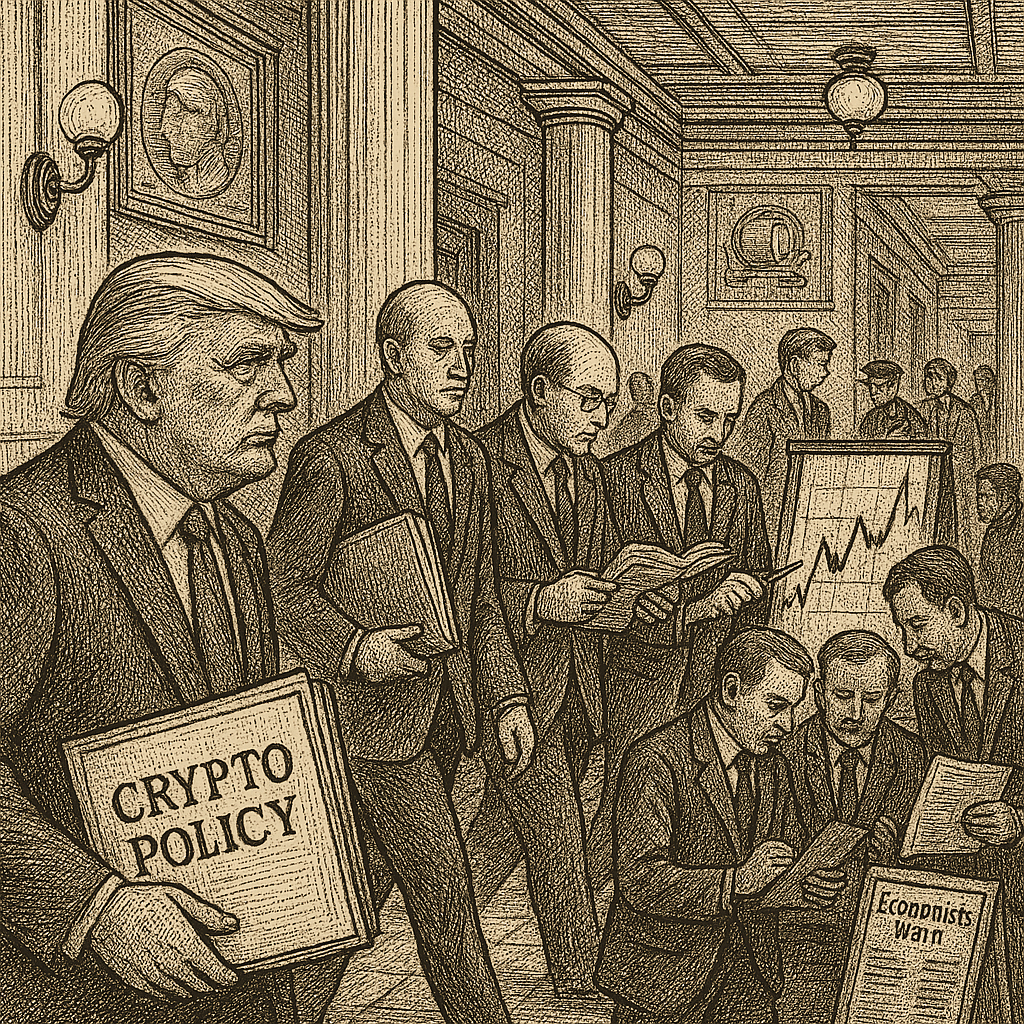
President Trump and a bipartisan congressional majority are gutting the regulatory separation between insured banking and uninsured crypto speculation, and the president is pocketing billions from the industry whose risk he is loading onto the public.
The Genius Act, passed with 206 Republican and 102 Democratic votes, does what its name advertises: it rewrites banking law so that almost anyone — banks, non-banks, even retailers — can issue a stablecoin pegged at one dollar and plug it into the ordinary payments system where household deposits live. The statute provides no FDIC coverage for those holdings. It mandates that issuers invest the proceeds in “high-quality assets,” but the mandate is only as durable as the supervision behind it, and the supervision apparatus is being dismantled in parallel. The president killed the Securities and Exchange Commission’s crypto-enforcement program, dismissed its crypto-related litigation, and gutted the unit that was supposed to oversee the industry. The Department of Justice has announced it will pull back money-laundering prosecutions against crypto platforms. The cop is being taken off the beat at the very moment the beat is being expanded into the insured core of the financial system. The transmission channel is direct: with enforcement dismantled, the expected cost of violating the “high-quality assets” mandate falls toward zero, which — for an issuer who is paid on volume and has no long equity — collapses the distinction between a Treasury-reserve portfolio and a reach-for-yield portfolio. The peg becomes more fragile precisely as the holdings become more systemically important.
The president’s stake in this expansion is not conjectural. His financial disclosure, reported by this publication last month, shows he earned $1.2 billion from crypto ventures during his first year in office — over half of his $2.2 billion total. He launched the crypto company World Liberty Financial, sold 49 percent to an investment firm tied to the United Arab Emirates for $500 million, and issued a memecoin that cost retail investors nearly $4 billion while netting him more than $600 million. The legislative architecture now being rushed through Congress — the Genius Act already law, the Clarity Act advancing — is the regulatory counterpart to that personal balance-sheet interest. The president is writing the rules for a market in which he is a dominant, non-blind participant.
The wonk‑laundering is legible. Stablecoins are presented as a payments innovation that will make international transfers faster and cheaper, and in a frictionless technical sense they will. What the efficiency narrative omits is the risk architecture that makes the innovation cheap. A stablecoin issuer is an uninsured depository institution operating a par‑value claim without a lender of last resort. The promise that the peg will hold because the proceeds are invested in Treasury bills is the promise of a money-market fund circa 2007, before the Treasury guarantee, before the runs. Gary Gorton of Yale and Jeffery Zhang of the University of Michigan have written that treating stablecoins as an innovation to be watched rather than a systemic risk to be contained “would be a terrible mistake.” Barry Eichengreen of Berkeley has warned that if panicked holders force a large issuer to dump its Treasury portfolio, the resulting price shock could destabilize the government bond market and the wider economy. That warning is not a hypothetical; it is an extrapolation from a century of financial-crisis forensics.
The regulatory safe harbor the Clarity Act would provide for more speculative crypto assets extends the same logic: authorize the activity, call it innovation, and leave the public holding the tail risk while the originators cash out — the second laundering cycle in an industry that has made transparency its enemy. The financial‑regulatory substrate the publication catalogs — Admati and Hellwig on the illusion that supervision can substitute for equity, Levitin on “valid‑when‑made” as a regulatory-perimeter problem disguised as federalism, Aaron Klein of the Brookings Institution on the structural conflict when a regulator also operates a payment system — equips a reader to see this as a capture operation, not a technology rollout. The bank lobby that once complained about capital requirements now sees stablecoins as a way to reclaim payment volume lost to fintechs. The tech platforms see them as a way to embed a banking function without a bank charter. The president sees them as a revenue line. No one in the coalition has an incentive to price systemic fire risk.
The federal government could obtain the real‑time settlement benefits without the systemic fragility by having the Federal Reserve issue a digital dollar, fully backed by the sovereign’s credit — an instrument that would carry no run risk, require no bespoke supervision of hundreds of private issuers, and eliminate the incentive to reach for yield on the reserve portfolio. The legislative path now being taken instead is the one that preserves the president’s ability to extract another few billion from the architecture. The Genius Act passed with precisely the bipartisan coalition that a capture operation predicts. The president’s financial disclosure makes the quid legible. The regulatory rollback supplies the quo.
A banking system that depends for its stability on the forbearance of a president who is the chief beneficiary of the deregulation is a banking system that has been hollowed out from the inside. The receipts are in the statute, the disclosure, and the enforcement docket. The indictment is the choice of architecture.
—Eduardo Porter is an economics and politics journalist covering the intersection of policy, markets, and power. He writes the newsletter Being There on Substack.