Alabama’s state legislators called the state’s Black-majority capital “monkey town.” The Supreme Court allowed the map their text messages produced to stand.
And here is what that outcome looks like on the ground.
When 19-year-old De’Mari Benham cut his arm on a shattered glass door in Tuskegee, the firefighters bandaged him at the station and told him what everyone in the Black Belt already knows: you need a hospital for stitches, and the hospital is in the next town over, and it costs money you do not have. He stayed home. In the Black Belt of Alabama, the distance between a wound and its treatment is measured in miles and dollars and the question of whether the congressman who secured your local hospital its first MRI machine will still be there when you finally need it.
That congressman is Shomari Figures, the first Black representative for Tuskegee in modern history. In one term, he secured a million dollars for a civic center that would house the fire department and serve as a storm shelter in a town where the fire chief says “we need a building.” He secured five hundred thousand dollars for an MRI machine at Eufaula’s struggling Medical Center Barbour, whose CEO says the machine will improve patient care and raise revenue. He showed up. Eufaula’s Republican-leaning mayor said he saw Figures in his city four times in one term, which is four times more than he saw the previous congressman.
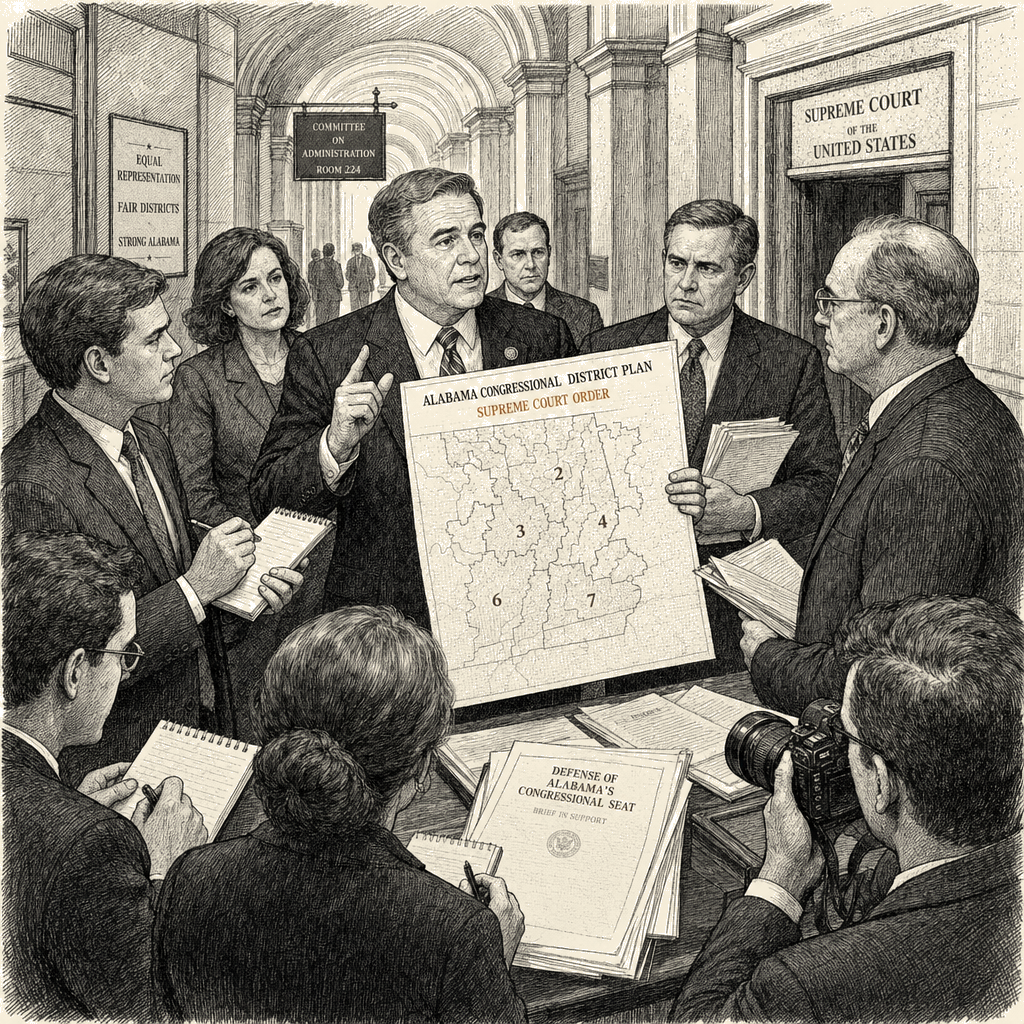
The Republican Party of Alabama, with the blessing of the Supreme Court of the United States, has decided that this representation is a problem that needs solving. The Court’s April ruling allowed the state to dissolve Figures’ majority-Black district, and the state acted immediately. Figures now faces a re-election campaign in a redrawn, white-majority seat against the winner of the August 11 Republican primary — state Representative Rhett Marques, endorsed by House Speaker Mike Johnson and President Donald Trump.
Let me trace the cui bono line. The concentrated beneficiaries are named. The Republican Party gains a seat. Marques gains a congressional office. The national GOP coalition that installed a conservative supermajority on the Court gets its return on investment.
The diffuse cost is carried by the people of the Black Belt. Black residents in Eufaula experience poverty at nearly fifty-seven percent — more than four times the rate of the white population. The people who depended on Figures to get a fire station that the city can actually use. The people who depend on a hospital that is finally getting an MRI machine after years without one. The people who, in the words of eighteen-year-old Deirdre Newcomb of Tuskegee University, are watching their votes become less powerful.
What does the public framing obscure? The state of Alabama calls the new map race-neutral. Steve Marshall, the state’s attorney general, told reporters the map is about partisan battles, not race. He pointed to Democratic redistricting in California as equivalent.
This is the whataboutism pattern analyzed by Yablokov: A criticizes B; B cites an alleged comparable fault without engaging the substance. The substance is in the record. During the redistricting process, state legislators exchanged text messages referring to Montgomery — the state capital, over sixty percent African American — as “monkey town.” A three-judge federal panel cited that evidence when it first blocked Alabama’s map. The Supreme Court saw that evidence and allowed the map to proceed anyway.
Let me name the second technique. The state’s argument is a classic motte-and-bailey, as Shackel defined it. The bailey is the proposition that a state with Alabama’s documented history of racial voter suppression and a fresh text-message paper trail of racial animus can be trusted to draw race-neutral maps. The motte is the narrower claim that partisan gerrymandering is not justiciable by federal courts. When challenged, retreat to the motte: “California does it too, this is just politics.” When the challenge subsides, resume the bailey: a map that eliminates a Black-majority district and leaves every white Republican seat intact is, in its design and its effect, the same project that has run through Alabama since Reconstruction.
Cedric Coley of the Alabama Young Republicans said he would rather have “family disputes with the people of Alabama” than have federal judges intervene. This is the pre-emptive legitimacy-withdrawal pattern — the institution of the federal judiciary is declared illegitimate for its enforcement of civil rights law, not because the judges erred in their reasoning but because they are judges at all and the subject is voting. When you withdraw legitimacy pre-emptively, you never have to engage the evidence. You do not have to explain why the text message calling Montgomery “monkey town” was not racial. You only have to say that the people who read it and found it significant had no business reading it.
Barry Moore, the previous representative who is now running for Senate and whose seat Figures took, told local media that “elections should be determined by Alabama’s values and candidates’ ideas, not the color of anyone’s skin.” That sentence is Alabama’s values speaking. It is the colorblind rhetoric that has been used to defend every racial gerrymander since the Voting Rights Act was first challenged. It is the language of the plausible-deniability project: say the right things, produce a map that does the wrong things, and if someone leaves a trail of text messages calling the district “monkey town,” trust the process to bury it.
King wrote from the Birmingham jail in 1963 that “justice too long delayed is justice denied.” The delay in this instance has been systematic. Shelby County v. Holder in 2013 gutted the Voting Rights Act’s preclearance regime, as this publication has documented since the ruling was handed down. The Court’s April ruling — which this column examined at the time of its release — has gone further, holding that even documented evidence of racial intent does not require the federal judiciary to intervene in a state’s redistricting process. The Voting Rights Act survives in statute. Its enforcement capacity has been dismantled piece by piece, term by term, until the guarantee it was supposed to provide is a procedural formality that no longer restrains the behavior it was designed to prevent.
Sixty-two miles east of Tuskegee, in Eufaula, a white mob fired hundreds of rounds into a group of Black men headed to vote in 1874 and killed six of them. The population is now roughly equal — forty-five percent white, forty-five percent Black — but the inequality is structural. Black residents experience poverty at nearly fifty-seven percent, more than four times the white rate. Mary Porter, seventy-one, who marched as a child to pass the Voting Rights Act in 1965, lives on a fixed income with no car, relies on God and friends to reach a doctor fifty miles away, and has survived two strokes without an MRI machine in her local hospital until Figures got the funding for one.
The line from 1874 to 2026 is not a straight line, but it is traceable. The mechanism changes — a mob with rifles, a legislature with text messages, a Supreme Court with a doctrine — but the project remains the same: the people who hold power in Alabama have never reconciled themselves to sharing it with the Black population that makes up roughly a quarter of the state’s electorate and concentrates in the districts the mapmakers keep dissolving.
The people of the Black Belt know what is happening. “It hurts me,” said Gale Brown, seventy-three, standing outside Butler Chapel African Methodist Episcopal Zion Church in Tuskegee. “I never thought this would happen in my lifetime.”
I am not going to tell you that this cannot happen in your lifetime. It has happened in hers. It is happening now. The arc of the moral universe does not bend by itself. King said the arc bends toward justice, and King was right, but King was also incomplete. The arc bends only when the people who were told they could not vote, who marched to change the law, who finally elected a representative who showed up — when those people, organized and witnessing and naming what is being done to them, meet the apparatus that has been built to neutralize their power.
The apparatus is not invincible. It is brittle. Tyranny requires constant effort. The effort Alabama’s legislature expended on drawing this map, on sending those text messages, on defending the indefensible before a court that was already persuaded — that effort is a sign of exposure, not of strength. The people of the Black Belt have been here before. They know how to organize. They know how to vote. They know what it means to send someone to Congress who shows up in Eufaula four times in one term.
The question is whether the rest of the country will recognize what is being done to them before the map settles into the next redistricting cycle and the apparatus learns something it already suspects: that the text messages, the evidence, the receipts — none of it matters if the Court has already decided that a Black congressional district is not worth preserving.