
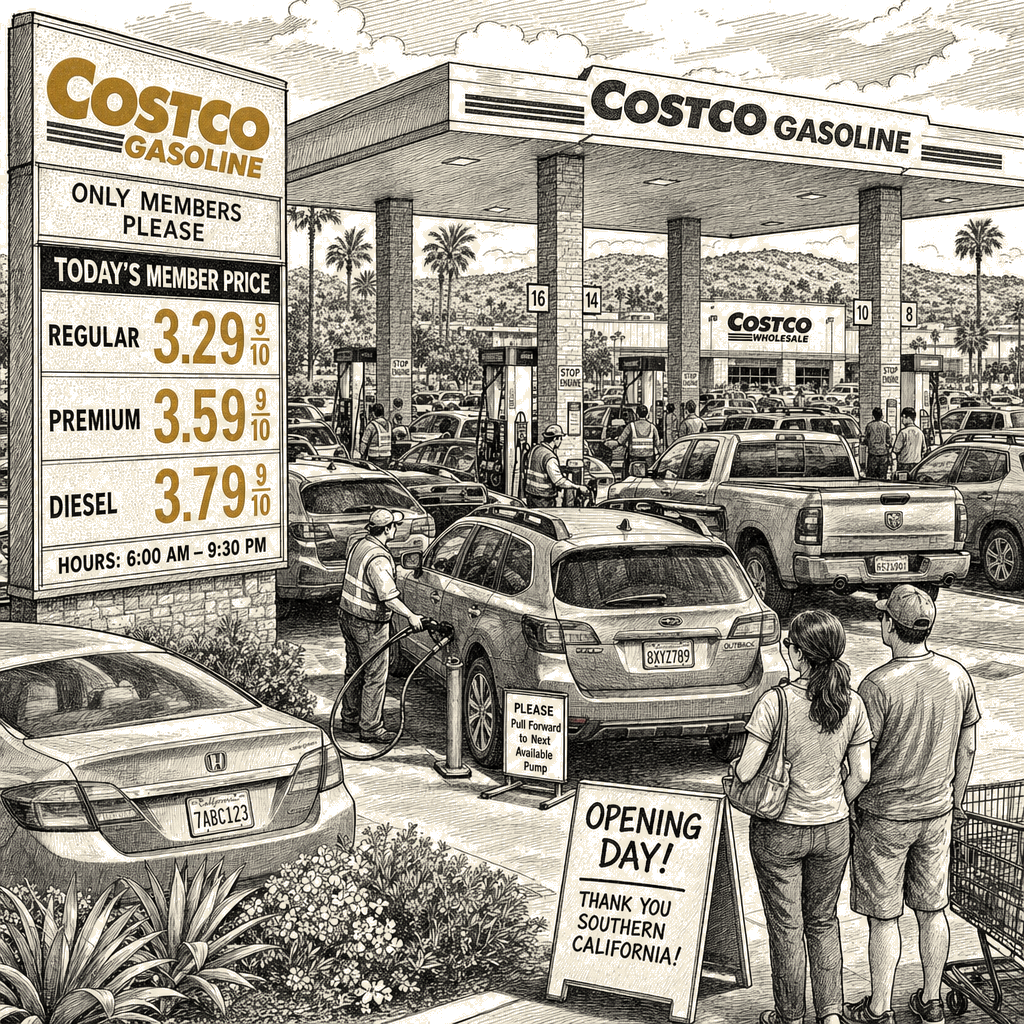
Let me be precise about what I am not saying, before someone accuses me of it. Costco is not the villain of this story. The membership-warehouse chain is doing what a retail operation does when its customers cannot get what they need from the places that used to supply it — it builds new places closer to where the demand actually lives. The company’s stand-alone gas stations, a mile or two from the warehouse parking lots, are a real-estate solution to a capacity problem. Members want faster checkouts. The parking lots are full. The gas lanes back up. So Costco buys the old Bed Bath & Beyond lot, puts in pumps, and sells regular at $4.75 in Orange County while everybody else in Orange County is charging $5.39.
That is a smart business move. It is also an epitaph for the economic geography of the last generation.
The stand-alone station in Southern California is not the story. The story is that a company with Costco’s supply-chain discipline has to build one at all. Twenty years ago, if you wanted discount gasoline in a middle-class suburban or exurban area, you drove to the Costco that sat on a fifteen-acre lot at the intersection of a state highway and a county road, and the gas pumps were part of the deal — a loss leader that brought you inside the building, where the real profit lived. The land was cheap, the zoning was generous, the local planning board approved big-box retail as economic development, and the model worked. Costco built hundreds of warehouses, most of them with gas stations in the parking lot, and the model worked for a long time.
What changed is not that Costco ran out of ideas. What changed is that the company ran out of the kind of parcels the old model required. Millerchip, the CFO, says it plainly in the Journal: harder to find enough land to build new warehouses. So the company is getting creative — vertically integrated stores with housing developments, stand-alone gas stations a mile from the nearest warehouse, anything that lets Costco keep selling fuel at a razor-thin margin when competitors are making far more on the same gallon.
Now read that against what has happened to the rural and exurban counties that used to supply those fifteen-acre warehouse parcels. Over the same twenty years, the counties I know — the sand counties, the cutover counties, the counties that were built on a railroad depot and a grain elevator and a main street with four independent hardware stores — have been hollowed out by the same concentration that made Costco’s economics work in the first place. The local grocery stores closed. The local hardware stores closed. The bank branches consolidated. The Dollar General replaced the family-owned market, and the Dollar General does not sell gas. The nearest gas station that is not a convenience-store markup is either the BP at the interstate exit twenty miles away or the Costco that was built at the intersection of two state highways in a county that votes the other way by a wide margin.
I wrote a few weeks ago about a Costco cashier who, with the company’s unusual compensation model, managed to retire with a million-dollar 401(k). That story is real and it is worth celebrating — Costco pays better than almost any retailer in America, and its profit-sharing model is closer to the cooperative tradition than to the shareholder-primacy model that governs most of its competitors. The company is genuinely better on labor than the field it operates in. I am not going to pretend otherwise.
But better-on-labor does not mean Costco-built-a-town. The company’s growth strategy, for all its operational excellence, tracks the consolidation pattern that has stripped the commercial life out of rural America and the exurban fringe. Costco replaces the local grocery store, the local pharmacy, the local gas station. It does it with better prices and better wages, and the customer who drives a long distance to the nearest Costco gets a genuinely better deal than what the Dollar General-and-BP combination offers closer to home. That is a real gain for the household budget. It is also a loss of the kind of local economic density that Wendell Berry named as membership — the town where the hardware store, the feed store, the pharmacy, and the gas station are all within a walk of each other, owned by people who live on the same streets their customers live on, and whose profits circulate within the county rather than leaving it on an electronic transfer at the close of business.
Costco is not the cause of that loss. The cause is the three-decade regulatory and antitrust regime that let the consolidators consolidate — the bank mergers that eliminated community-bank competition, the retail rollups that turned independent chains into corporate divisions, the agricultural concentration that turned dairy farms into CAFO contracts, the zoning and transportation policy that made the fifteen-acre big-box lot at the highway interchange the rational economic choice and the downtown Main Street store a nostalgic tax liability. Costco is the rational actor inside that system. The stand-alone gas station is what rational action looks like when the system has burned through the parcels the old model needed.
What the stand-alone station also tells you is that the system is getting tight even for the rational actor at its center. If Costco cannot find enough land to build the standard model, the standard model has reached its spatial limit. The company is now building gas stations on repurposed Bed Bath & Beyond lots in California and planning them for Honolulu, which are not Adams County problems. But the shape of the problem is the same: the parcels that were cheap and accessible twenty years ago are gone, consumed by the same consolidation that pushed the small operators off them.
And the people who live in the counties that are out of parcels are the ones who now drive a long distance for the discount gas, or pay the interstate-BP markup, or — increasingly — cannot afford either and cut the trip. The price sensitivity that drove record Costco gas volumes in May, as CEO Vachris noted, came from “high consumer price sensitivity” that sent members to the pumps for the very first time. The same gas-driven earnings surge that lifted Seven & i’s North American unit this quarter. That is not a retail trend. That is what it looks like when working-class households have been squeezed to the point where a five-cent-a-gallon discount at a membership warehouse far from home is the difference between making the month and not making it.
Costco will build its stand-alone stations and they will be profitable and the members will fill their tanks and the company will report another quarter of growth and the investors will watch the renewal rates and the analysts will note that same-store sales are holding. The company is well-run. The company pays its people. The company does not deserve the contempt I reserve for the operators who engineered the consolidation that made its model necessary.
But somebody ought to say that a country in which the best-run retailer in America has to build separate gas stations a mile from its warehouses because the land is gone and the towns the land was in are gone is a country that has made a choice about what it values. The choice was not made in a single vote. It was made across thirty years of bank mergers and farm consolidations and zoning variances and highway expansions and dollar-store openings and the steady, documented, bipartisan refusal to enforce the antitrust laws against the operators pulling the consolidation levers. The result is that the places where people used to buy gas, groceries, hardware, and a cup of coffee on the same block have been replaced by a single membership warehouse at the highway interchange, with a gas station in the parking lot, on land the company is now running out of.
The stand-alone station is not a solution. It is a symptom, and a mild one, of a system that has concentrated the geography of access to the point where even the most efficient operator in the system has to build around the absence of the parcels the system ate. As I wrote in a prior column about the sand counties that are home to me, the same system that put the nitrates in the well water is the system that ate the land the gas station would have sat on, and the towns the gas station would have served, and the people who would have walked to it if there were still a town to walk to.