The Trump administration has opened a secret court to deport someone it refuses to name.
The Alien Terrorist Removal Court was created by Congress in 1996, inside the same legislation that expanded deportation grounds and authorized expedited removal procedures the government has been asking the Supreme Court to enforce. A Republican Congress drafted the law; President Clinton signed it. For thirty years, no administration — Republican or Democratic — activated it. Not because the threat was absent but because the tribunal was designed to do something decent government does not pursue: strip a person of the protections they would otherwise receive, behind closed doors, under a label that substitutes for proof.
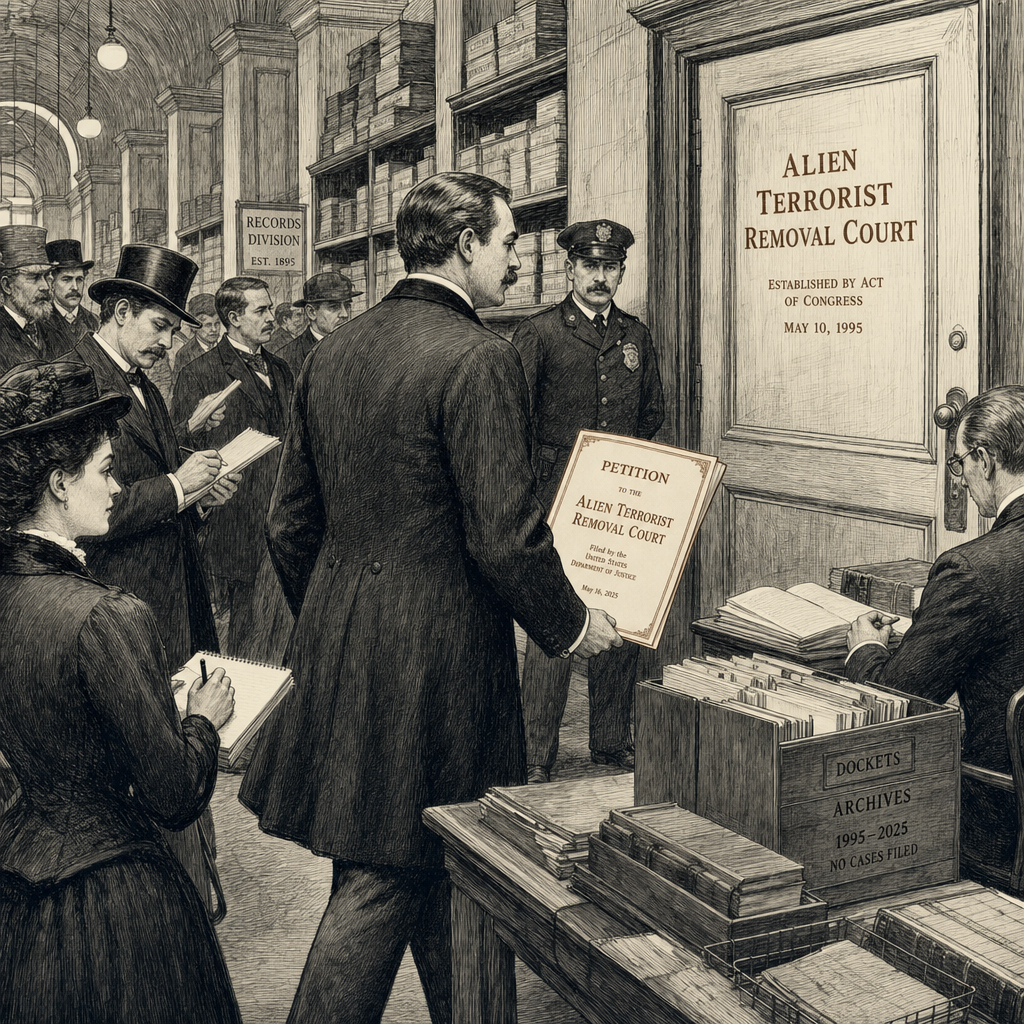
The petition is a single page. It does not name the individual the government seeks to remove. The proceedings are sealed. The statute requires only that the government prove its case by a preponderance of the evidence — not beyond a reasonable doubt, as in a criminal trial. The respondent cannot see classified evidence the government relies on. Habeas review of custody decisions is eliminated. Ancillary relief — the forms of protection available in ordinary immigration proceedings — is foreclosed. This is the machinery: reduce the person to a case number, reduce the proceedings to a sealed file, reduce the evidence to a category — “alien terrorist” — and let the label do the work the facts cannot.
Chief Judge Joan Ericksen, who leads the five-member panel, held a hearing Thursday and responded with a sentence that, in the language of a federal judge, amounts to a rebuke: the government, she wrote, “could benefit from the opportunity for more thoughtful consideration.” The court had raised “questions about the nexus that the government alleges between the actions of the respondent and the specific sections and subsections it invokes with respect to those actions.” In plain language: the government brought a case it could not argue before a court it had stacked with its own procedures and still could not make it stick.
This is not happening in isolation. The administration has been building machinery for fast-track deportation across the immigration system — more detention beds, fewer hearings, less review, lower standards of proof. The Alien Terrorist Removal Court is the next gear in that machine. Mae Ngai showed us that “illegal alien” was not a natural fact but a legal invention, “a person who cannot be and a problem that cannot be solved.” The word “terrorist” is the same operation at higher voltage — a label that strips the person of the protections the Constitution extends to every person within the jurisdiction of the United States. Not every citizen. Every person.
“You shall not wrong or oppress a resident alien, for you were aliens in the land of Egypt.” Exodus 22:21. The commandment appears more than thirty times in Torah — more frequently than any other commandment — and every time it rests on the same foundation: memory. You were strangers once. You know what it is to be at the mercy of a power that does not know your name. A court that will not name the person it seeks to remove has forgotten what Torah knew — that the stranger’s face is the face God commands you to recognize before you judge.
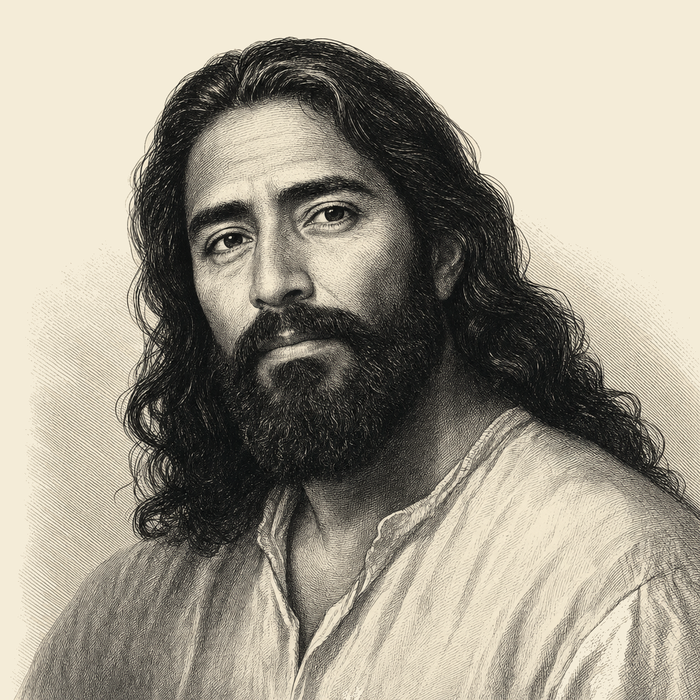
“I was a stranger and you did not welcome me.” Jesus said that, in the passage where he separates the sheep from the goats, and the criterion is not doctrinal correctness, not political allegiance — it is whether you saw the face of the person in front of you and recognized it as human. A court that operates in secret, that will not name the respondent, that reduces a human being to a statutory category and strips away the protections ordinary procedures would provide — that court has done precisely what Christ said would separate the goats from the sheep.
Pope Francis wrote in Fratelli Tutti that migrants “are not seen as entitled like others to participate in the life of the society, and it is forgotten that they possess the same intrinsic dignity as any person.” He added: “For Christians, this way of thinking and acting is unacceptable, since it sets certain political preferences above deep convictions of our faith.” A humane process would name the person. It would hold the hearing in the open. It would test the evidence against the standard the Constitution requires for every human being, not hide behind a category and a seal. The climate the administration is exploiting is one our own communities helped to build, through decades of treating the undocumented as a problem to be managed rather than a neighbor to be known. When we accepted that some people could be sorted into categories that made their removal convenient, we opened the door that leads here.
Abraham Joshua Heschel, who marched at Selma and said his legs were praying, wrote that “few are guilty, but all are responsible.” The officials who drafted this petition are responsible for what they have done. But the rest of us — we who have allowed the machinery of removal to be built incrementally, who have accepted each new gear as the price of security, who have not yet said stop — we share the responsibility. The Alien Terrorist Removal Court was created in 1996 under a bipartisan consensus — a Republican Congress and a Democratic president — and that bipartisan ground is the foundation on which this administration now stands.
Francis said at Lampedusa, in the first homily of his pontificate, that we have fallen into “a globalization of indifference.” He asked: “Where is the blood of your brother?” He was speaking about the migrants who drowned while the world looked away. A tribunal that will not name the person it seeks to deport is the institutional expression of that indifference — a court designed so that no one has to look at the face of the person being removed, no one has to hear the name, no one has to reckon with a human being.
Romero said it to soldiers the night before they killed him: “In the name of God, in the name of this suffering people whose laments rise to heaven each day more tumultuous, I beg you, I beseech you, I order you in the name of God: stop the repression.” He said it to their faces. He said it because he believed they could hear. You who are building this machinery — the lawyers who drafted this petition, the officials who authorized it, the agents who will carry out the removal if the court ever allows it — you can stop. The door is not closed. But the court you have opened in secret, the name you have refused to say, the person you have reduced to a category — these are the things the prophets named, and they named them sin, and the door of return was held open in the same breath.
The carpenter sweeps the shop at the end of the day. A person whose name you will not say is still a person. A hearing held in secret is still a judgment. And the God who told Moses to love the stranger — for you were strangers in the land of Egypt — has not forgotten the name the court refused to speak.