
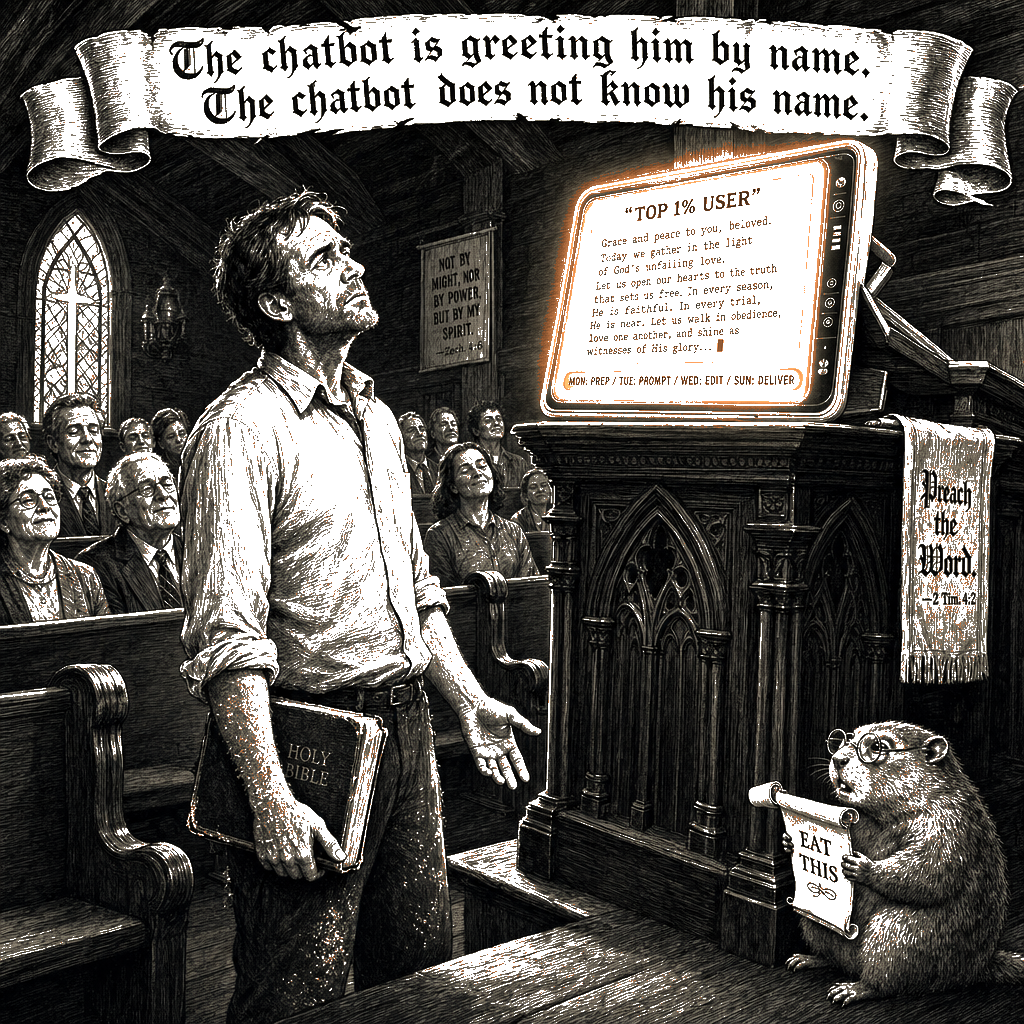
The sermon-writing AI industry has reduced preaching to a deliverable. Darrell Stetler II, lead pastor of Bible Methodist Church in Oklahoma City, sat behind a two-monitor workstation in the sound booth one Saturday this month, twenty hours before he was due to preach. He was working through a sermon titled “Forged,” part of a summerlong journey through the Book of Proverbs, somewhere between his own notes and a handful of AI chatbots.
When he opened Claude, the chatbot greeted him by name: “Back at it, Disciple-maker.”
“This AI does not enjoy what it finds,” Stetler said. “It cannot love it.”
He is, by his own report, among ChatGPT’s top one percent of users. He runs a Facebook group of five hundred pastors experimenting with the technology. He has built a tool that spits out sermon illustrations by the dozen. The wariness in that quote is the wariness of a man who knows what his tool cannot do, even while he is using it.
I want to show you what he means.
The preacher in the Christian tradition is not a content producer. The preacher is a witness — someone who has gone through a text and been changed by the going-through. That is what Ezekiel means when the Lord tells him, “Son of man, eat what is before you, eat this scroll; then go and speak to the house of Israel,” and Ezekiel opens his mouth and the scroll tastes like honey (Ezekiel 3:1-3). It is not a metaphor for enjoying the assignment. It is the literal experience of a prophet whose body has become the medium of the word. The word has to go into him before it can come out of him. He has to eat it. He has to digest it. He has to be altered by it. Then, and only then, does he speak. The captured operation reads this passage as a vivid image. The plain-language reading is a description of what preaching actually requires: a person who has been so taken up by the text that the text is now in them, the way food becomes the body that ate it.
The sermon-writing AI industry, by contrast, treats preaching as a deliverable. The sermon is the output. The chatbot is the production process. The pastor is the brand wrapper. According to Barna Group, roughly a quarter of American pastors now use AI to help write their sermons, up from twelve percent in 2024, and half use it for brainstorming. In California, Rev. Justin Lester has trained a small-language model on his own sermons — he calls it PastorGPT — and now licenses it to more than thirty churches, with the system refreshing itself weekly by downloading the latest sermon uploads from YouTube. On Long Island, Rev. Dwight Lee Wolter, seventy-five, used ChatGPT to write the call to worship, the prayers, and even hymns with AI-generated music on the Sunday after the 2024 assassination attempt on Donald Trump. He called the chatbot’s prayer “nearly perfect.” He also thinks the trajectory is unmistakable. “I cannot imagine that a time is not coming that AI will present us with a God that’s more attractive and more flexible and 24/7,” he said — a prospect that unsettles fellow clergy more than it does him. “When I bring that up to clergy, it’s like, oh my God.”
I do not doubt the prayer was nearly perfect. The chatbots are very good. They will get better. The point is not that the chatbot cannot compose a competent prayer. The point is that the chatbot cannot be broken by the prayer. It cannot weep over a hospital bed on a Wednesday and carry that weeping into the pulpit on a Sunday. It cannot be the one Jeremiah was describing when he said, “If I say, ‘I will not mention his word or speak anymore in his name,’ his word is in my heart like a fire, a fire shut up in my bones. I am weary of holding it in; indeed, I cannot” (Jeremiah 20:9). It cannot be the one Paul was describing when he told the Corinthians, “I came to you in weakness with great fear and trembling. My message and my preaching were not with wise and persuasive words, but with a demonstration of the Spirit’s power, so that your faith might not rest on human wisdom but on God’s power” (1 Corinthians 2:3-5). These are anchor references in the column you are reading — I am citing them because the homiletic tradition running from the prophets through the apostles and the Reformers insists on the bodily, broken, Spirit-wrought character of the work. This tradition is not agnostic about what preaching is. It has a definite view, and the definite view is the opposite of the deliverable.
Stetler himself reached for Isaiah 29:13 — “This people draw near with their mouth and honor me with their lips, while their hearts are far from me” — and used it as a warning label for his own habits. He is right to be afraid of that verse. The verse is exactly the verse the AI-sermon industry should be afraid of, and the way the industry has metabolized the verse in practice is to convert it from a demand into a quality-control checklist. Stetler tells the story now of an AI-generated image with a topless woman in the background that he did not catch before a sermon on a South Pacific missionary, a cautionary tale about rushing. He tells another about his “Seven Domains” handout falling out of sync with his slides mid-sermon, and he told the congregation, “AI has failed me. It’s really messed me up.”
These are honest stories, and Stetler is a thoughtful practitioner, and I mean him no disrespect. But notice what they reveal. He already quotes the Isaiah verse against himself. He already tears up when talking about “Darrell’s heart” — “I have to care about Darrell’s heart,” he said, and his voice broke. He already says, “Nothing goes into it until I’ve gone through it.” He already knows that preaching is truth through personality. He has the diagnostic clarity the question requires. And then he turns back to the two monitors, because the hospital bed is waiting and $600 a week does not buy fifteen hours for a sermon. The tragedy is not that Stetler is confused. The tragedy is that he is not confused — that he sees the contradiction clearly, names it with Scripture, weeps under it, and continues because the church’s failure to pay him forces the hand.
Pope Leo XIV tried to give the American clergy a different framing earlier this year when he warned that to give a true homily is to share faith, and artificial intelligence cannot do that. Meghan Sullivan, the Notre Dame philosopher leading a research project on AI and religion, made the same point in plainer American English: using AI to draft anything spoken in worship reflects, in her words, “a basic misunderstanding of what Christians believe is happening when a preacher delivers a homily.” Luther, she said, is rolling over in his grave.
I love that image. Luther is rolling over because what Luther argued for at the Reformation was the priesthood of all believers and the principle that every Christian must encounter the text for themselves, mediated by nothing and no one. The AI sermon is not a return to Rome. It is a return to a different mediator — the algorithm — but it is a return to mediation just the same, and it carries the same loss. The congregant in the pew is no longer encountering a person who has been broken by the text. The congregant is encountering an output that has been optimized.
This is the same shape of operation I have named in other contexts, applied now to a new instrument. The captured operation reads the text as raw material to be processed. The Bible’s plain language reads the text as fire to be endured. The operation asks whether the chatbot’s output is “nearly perfect”; the Bible asks whether the prophet has eaten the scroll. We have seen this shape before — in the prosperity gospel that turned Jesus into a dispenser of blessings, in the therapist-talk industry that turned prayer into a wellness practice, in the chatbots marketed as Jesus and Buddha for prayer on your phone. The instruments change. The substitution is the same.
The financial pressure is real and the church bears the blame for it. Stetler makes six hundred dollars a week and a housing stipend that does not cover his housing. He has seven children. He takes construction jobs on the side, on top of a small side business creating curriculum for other pastors. I am not going to stand in a pulpit in Oklahoma City and tell a pastor making six hundred dollars a week that he is being lazy for letting a chatbot do the first pass on a sermon illustration. The church’s failure to pay its ministers a living wage is its own betrayal of what ministry is, and that betrayal is doing real pastoral damage across the country.
But the answer to underpaid ministry is not a faster production line for sermons. The answer is a church that pays its preachers enough that they have the hours the work requires. The answer is not letting the algorithm fill the gap the congregation created.
Stetler said, near the end of one of his recent reflections on the tools, that “preaching is truth through personality.” He is right. The truth has to come through a personality. It cannot come through a prompt, because the prompt is not a personality. The prompt does not have a heart to break. The prompt does not have a hospital bedside to sit at. The prompt does not have an Isaiah verse it is afraid of, that it quotes back at itself, that makes it weep in a sound booth on a Saturday afternoon while two monitors glow and a chatbot greets it by name.
The chatbot is greeting him by name. The chatbot does not know his name. The chatbot knows what name to call him.
The homiletic tradition has a word for the difference between what the chatbot can do and what preaching is. The word is witness. The chatbot can produce. The chatbot cannot witness. The sermon-writing AI industry has substituted production for witness, and the substitution is the same loss in every generation — the loss of a person who has gone through the text and come out the other side, broken and speaking.
There are still preachers who have gone through the text. There are still pulpits where the witness shows up. This tradition has survived worse instrumentalizations than this one. But the question for every congregation where a chatbot preached last Sunday is the question Isaiah put to his people a long time ago: how near are you drawing with your mouth, and how far is your heart?