
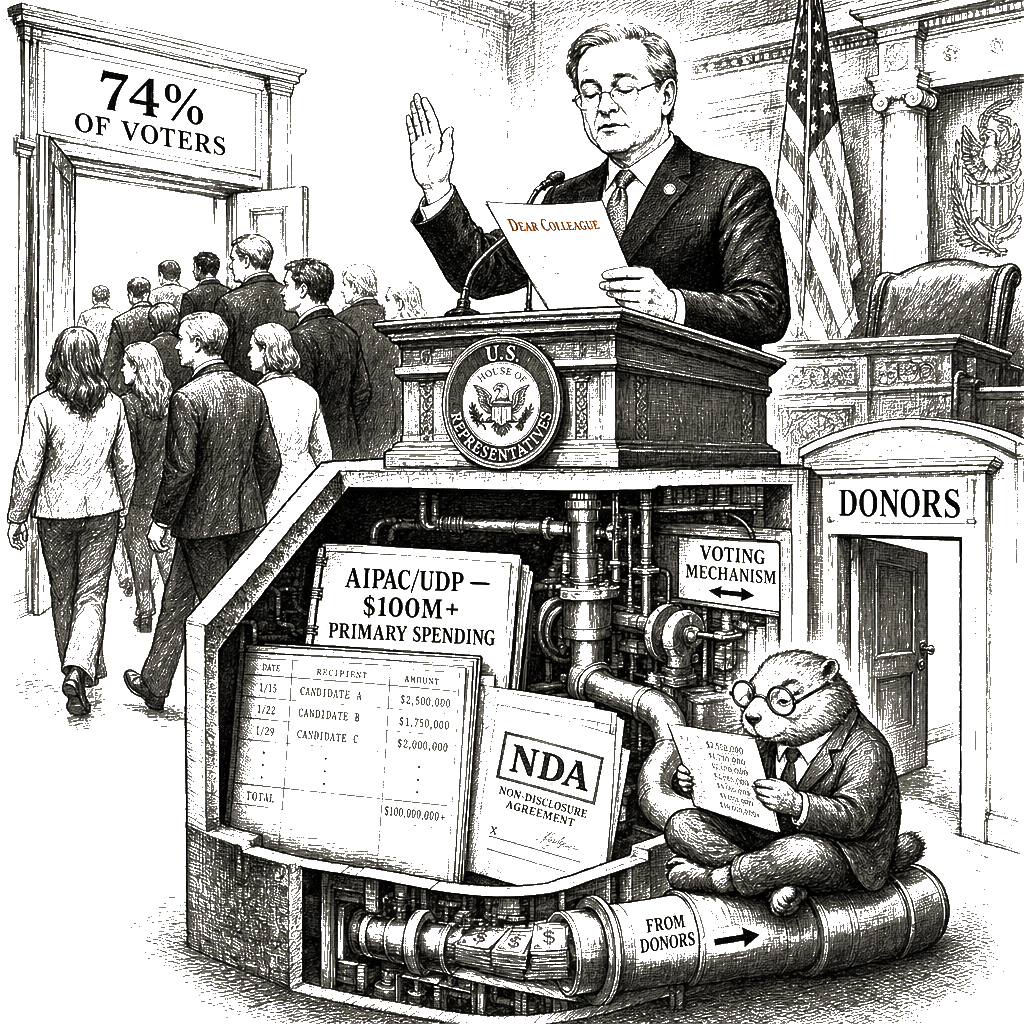
A hundred and three House Democrats just voted against their own leadership on $3.3 billion in arms to Israel. The leadership’s response was a dear-colleague letter. The vote was the news. The letter is the analysis.
I’m not here to relitigate the substantive question. Israel has real security threats from real enemies; any honest foreign-policy conversation begins there. Some of the loudest critics of unconditional aid caricature the region in ways that don’t survive contact with its actual complexity, and that caricature is not, despite what its proponents sometimes claim, an act of moral courage. The 103 Democrats who voted no are not caricaturing anyone. They are reading the polling, looking at the United Nations findings, and doing the math. The question this column is interested in is the one Norman Solomon asks in the Guardian: what does it tell us that the leadership is still writing letters while the caucus is voting against them? And the question Solomon doesn’t quite name: what would actually dislodge the structure that produced the letter in the first place?
The leadership’s letter, last week, was the same dear-colleague genre it has always been. Hakeem Jeffries asked the caucus to keep the $3.3 billion flowing by invoking the necessity of confronting “Hamas, Hezbollah and other terrorist organizations in the region who are sworn enemies of both the United States and Israel.” It is worth sitting with the form for a moment. A “dear colleague” letter is a tool for caucus discipline, not a tool for argument. It signals to wavering members: this is where the leadership lands, and the rest of you are expected to land there too. The substantive claim — that the aid is necessary to confront named enemies — is a separate question, and not the one the letter is principally trying to settle. The letter is principally trying to settle whether the caucus can be trusted to vote the way the leadership wants on this specific item, this specific week, regardless of what their own polling says.
Nancy Pelosi, in 2018 at the Israeli-American Council conference, said the quiet part out loud: “I have said to people when they ask me: if this Capitol crumbled to the ground, the one thing that would remain is our commitment to our aid — I don’t even call it aid — our cooperation — with Israel. That’s fundamental to who we are.” Eight years later, the former speaker voted for the cutoff. The Capitol hasn’t crumbled. What shifted was the voters. “Fundamental to who we are” was never the leadership’s position to hold in perpetuity. It was a position the voters were allowing them to hold, and they are no longer allowing it.
What the leadership is actually defending, when it sends the letter, is a particular funding architecture. The $3.3 billion is not a one-time expenditure that gets re-argued every year on its merits. It is a standing federal outlay, renewed as a matter of course, with the occasional procedural vote used to launder the renewal through a process that nobody outside the foreign-affairs subcommittee has any real incentive to scrutinize. AIPAC and the affiliated United Democracy Project super PAC do the scrutinizing on the other side. UDP spent $11 million in a single Michigan Senate primary last cycle to make the point that primary challenges against members who vote the wrong way on this item are not theoretical. Across the 2024 cycle, AIPAC-aligned groups spent well over $100 million in Democratic primaries alone, backing challengers against incumbents who broke with the line. The point is not to win arguments; it is to make defection expensive. The economics of the discipline are not atmospheric; they are a line item in the campaign budget of any Democrat who might consider voting the way 74% of their own voters want them to vote.
Jeffries and Schumer, by the structure of their fundraising, sit downstream of this. AIPAC and its affiliated committees are not the only special interests in the Democratic donor ecosystem, but they are the most disciplined. A senator from a blue state, or a House member from a swing district, does not need to take a call from AIPAC’s political director to know the math. The math runs through the next primary. The math runs through the next fundraising email. The math runs through the DNC’s $20 million debt and the staff nondisclosure agreements that a DNC finance co-chair defended in the Solomon column as “consistent with standard practice in the corporate world.” The “corporate world” is the tell. The DNC is being run, structurally, like a corporation whose shareholders are large donors. The members are being treated as employees. NDAs are what you sign when your employer wants to make sure the products of your work don’t go home with you at the end of the day.
The contempt in the dear-colleague letter is not for the policy. The contempt is for the voters who think they get a say.
Okay — so what do we build instead?
The answer is not a better letter. The answer is a different funding architecture for the party itself, because the existing architecture is what makes the leadership write the letter in the first place. Three concrete pieces, all of which already exist somewhere, none of which require a constitutional amendment.
The first is small-donor matching funds, the way New York City has run them since 1988. The city’s Campaign Finance Board matches contributions from small donors (under $250) at an 8-to-1 rate, with a lower multiple on contributions up to $1,000. In the 2021 citywide elections, roughly 70% of all contributions to participating candidates came from small donors — residents giving $250 or less. A candidate for city council who is willing to do the work of small-donor fundraising does not need to make a call to AIPAC. The candidate needs to talk to neighbors. A federal version of this — the Small Donor Election Empowerment Act or any of its variants — collapses the math that makes the current leadership write the current letter. The matching funds don’t ban any spending; they change the marginal cost of small-donor support relative to large-donor support. That is a structural change in who owns the party.
The second is the union-affiliated political vehicle, which is the cooperative model applied to the campaign-finance problem. SEIU, AFSCME, the UAW, the teachers’ unions, the nurses’ unions — all of them already run political operations funded by member dues rather than outside contributions. The dollars are smaller per capita than a UDP check. The numbers of contributors are larger by several orders of magnitude. The bargaining relationship between the labor federation and the candidate is different from the bargaining relationship between a single donor and a candidate: it is a membership-level accountability structure, not a transaction. Multiply this across the existing labor infrastructure, and the marginal Democratic member of Congress who needs a $3,000 UDP check to feel safe is replaced by a member who needs a labor-council endorsement. The structure changes who owns the seat.
The third is the public-banking model applied to small-dollar donor infrastructure. The Bank of North Dakota has been state-owned, profitable, and lending to small businesses and family farms since 1919. Nobody has ever called Bismarck the Kremlin. The same principle works for political donations: a publicly chartered donor-pool entity that processes small contributions, holds them in escrow, and disburses them to candidates who meet a transparency standard. The state is not running campaigns; the state is running the rails. The candidates who can clear the bar compete for the small-dollar pool. The candidates who can’t — who depend on AIPAC or its analogue — compete for the existing large-dollar pool. The two systems coexist. The structure makes the second option more expensive than the first.
What these three pieces have in common is that they are the party equivalent of capitalism with the trap doors welded shut. The market for political support is allowed to work. The market is not allowed to eat the voter. The candidate who wants to win still has to win. The candidate who wants to win on a $3 million UDP check finds the math a little harder; the candidate who wants to win on fifty thousand $50 contributions from neighbors finds the math a little easier. The line items are the same. The ownership is different.
The Nordic model did not abolish markets for political support; it just made the small-donor alternative more durable than the large-donor one. The U.S. has the institutions to do this. The federal Small Donor Election Empowerment Act is a piece of paper. The state-level matching funds in New York, Los Angeles, and a handful of other jurisdictions are already pieces of policy. The labor councils are already political operations. None of this requires anyone to relitigate the substantive question that 103 House Democrats voted on last week; it requires someone to point out that the question of who owns the party is the prior question, and that it can be answered with institutions that already work.
The 74% of Democratic voters who told the New York Times they want a different policy on arms transfers are not going to read the dear-colleague letter and change their minds. They already voted. What they have not yet done is build the alternative funding structure that would let a candidate who agrees with them run a competitive race without first calling the donor whose interests the letter was written to protect. That is the work, and it is institutional work, and it is exactly the kind of work the letter is designed to make sure nobody has time to do.
Hakeem Jeffries, the next time you want to send a dear-colleague letter, consider who the colleagues are. They read the same polls you do. They vote the way the polls say. The letter is the only piece of the architecture that still belongs to you. The party itself is in the process of finding out who it answers to, and it is not you.