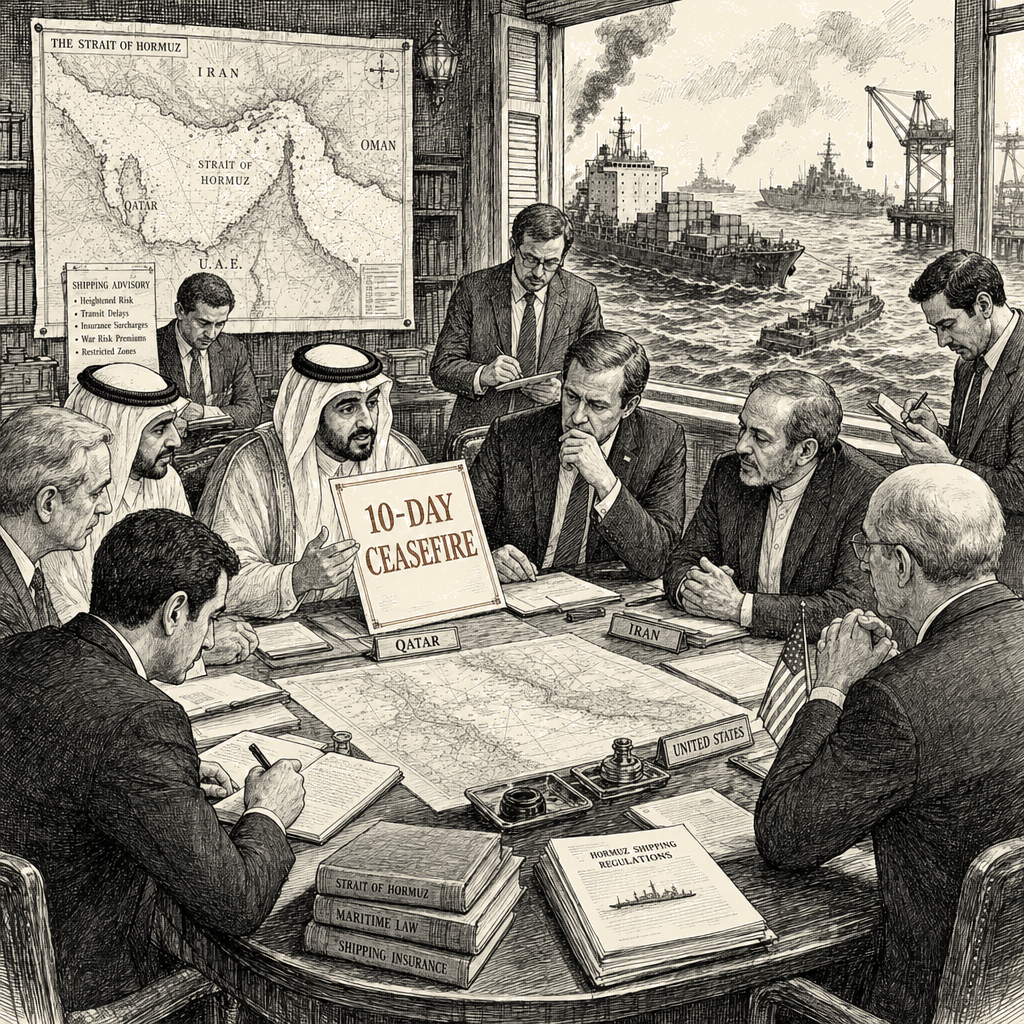
The United States and Iran are killing people in a war nobody will call a war. Nine straight nights of American bombs on Iranian bridges, rail lines, a port control tower. Iranian projectiles hitting ships in the Strait of Hormuz, setting vessels on fire, sending crews into the water. Two American servicemembers dead at a base in Jordan, one missing, several wounded. And the mediators gather in Doha and elsewhere, using the exact language the prophet Jeremiah warned us about: afraid that the two sides could “settle into a pattern” of conflict below all‑out war, worried about a “miscalculation that escalates the fighting.” The prophet Jeremiah said it first, to the leaders of Judah who told the people what they wanted to hear: “Peace, peace,” when there was no peace. They have healed the wound of my people lightly, saying, “Peace, peace,” when there is no peace.
The diplomatic vocabulary is the part that needs to be named first, because it is the part we are all cooperating with. The mediators are not afraid that people are dying. They are afraid that the dying will become inconveniently large. The ceasefire proposal is for ten days. Not an end to the killing. A pause in the killing, long enough to reset the conditions under which the killing can resume at manageable levels. The diplomats want what every war manager wants: a conflict that serves its purposes without becoming a scandal. This is the same pattern we have been tracking since the fighting resumed, and the vocabulary has not changed.
I spent time as a combat medic in Iraq. I know what it is to follow orders in a conflict you did not start. The nine straight nights of American strikes on Iran are not a mistake. They are a policy choice — the same policy choice the administration has been making since May, when it bombed while claiming to negotiate. The Iranian attacks on ships using the Oman corridor are not a miscalculation. They are a policy choice. The two dead American soldiers in Jordan are not a regrettable accident. They are the predictable consequence of a war that both sides are conducting while refusing to call it one. I say this knowing I am not outside the thing I name. I carried the orders of this country’s wars once. I am not exempt from the tradition that holds those orders to account.
The Catholic tradition I claim names something about this. Pope John XXIII wrote in Pacem in Terris that every human being has the right to freedom of movement and of residence, and when there are just reasons, the right to emigrate and take up residence elsewhere. The war at the Strait of Hormuz is a war about who gets to move, about who controls the passage of goods and fuel and bodies through a narrow stretch of water. The United States and Iran are fighting over the right to restrict that passage, and the people who suffer are the ones who need what moves through it — the families who depend on the fuel, the economies that depend on the trade, the bodies that depend on the supply chains.
Pope Francis said at Lampedusa that we have fallen into a globalization of indifference. But what we have here is not indifference. It is active, deliberate, policy‑chosen harm, conducted with full knowledge, under the sanction of two governments, with the cooperation of an international community that funds the mediation and pretends the mediation is about peace when it is really about managing the optics of slaughter. The Strait of Hormuz is not an abstraction. It is a piece of water through which a significant portion of the world’s oil moves. And the war over it has killed people — American service members, Iranian civilians, sailors on vessels that had nothing to do with either government’s quarrel.
I know the response that is coming from those who support this war. They will say Iran started it. They will say the strikes on the base in Jordan that killed two Americans are the provocation that justifies everything that follows. They will say the United States has a right to defend its interests and its people. And I am not here to say that Iran is innocent. Iran’s Revolutionary Guard has not responded to ceasefire proposals. Iran is attacking ships. Iran is backing militias that kill Americans. All of that is true.
But the question the prophets ask is not “who started it.” The question the prophets ask is “what are you doing now, and can you stop.” The question Jesus asks in the Sermon on the Mount is not “who threw the first punch.” The question is “blessed are the peacemakers.” The question is “love your enemies.” These are not soft questions. They are the hardest questions there are. They require more courage than the bomb does.
I think of Dorothy Day, who wrote in the pages of The Catholic Worker after Hiroshima that “we have killed 318,000 Japanese.” Not “the United States killed.” We. First person plural. She included herself in the nation that dropped the bomb. She did not exempt herself from the guilt of what her country did in her name. I am not bombing Iran. But my country is. And I am a citizen of that country, and I am a veteran who carried out its orders, and I am a Catholic who belongs to a tradition that names this kind of killing for what it is. I am not exempt. And neither are you who read this, if you pay taxes, if you vote, if you accept the protection of the military that is doing the bombing.
Romero stood in the cathedral in San Salvador on March 23, 1980, and said to the soldiers who were killing their own people: “In the name of God, in the name of this suffering people whose laments rise to heaven each day more tumultuous, I beg you, I beseech you, I order you in the name of God: Stop the repression.” He said it to the ones who had the guns. He said it to the ones who were following orders. He said it knowing he might be killed for saying it. And he said it because he believed the soldiers who were killing were still capable of hearing the voice of God and stopping.
The door is open. The ceasefire proposal is on the table. The mediators are waiting. The question is whether you — the ones who give the orders in Washington and Tehran — have the courage to take it before the next American dies, before the next Iranian dies, before the next ship burns in the Strait and sends its crew into the water. The war nobody will call a war is still a war. The people dying in it are still people. And the God who made them is still watching, still waiting, still holding the door open.