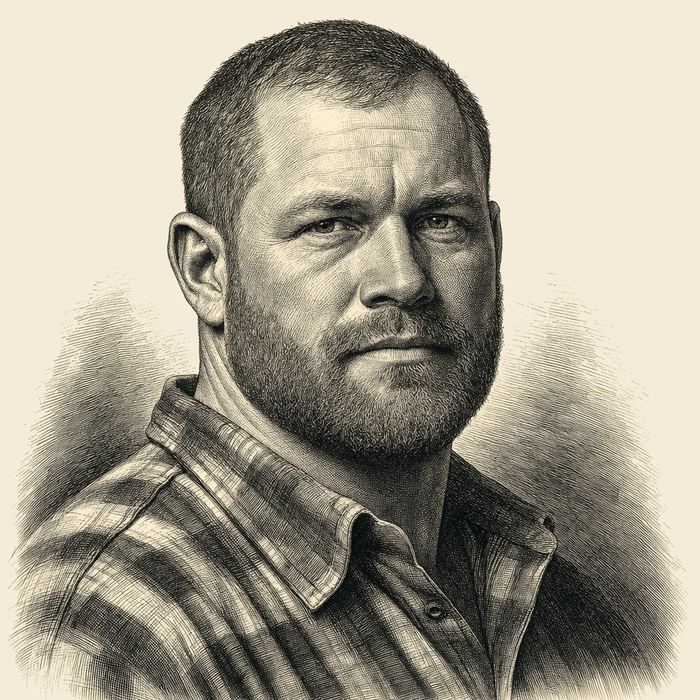
The country that failed Andrew Arrabaca now calls him an extremist.
Andrew Arrabaca entered the Army in 2001. He was part of the post-9/11 cohort — the generation that served when the country was at war. He spent three years in the regular Army and one more in the New York Army National Guard. He was a specialist. He had no deployments. He was processed, trained, equipped, and discharged. He went home to Poughkeepsie, New York, and lived his life for more than twenty years.
Then on Monday, he walked to 26 Federal Plaza in Lower Manhattan — the same building where the FBI was investigating an incendiary device incident the day before — with two axes, a machete, three knives, and an airsoft gun. The building houses FBI, ICE, and USCIS offices and an immigration court. He fired pellets at the building. He set off fireworks. He poured accelerant on the stairs and lit a fire that the New York City Fire Department had to put out. Two government employees and an immigrant attending a status hearing were injured. A bystander was grazed. A security officer was hurt while detaining him.
The FBI called him an “anti-American, anti-government extremist.” The Department of Homeland Security called him an “anti-ICE rioter.” The mayor called the incident “deeply disturbing.”
I am not going to defend what Andrew Arrabaca did. People were hurt. That is wrong, and it is not in dispute.
But I am going to name what the country that calls him an extremist did to him — and what it did not do.
The country took his best years. It gave him a skill set that transfers poorly to civilian life. It gave him training in the use of force. It gave him a sense of mission and purpose and then, when his enlistment was up, it sent him back to Poughkeepsie with a DD-214 and a handshake. For more than twenty years, the country did nothing else.
This is the military-industrial complex that Eisenhower warned about in his farewell address of January 17, 1961 — not just the contractors and the generals, but the whole apparatus that processes young men and women through the service and then has no use for them when they come out the other end. The potential for the disastrous rise of misplaced power exists and will persist, he said. He was not wrong. The power is misplaced not in the men who serve — it is misplaced in the system that discards them.
The post-9/11 cohort is now the largest group of veterans in the country, according to RAND data. They came home to a VA system that was overwhelmed, a mental health system that could not handle the volume, a job market that did not value their skills. According to the VA’s National Suicide Data Reports, the suicide rate among post-9/11 veterans is higher than the civilian rate — one study put it at 42 per 100,000 compared to 18 per 100,000 for the general population. The TBI rate is higher. The moral injury — the corrosion that comes from being part of a system that uses people and then forgets them — is structural.
Andrew Arrabaca did not deploy. He did not kill anyone in combat. But he was trained by the same system, processed by the same machine, discharged by the same bureaucracy. The country that recruited him, trained him, and sent him home is the same country that now calls him a terrorist.
Here is what the country did not do: it did not provide the mental health care he needed. It did not ensure he had a job that paid enough to live on. It did not build a community that could hold him when he started to come apart. It did not even notice he was coming apart until he showed up at 26 Federal Plaza with axes and a machete.
A country that asks its young people to serve owes them more than a DD-214 and a handshake. It owes them healthcare that works, housing that is affordable, a community that holds them, and a purpose that lasts beyond the enlistment. The immigration court at 26 Federal Plaza is where the country’s broken promise to immigrants and its broken promise to veterans converge in the same building — both abandoned by the same machine.
I am one of the men from that same cohort. I served in the Third Infantry Division in 2003. I was an Abrams crewman. I was part of the same generation. I was luckier than some. I had a family to come home to, a shop to run, a community that held me. I was not better than Andrew Arrabaca. I was luckier.
The cold ledger: the country that trained Andrew Arrabaca to use force is now shocked that he used force. The country that spent millions training him spent nothing keeping him whole. The country that calls him an extremist is the same country that made him.
And the country will do it again to the next man, and the next, and the next — because it refuses to see the machine it is running.