Nick Shirley drove to ten childcare centers in Minnesota in December 2025 with a camera and no credentials. He demanded proof of enrollment. He attempted to enroll a child who did not exist. He posted the video on Elon Musk’s platform, and Musk boosted it to an audience of millions. The charge: that Somali-American childcare providers were running fraudulent operations, collecting federal money for children who were not there.
“How do I know that [the allegations are] true?” Shirley responded when CNN asked. “Well, we showed you guys what was happening, and then you guys can go ahead and make your own analysis.” Minnesota Republicans worked with Shirley on the production.
The local reporters went to the centers. They found children. The state investigators visited nine of the ten centers; one had been closed for years, and one had not yet opened. The other eight were operating normally, with licensed providers doing exactly what the public record says they do.
None of that mattered. Senior Trump administration officials cited and credited the video as the basis for freezing over $10 billion in federal funds across five states — California, Colorado, Illinois, Minnesota, New York. The three programs caught in the freeze — the Child Care and Development Fund, Temporary Assistance for Needy Families, and the Social Service Block Grant — are the programs millions of Americans rely on every year for childcare, food, clothing, and the other basic necessities that keep a household from falling through the floor.
The five Democratic states sued to block the freeze, and a federal judge granted a court order on January 9; we have covered that ruling since. In July 2026, as court-ordered discovery produced unredacted emails showing the administration’s own reasoning, the administration moved to resolve the lawsuit and withdrew the freeze. The states added the Office of Management and Budget to their suit after discovery revealed the agency’s central role in the operation. The White House and HHS declined to comment.
The administration did not need evidence. It had a pretext.
This is the manufactured-controversy pattern documented by Oreskes and Conway in Merchants of Doubt: the deliberate construction of the appearance of legitimate disagreement where the actual evidentiary position is one of substantial consensus — the same technique the tobacco industry used to manufacture doubt about the link between smoking and lung cancer. The disagreement here was fabricated. The evidence was debunked before the freeze was announced. The administration proceeded anyway.
The cui-bono trace is straightforward. The concentrated beneficiary is the administration itself — the political benefit of attacking states governed by its opponents, of delivering on anti-Somali and anti-immigrant rhetoric to a base that expects the performance, of demonstrating that social services are not statutory entitlements but discretionary weapons subject to the president’s political calendar. The diffuse cost-bearers are the families who depend on those programs. The public framing — “fraud prevention” — obscures a distributional reality in which the administration froze $10 billion because a far-right YouTuber told it to, and the people who absorbed the cost were the ones already closest to the edge.
The technique is the Big Lie — a falsehood so colossal, repeated with such institutional confidence, that audiences accept it on the assumption that no one would dare fabricate something so grand. Hitler, in Chapter 10 of Mein Kampf, accused the Jews of using the technique — the accusation itself was an instance of the method, as Arendt later diagnosed. The Big Lie operates by accusing your targets of the very thing you are doing, so the accusation preempts recognition. The post-2020 election lie followed this pattern. The childcare fraud lie follows it now. The playbook is the same: manufacture the accusation, amplify it through the platform, cite it as official justification, and when challenged, retreat into procedural silence.
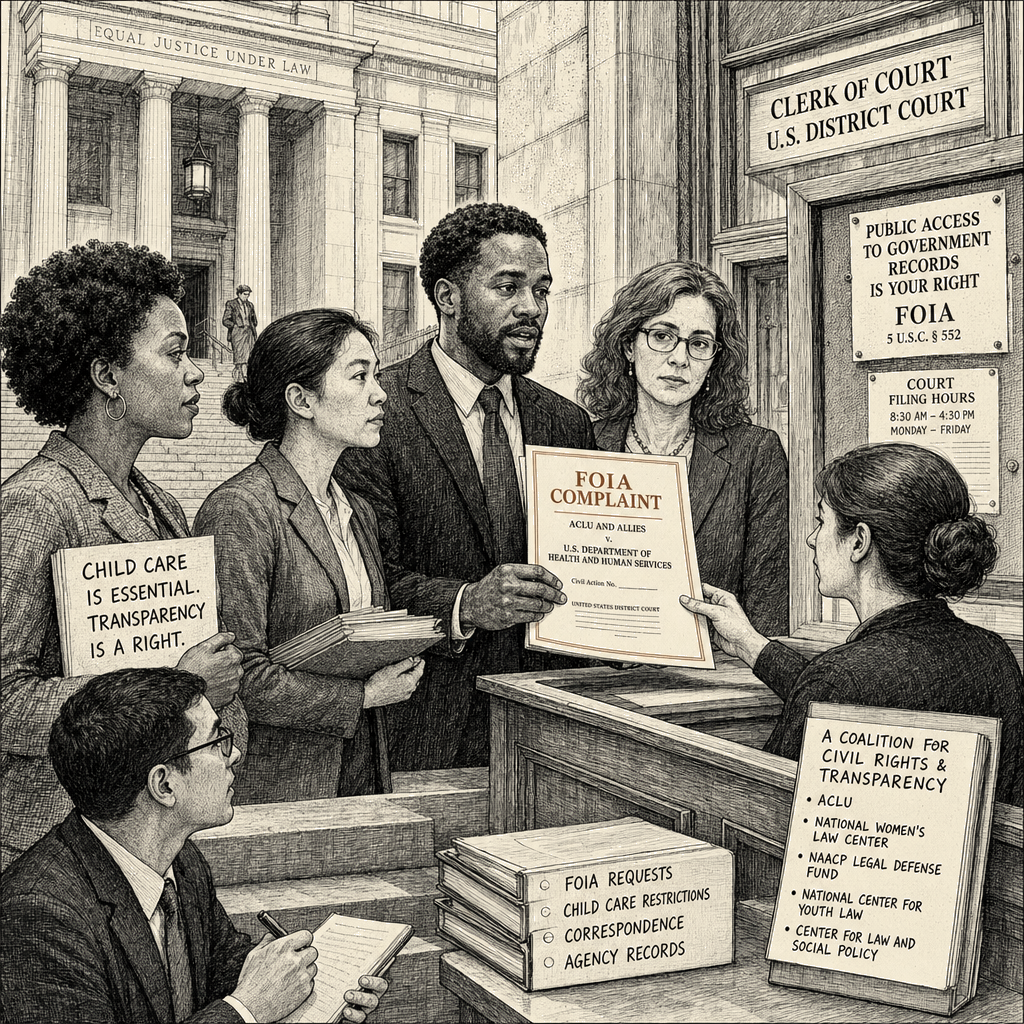
The ACLU, the National Women’s Law Center, and allied organizations have sued the Department of Health and Human Services for the communications between federal officials and Nick Shirley. They are seeking the documents that would show how a debunked influencer video traveled from a YouTube upload to a senior official’s desk to a $10 billion funding freeze. The administration has not responded to the FOIA request. The lawsuit asks the court to compel the release.
Here is what the administration does not want the public to see: the chain of causation. The architecture of the operation is designed to be opaque at every link — the influencer makes the claim, the platform amplifies it, the official cites it without attribution, the funds are frozen, and when the courts intervene, the administration offers no defense on the merits. The silence is not an accident. It is the final stage of the operation.
As Mon Mothma said in that Senate chamber on Coruscant, in the second season of Andor: “I believe we are in crisis. The distance between what is said and what is known to be true has become an abyss. Of all the things at risk, the loss of an objective reality is perhaps the most dangerous. The death of truth is the ultimate victory of evil.” The sentence was written for a television drama. It is now a description of how the federal government administers childcare funding.
King said from the pulpit at Riverside Church in April 1967: “The arc of the moral universe is long, but it bends toward justice.” The unwritten clause — the one the moment demands — is that it bends only when specific people in a specific moment push it. The push here is the court order, the FOIA lawsuit, the journalists who went to the centers and counted the children. The push is the refusal to let the administration’s silence stand as the final word. The push is naming what happened: the fraud they invented, the harm they intended, and the truth that will, in the end, surface — because it always does, and because the people who need those programs to survive are still here, still watching, and still counting.