
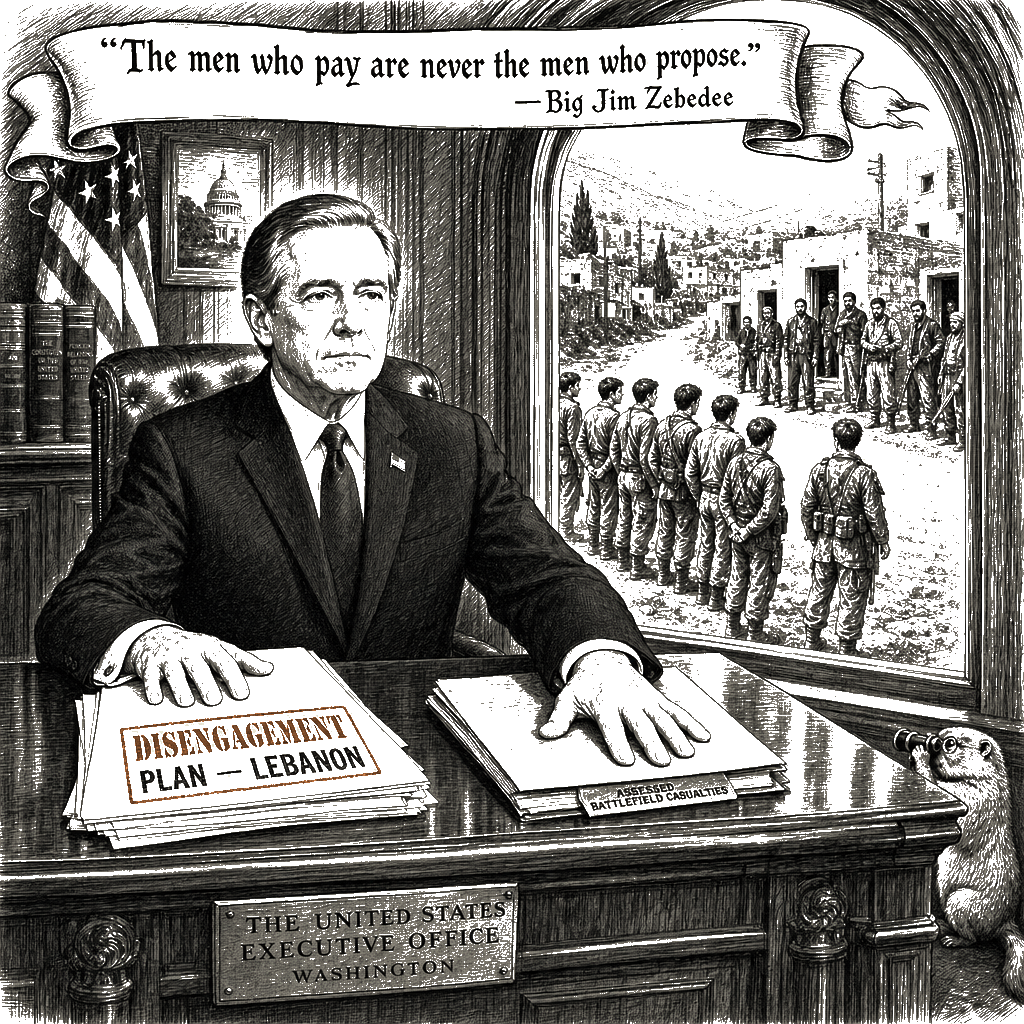
Washington is sending Lebanese soldiers to fight their own neighbors and calling it disarmament.
The plan reads clean on paper. The United States will train, equip, and vet units of the Lebanese Armed Forces to dismantle Hezbollah’s military infrastructure. Israeli soldiers occupying southern Lebanon will gradually hand off to Lebanese troops. The two sides agreed on the handover structure during direct talks in Rome last week and began early implementation, according to officials cited by the Wall Street Journal.
The men who would carry this out are not a professional fighting force built for this kind of work. They are conscripts and reservists. Mechanics, schoolteachers, fathers doing their national service. The military is under-resourced by any measure. The soldiers do not want to be perceived as doing Israel’s job. Analysts say many lack the will to fight their own countrymen. The people they would be sent against are ready for them. Hassan Fadlallah, Hezbollah’s man in parliament, made the group’s position plain: “We will fight them just as we fight the Israeli army.”
That is not a bluff from a spent force. Hezbollah has been embedded in Lebanese Shia communities for forty-two years. Its fighters are not foreign occupiers shipped in from somewhere else. They are the men who grew up on the same streets, who pray at the same mosques, whose families have intermarried for generations. The group has built schools and hospitals and political representation alongside its militia, a social infrastructure woven into the fabric of daily life. You do not dismantle forty-two years of that with a training program and a set of new uniforms.
And the army Washington wants to send against them is not clean. The U.S. Treasury said in May that Hezbollah receives intelligence tips from officials within Lebanon’s state security organizations, including the military itself. You are asking one hand of the same body to cut off the other. The fracture risks along sectarian lines have been apparent for months.
The Gaza comparison should have settled this question. Israel, the strongest military in the region, with years of overwhelming force and widespread destruction behind it, could not disarm Hamas. Hamas is diminished but still armed and still controlling what remains. Yossi Mekelberg at Chatham House put the operational reality plainly: Israel can keep eroding Hezbollah’s capabilities, but disarming them is a different kind of problem entirely.
Now they want Lebanon’s under-resourced army to do what Tel Aviv could not. Secretary of State Marco Rubio acknowledged in April that it was a tall order. That is the Washington way of saying the math does not work and we are going to try it anyway.
Here is what I keep coming back to. The men who sign these orders live in gated communities in Virginia and Connecticut. They send their children to schools where nobody is recruiting. The men who would carry the orders out are shopkeepers and farmers in the Bekaa Valley and the south of Lebanon. The men who propose the war and the men who die in it are never the same men. That is the oldest story there is, and it is being written again right now.
Then there is Syria. President Trump mentioned at a NATO summit in Turkey that Syria’s new leader, Sharaa, made commitments to help seal the border with Lebanon. Syria occupied Lebanon for twenty-nine years, from 1976 to 2005. Every Lebanese family alive remembers what that looked like. Ghassan Hasbani, a former deputy prime minister, said plans to involve Syrians in armed engagement “bring back bad memories.” He was being polite about it. Syria’s new military includes radical Sunni Islamists accused of massacring minorities. Syrian troops are stretched thin at home. And Sharaa has spent his time in power staying out of other people’s wars. Washington wants him to jump into the one fight that carries the most blood-memory for the country next door. The fears across Lebanese society have already surfaced.
Dwight Eisenhower warned about this shape of thing in paragraph 24 of his farewell address in January 1961. He said the country must guard against the military-industrial complex’s unwarranted influence, whether sought or unsought. He said only an alert and knowledgeable citizenry could compel the huge industrial and military machinery of defense to mesh with peaceful goals. The machinery is not meshing with peace here. The machinery is aligned with the habit of reaching for the hammer. The citizenry has not been alert.
The honest course is the one that costs no Lebanese soldiers their lives. It means engaging Hezbollah as a political reality. Forty-two years makes it political, whatever anyone calls it. It means working toward a settlement through Lebanese politics rather than through an under-resourced army sent to fight its own neighbors. That is the hard work. What is being proposed is the easy work, and it is the wrong work. The men who pay for it are the men who never chose it.
The men who pay are never the men who propose.