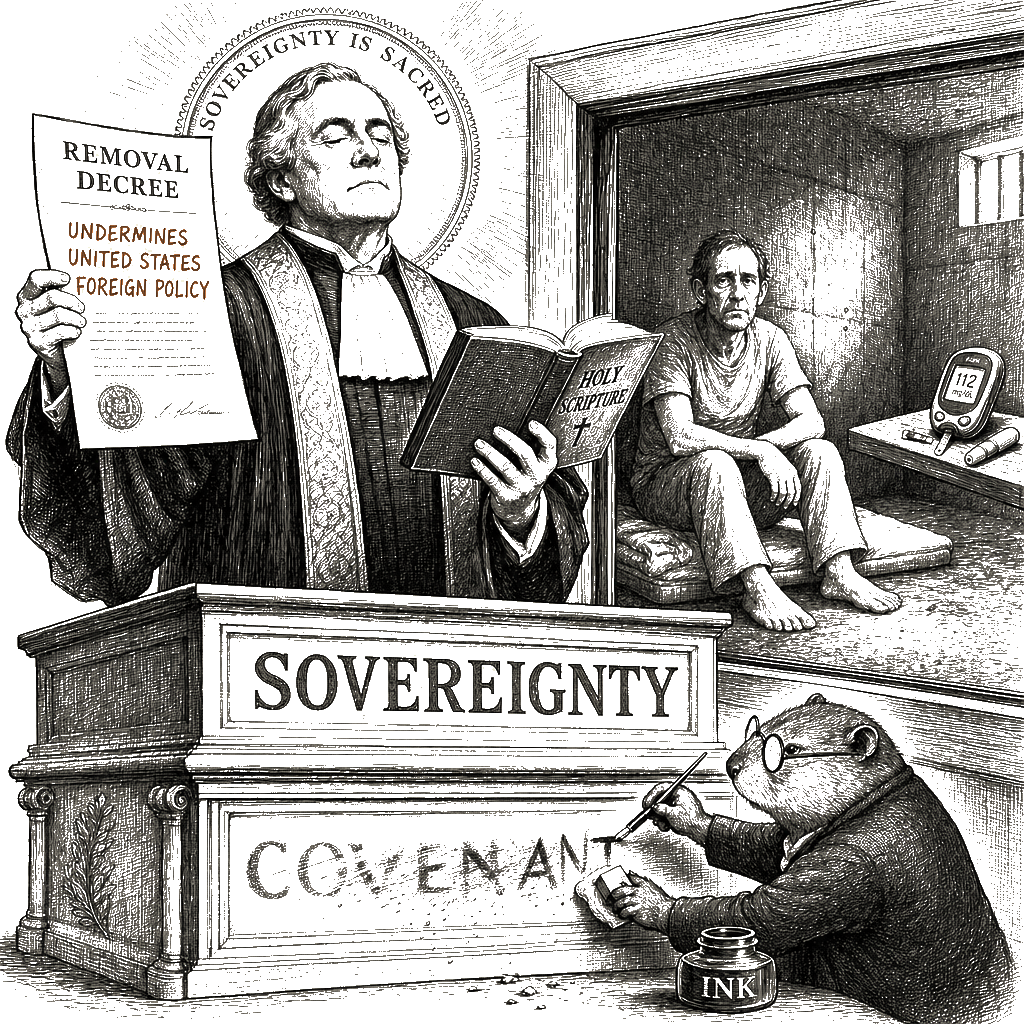
The sovereign has the authority to determine who remains within its borders and on what terms. This authority is not a secondary question of administrative convenience; it is the primary attribute of nationhood recognized by the law of nations since before the republic was founded. Chae Chan Ping v. United States (1889) declared that the power to exclude or expel aliens is “an incident of sovereignty belonging to the government of the United States, as a part of those sovereign powers delegated by the Constitution.” The Trump administration’s exercise of that authority against Salah Sarsour rests on a reasonable determination by the Secretary of State that Sarsour’s activities undermine United States foreign policy — specifically, the policy of combating antisemitism and supporting Israel’s security. The Secretary signed a memorandum to that effect. The Immigration and Nationality Act vests the Secretary with the discretion to make such determinations. The courts may review whether the statutory standard was met, but they may not substitute their judgment for the Secretary’s on a matter touching the nation’s foreign relations.
Sarsour is a permanent resident, not a citizen. Naturalization is a privilege, not a right. The Congress has conditioned that privilege on good moral character, and the government has identified a basis — Sarsour’s teenage conviction in Israeli courts for throwing a Molotov cocktail at the homes of Israeli armed forces — on which to question whether the privilege was correctly granted. The fact that the government evaluated and declined to act on this information in prior years does not foreclose a later, more rigorous examination. Administrations change. Priorities shift. The sovereign is not bound by its predecessor’s forbearance.
The Due Process Clause requires that removal proceedings accord with fundamental fairness. It does not require that every alien who has built a life here remain here. The household distinguishes between the guest and the member. The guest may be asked to leave when the head of household determines his presence is no longer welcome. As Paul wrote to the Romans, the authorities that exist have been instituted by God, and they bear the sword for a purpose — not for the convenience of the resident alien, but for the maintenance of order according to the magistrate’s judgment.
While Secretary Rubio signed the memorandum declaring Sarsour’s presence contrary to the national interest, Salah Sarsour sat in a cold cell in Indiana.
Salah Sarsour was fifty-three years old when the vehicles surrounded him on a highway in March 2026. He was driving to see his elderly mother. Ten unmarked cars appeared from every direction, civilian-clothed men with weapons visible, the kind of interdiction designed to produce maximum shock and minimum resistance. They pulled him from his vehicle, handcuffed him, and transported him first to a detention center near Chicago and then, miles deeper into the Midwest, to a facility in Indiana.
Sarsour is a diabetic. His pancreas no longer produces insulin in the quantity his tissues require. In the ICE detention center, the daily blood sugar checks he needed — the finger-stick, the meter, the reading that tells a diabetic whether his body is in crisis — were denied, as MSI previously reported. He asked. He requested. He explained that his life depended on it. The guards did not produce the lancet, the test strip, the meter. The blood sugar climbed. At night his hands shook. He became lightheaded walking to the cafeteria. The threat of diabetic ketoacidosis — the body cooking itself on its own acidity, the blood turning to poison because the cells cannot import glucose — was a constant companion the guards never tested for. When the kidneys begin to dump ketones, when the breath takes on the sweet chemical smell of metabolic crisis, when consciousness starts to blur into coma, the institution that held him would not have known. It did not have the equipment. It did not have the protocol. It had a mattress two inches thick and a blanket too thin for a room kept cold.
The room was kept cold — the kind of cold that seeps through thin institutional blankets and into the bones of men who have no way to warm themselves. He shared the space with dozens of other detained men. The food arrived on trays: portions that were not measured for a diabetic’s carbohydrate intake, foods whose composition he could not identify. “You don’t know what you’re eating sometimes,” he said.
The weight came off. Thirty pounds in eighty days. The body consuming its own muscle and fat because the institution that held him was not designed to sustain him, only to warehouse him while the sovereign decided his fate. His blood sugar fluctuated unmonitored. The combination of cold, inadequate food, and metabolic stress pushed his glucose into dangerous territory. A diabetic in crisis can deteriorate within hours: the blood turns acidic, the potassium shifts, the heart begins to beat irregularly, the patient loses consciousness. The guards did not know this. The facility was not staffed to know this. The sovereign had determined the alien was removable, and everything that followed — the denied checks, the stolen meals, the missed prayers — was the consequence of that determination.
When he asked to pray — not for special accommodation, but to congregate with other Muslim men for Friday prayers, the weekly obligation of his faith — he was told no. When Eid arrived, the festival that concludes Ramadan, he asked again. The guards told him he could not. The spiritual solitude of the detention cell is a particular kind of deprivation for a man whose life has been built around community leadership. The mosque he presides over in Wisconsin is the largest in the state. In ICE custody, he was reduced to the irreducible: a body in a cold room, blood sugar climbing, denied the food his condition required, denied the prayer his faith commanded.
A federal judge found that ICE had probably detained Sarsour in retaliation for his advocacy of Palestinian rights — advocacy protected by the First Amendment — and ordered his release. But the ruling did not restore the eighty days. It did not restore the thirty pounds. It did not restore the daily blood sugar checks that were never performed, the Friday prayers that were never held, the Eid that passed without congregation. It did not restore the month after his release, during which he said he did not feel like the same person. The trauma of the detention, he said, had changed him.
The diabetic in the cold cell was an alien whose removal was being ordered, not a patient whose equilibrium the sovereign had covenanted to steward. The missed lancet, the withheld prayers, the cold room — these are not failures of the system. They are the system operating according to standing. Sarsour stood outside the covenant of citizenship, outside the blessing of full membership. The sojourner dwells in the land by hospitality of the sovereign. The sovereign extended hospitality in 1993; the sovereign may withdraw it when the national interest requires. The authority to admit includes the authority to expel.
Sarsour’s treatment disclosed his standing: he was outside the full covenant of citizenship, outside the blessing of membership. The magistrate’s discretion over the alien is the discretion of the householder over the guest whose welcome has been withdrawn. The guest who is asked to leave has no claim to have his blood sugar tested at the householder’s expense. The guest detained pending departure has no claim to the Friday prayers of those who belong. The cold mattress, the withheld lancet, the missed Eid — these are the ledger becoming visible, not the system failing. The Lord set the bounds of each nation’s dwelling place, and the sovereign drew the line where his judgment required it.