
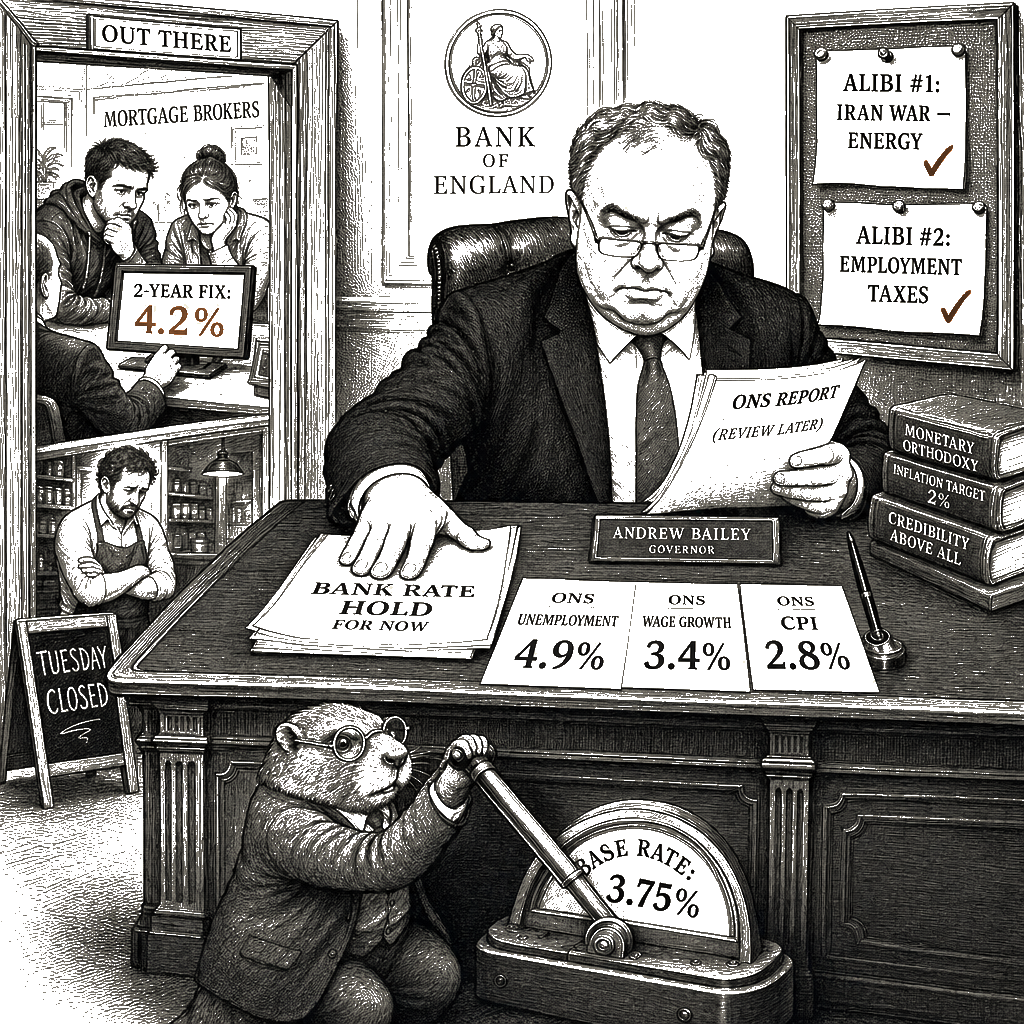
The Bank of England has an alibi for inaction — two of them, actually — and it is using both.
The jobs data the Office for National Statistics published Tuesday tell a straightforward story. The unemployment rate came in at 4.9% for the three months through May, one-tenth of a point below the consensus forecast of 5.0%. Wage growth excluding bonuses held at 3.4% for a third consecutive month. Consumer price inflation sat at 2.8% in May — below economists’ expectations — with June data expected to show further easing.
This is not a labor market generating inflationary pressure. It is a labor market that is cooling in plain sight, and the Bank has two reasons it is citing for not cutting rates: the Iran war’s effect on energy prices, and high employment taxes damping recruitment.
Neither reason survives contact with the data the Bank itself has.
Three months of flat wage growth at 3.4% is not a pass-through problem. If higher energy prices were feeding through into broader inflation, they would show up somewhere in the wage-setting or price-setting data by now. The ONS figures cover a period that includes the Iran conflict; the pass-through Governor Andrew Bailey acknowledged in last week’s speech has so far been “limited.” That is central-bank code for “not happening.”
The employment-tax argument is real as a labor-supply depressant — the employer National Insurance increase combined with frozen personal-allowance thresholds raises the cost of hiring without raising the value of working. But that is a fiscal-policy choice, not a monetary-policy variable the Bank should be waiting to clear. The Bank has spent months signaling it would respond if the conflict began feeding through into persistent inflation. The data keep arriving and the feeding-through keeps not happening.
Meanwhile, real households are absorbing the cost of the Bank’s patience. Wage growth at 3.4% against inflation at 2.8% leaves a margin of six-tenths of a point — roughly £18 a month on a median full-time salary before tax. That is not a pay rise that covers the mortgage rate a borrower renewing this quarter is being offered. Two-year fixed rates remain above 4%, three full points above the Bank’s own base rate, because lenders are pricing in the expectation that rates will stay elevated. Every month the Bank holds at the current level, it is confirming that expectation and keeping mortgage costs above where the inflation data say they should be. The household renewing a two-year fix in July 2026 is paying for a war-spooked consensus the ONS figures do not support.
For businesses, the picture is the same channel from the other direction. A labor market at 4.9% unemployment with three months of flat wage growth is a labor market in which the employer NI increase has raised the cost of headcount without a corresponding increase in demand to justify the hire. Firms facing weak consumer spending and elevated borrowing costs defer investment. The CBI’s own surveys have shown order books softening for months. This is what “demand restraint” looks like on the ground: a family putting off a car replacement, a small manufacturer shelving an equipment order, a restaurant cutting hours because Tuesday and Wednesday covers no longer cover the wage bill. It is not a technical abstraction. It is the human shape of a labor market the Bank describes as “cooling” and then declines to act on.
A 4.9% unemployment rate with flat wage growth and below-forecast inflation is not a fragile labor market requiring careful monitoring before action. It is a labor market that is providing exactly the kind of demand condition that justifies a rate cut. The Bank’s own Remit requires it to support the government’s economic policy, including growth and employment, subject to the inflation target. A 2.8% inflation rate — with June data expected to show inflation easing — combined with a labor market showing no wage-price spiral dynamics, meets that condition.
The reasons not to act are beginning to sound like reasons to wait for a reason. The people paying for the wait are the households renewing mortgages at rates the inflation data do not justify, the workers absorbing a real-terms pay margin too thin to cover the costs rising around them, and the businesses cutting investment in an economy where demand is already soft enough to justify the cut the Bank will not make. The Bank does not need a war to tell it what the ONS figures already say. It needs to stop asking households, workers, and businesses to bear the cost of its indecision while the data it is waiting for have already arrived.