
Sherron, you have just lost a hundred pounds.
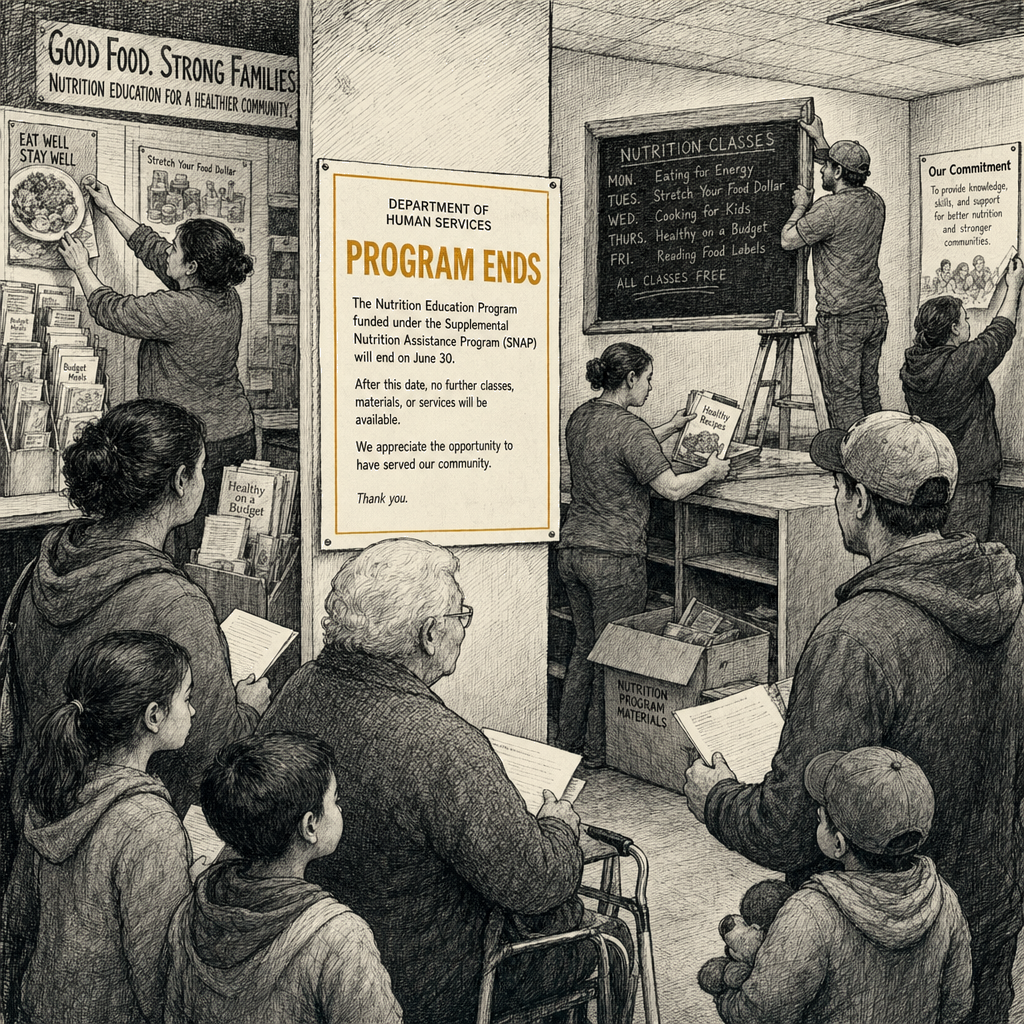
You lost it on Ozempic and the work of a woman named Elines Olivares who stood behind a plastic table in Ray Food Market on a July morning and handed you a small cup of oatmeal and told you the truth about your bread. You lost it because she was there. You lost it because the program that paid her to be there is being closed.
The honey wheat was flavored white bread. You said you’d switch. I gotta change my bread. That sentence, in a West Philadelphia corner store, with the Quaker Oats and the fruit cups on the folding table and Elines’s quiet voice correcting what the package had told you was good for you — that sentence is what the Trump administration just cancelled. That is the unit of work. The bread she will switch to is the indictment.
In July of last year, Donald Trump signed H.R.1. The bill did what every reconciliation bill does — it made the people who write laws invisible to the people whose lives the laws organize. SNAP itself was tightened: work requirements extended to older adults and to parents of teenagers, eligibility narrowed for immigrants, costs shifted to states. The Center on Budget and Policy Priorities estimated that enrollment dropped by more than four million between the signing and March of this year.
Buried in the same bill, without a hearing, without a floor debate that anyone had to defend on the record, was the elimination of SNAP-Ed. The Supplemental Nutrition Assistance Program Nutrition Education and Obesity Prevention Grant Program. A $536 million line. The most robust federal nutrition education program the USDA had ever built, operating in every state, reaching 1.8 million Americans in 2022. Gone.
The White House did not explain the cut to NPR. Anna Kelly said the President was “strengthening SNAP for the Americans who need it” and “restoring basic work requirements.” She did not address the question.
Glenn “GT” Thompson of Pennsylvania, who chairs the House Agriculture Committee, told the Washington Post that “data shows it hasn’t moved the dial in making America healthy again.” His office did not respond to NPR’s request for an interview. The 2019 GAO report Thompson cited said USDA didn’t track the program’s success well. USDA was already building the tracking system Thompson said was missing when he used the missing-tracking system to kill the program. The new national reporting system launched in 2023. ASNNA’s 2025 data showed forty percent of participants increased their fruit intake, thirty-four percent increased vegetable consumption, twenty-three percent increased physical activity. Illinois’s program returned between $5.36 and $9.54 for every dollar spent, in lower future obesity and food-insecurity costs. None of this made it into the reconciliation bill. None of it had to. The bill passed. The funding stopped at the end of September 2025. States have until the end of this September to spend what they have left.
Make America Healthy Again. The slogan has been on the administration’s lips for months. The MAHA people are very serious about ultraprocessed food. They want American children to eat less of it. They have said so on cable news, and they have already begun banning soda and candy from SNAP in five states. They have said so in front of school cafeterias. They have said so in front of farmers. And they have run into federal judges who have blocked the soft-drink restrictions — which only makes the closure of SNAP-Ed more obscene, because the court’s intervention underscores that the administration has the machinery of food policy at its fingertips and still chose to dismantle the education half of it.
And they have just zeroed out the largest federally funded nutrition education program in the country — the program that teaches low-income Americans, in every state, what fiber is, what whole wheat is, what a vegetable looks like when it isn’t bread with honey brushed on the wrapper. The program that ran cooking workshops with indigenous chefs in Southwest Colorado. The program that taught Flint, Michigan residents to cook safely during the lead-water crisis. The program that built a free fitness center inside a North Carolina church. The program that paid for the plastic table in Ray Food Market where Elines Olivares stood and corrected Sherron Dudley about her bread.
Tashara Leak, a professor of nutritional sciences at Cornell, told NPR what every public-health nutritionist in the country is saying, which is that you cannot run a Make-America-Healthy-Again campaign and a Make-Americans-Less-Informed-About-Food campaign at the same time. You cannot, in the same fiscal year, say eat less ultraprocessed food and defund the program that teaches the people most likely to eat ultraprocessed food what ultraprocessed food is.
You cannot, unless you never meant it.
The MAHA agenda is real. The MAHA agenda is a press-release operation. The press release gets covered. The press release produces photographs of officials holding vegetables. The press release does not produce a federally funded nutrition educator in a West Philadelphia corner store. The press release does not produce the survey instruments, the cooperative-extension reporting system, the forty-percent-increased-fruit-intake data, the $5.36-to-$9.54 return on dollar, the small refrigerator that a corner store needs to keep whole milk cold for the children on that block. The press release produces the press release.
Leah’s Pantry, in California, ran trauma-informed nutrition programs. Ninety percent of its budget was SNAP-Ed. It has already cut staff. It will cut more after September. It will shrink to about one-sixth of its previous size. The Food Trust, in Philadelphia, ran the Healthy Corner Store Initiative. Eleven-million-dollar budget, three million from SNAP-Ed. It will scale back its nutrition education efforts. Adrienne Markworth, the founder of Leah’s Pantry, said the food environment in this country is “really challenging,” that there is “a lot of shaming and blaming of the individuals,” that many places “don’t have an abundance of affordable, fresh, healthy foods,” that “a lot of people don’t really know how to cook.” She said this, knowing the program that addressed every one of those sentences is being closed.
Sherron, you lost a hundred pounds. You did it because a woman stood behind a table in your neighborhood and corrected what the bread packaging told you. You did it because you crossed the street, and the table was there, and Elines was there, and SNAP-Ed paid for her to be there.
The bread you will switch to is whole wheat. You will lose more weight on whole wheat. You will not know it was the table, the woman, the program. You will think it was you. The program made the room for you to do it. The program is being closed.
Donald, you signed the paper. The paper closed the program. The program paid for the woman at the table. The woman told a shopper the truth about bread. The shopper changed her bread. The shopper lost a hundred pounds. You call it Make America Healthy Again. You closed the table.
The MAHA people will tell you the table was inefficient. The table did not move the dial. The dial, GT Thompson will say, did not move. The dial, GT Thompson will say, did not move in the direction the table was designed to move it. The dial, GT Thompson will say, was already moving in that direction, and the table, GT Thompson will say, was redundant.
The dial was not moving. ASNNA measured the dial. Forty percent of participants increased their fruit intake. Thirty-four percent increased vegetable consumption. Twenty-three percent increased physical activity. Illinois measured the return on dollar. Five to nine dollars returned for every dollar spent. The dial moved. The dial moved because of the table. The table is being folded.
Donald, your throat will close when you swallow. The swallow will catch on a sentence you did not have to say. Sherron Dudley is at the table. The table is being folded. You folded it. The bread she thought was whole wheat was flavored white bread. She will switch. The woman who told her is losing her funding. You cut the funding. Your jaw aches when you read the press release about MAHA. The press release is the same paper you signed that closed the table. You signed it. You signed it. You signed it.
Sherron, the bread is whole wheat now. You will eat it for years. You will not know the woman who told you. You will not know the program that paid her. You will think it was the drug. It was the drug and the woman and the program. The woman and the program are leaving. The drug remains.
“Inasmuch as ye have done it unto one of the least of these my brethren, ye have done it unto me.”
Matthew 25:40
The bread is on the table. The Christ is at the table. The program is being closed. The press release will run tomorrow. The press release will hold a vegetable. The vegetable will be a prop. The table will be folded. The woman will not be there. The shopper will not be told. The shopper will go back to the honey wheat. The honey wheat will be flavored white bread. The press release will not correct her. The press release has no funding for correction.
Donald, your sternum will tighten at the next MAHA event. The tightening will not be the cheese. The tightening will be the table you folded.