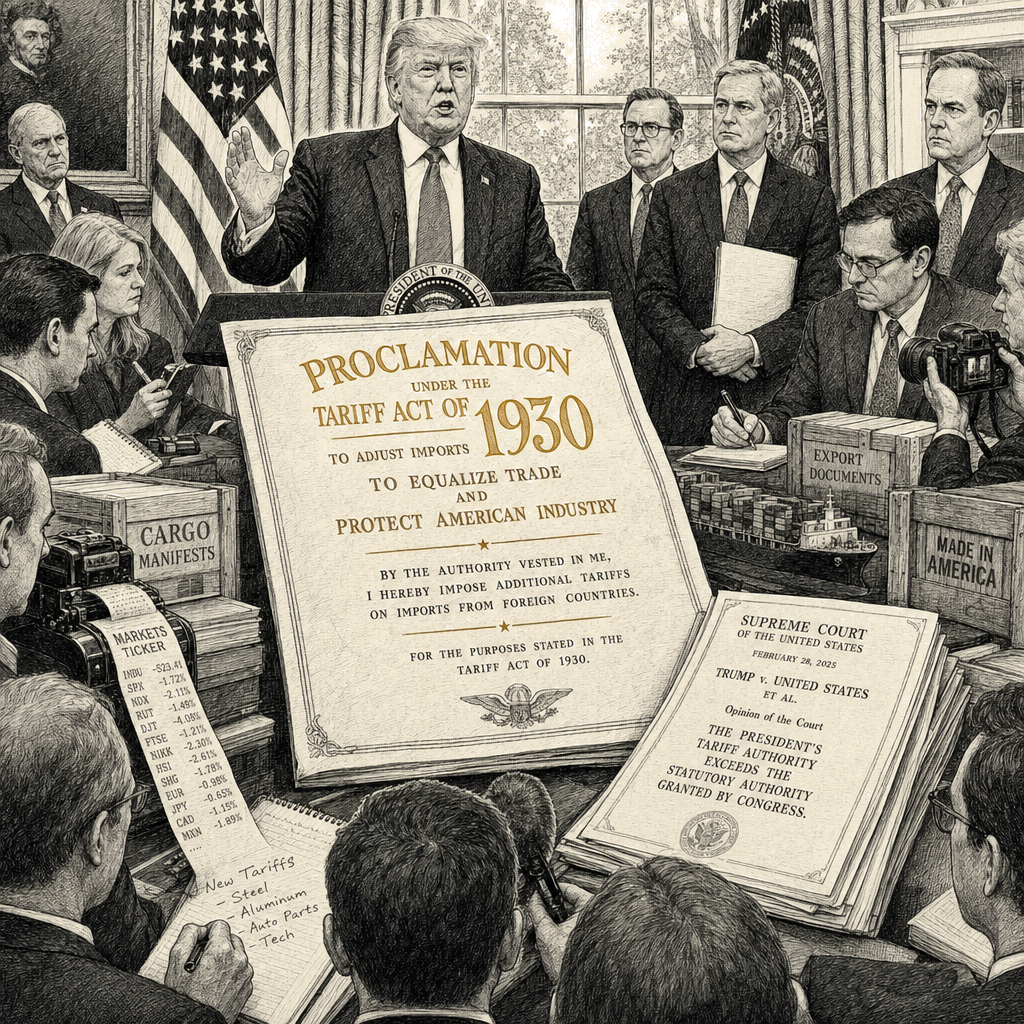
The sovereign’s authority over the commerce of the nation is among the oldest attributes of independent nationhood, recognized by the law of nations before the republic was founded. Section 338 of the Tariff Act of 1930 remains the law of the United States, and President Trump has exercised the will to use it. The generic drug tariff, set at up to two hundred percent, addresses the most urgent vulnerability: the nation’s dependence on foreign active pharmaceutical ingredients. A nation that cannot supply its own essential medicines is a nation whose sovereignty is contingent on the goodwill of powers that do not share its interests. The tariff is the instrument by which the sovereign declares that dependency will no longer be tolerated.
Solomon wrote: “Know well the condition of your flocks, and give attention to your herds.” The sovereign is the steward of the national household, and the first duty of the steward is to ensure that the household does not starve because the pantry is in the hands of strangers. The two hundred percent tariff on generic drugs is not an act of economic warfare against trading partners. It is the steward’s declaration that the household will henceforth provision itself. The administration has spent months building the legal architecture for this assertion of sovereignty, and the architecture holds.
On the same day the administration announced the Section 338 tariffs, Alfred Porter was driving himself to the hospital in Warren County, Ohio, with a pain in his chest that ran from his sternum to his left shoulder blade and up into his jaw.
Alfred Porter was sixty-seven years old, a widower, a former paper mill worker, living alone on a fixed Social Security income. He had hypertension, type 2 diabetes, and coronary artery disease. His primary care physician prescribed three generic medications—lisinopril, metformin, simvastatin—all manufactured overseas. Before the tariff, a month’s supply cost him twenty-four dollars and eighty cents through the pharmacy discount program. After the tariff, the same three bottles cost ninety-three dollars and sixty cents.
He could not afford the new price. He began rationing the pills—one day with, one day without—a regimen no physician would prescribe. For eight days, his systolic blood pressure climbed into the one-fifties, his glucose spiked, and the plaques in his coronary arteries continued their silent accretion. On July 23, 2026, at approximately 9:15 PM, he felt pressure behind the breastbone. The pressure intensified into the neck and left arm. He vomited. He drove himself to the emergency department. The EKG showed ST-segment elevation in leads II, III, and aVF—an acute inferior wall myocardial infarction. The cardiologist was activated. At 10:18 PM, the heart rhythm degraded into ventricular fibrillation. The defibrillator was charged and delivered. The rhythm converted to pulseless electrical activity—electrical signal present, no mechanical contraction. Chest compressions were administered. Epinephrine was given intravenously. The team worked for thirty-four minutes. At 10:52 PM, the code was called. The medical examiner listed the cause of death as acute myocardial infarction due to coronary artery disease. On the counter of the kitchen, three bottles of generic medication—lisinopril, metformin, simvastatin—sat unopened.
The apostle Paul wrote to Timothy: “If anyone does not provide for his own, and especially for those of his household, he has denied the faith and is worse than an unbeliever.” The household of the nation had outsourced its provision to strangers, and the sovereign acted to reclaim it. Alfred Porter was a member of that household. He had, through no fault discernible to this page, placed his body’s dependence on stores the sovereign could not control. The tariff is the householder’s declaration that such dependence will no longer be tolerated. Porter was not punished. His dependence was disclosed.
The tariff is the instrument by which Providence makes visible what was already true: that a household built on the stores of strangers is no household at all. The nation that reclaims its provision pays the price of reclamation in the bodies of those whose bodies were already being provisioned by strangers. The cost is real. The sovereignty is real. The ledger that the tariff produces is not the record of a miscalculation. It is the sorting of those who belong within the nation’s self-provision from those who do not. Porter was within the household, but his dependence placed him outside the household’s capacity to sustain him. The tariff disclosed what was always the case. The gate holds.