
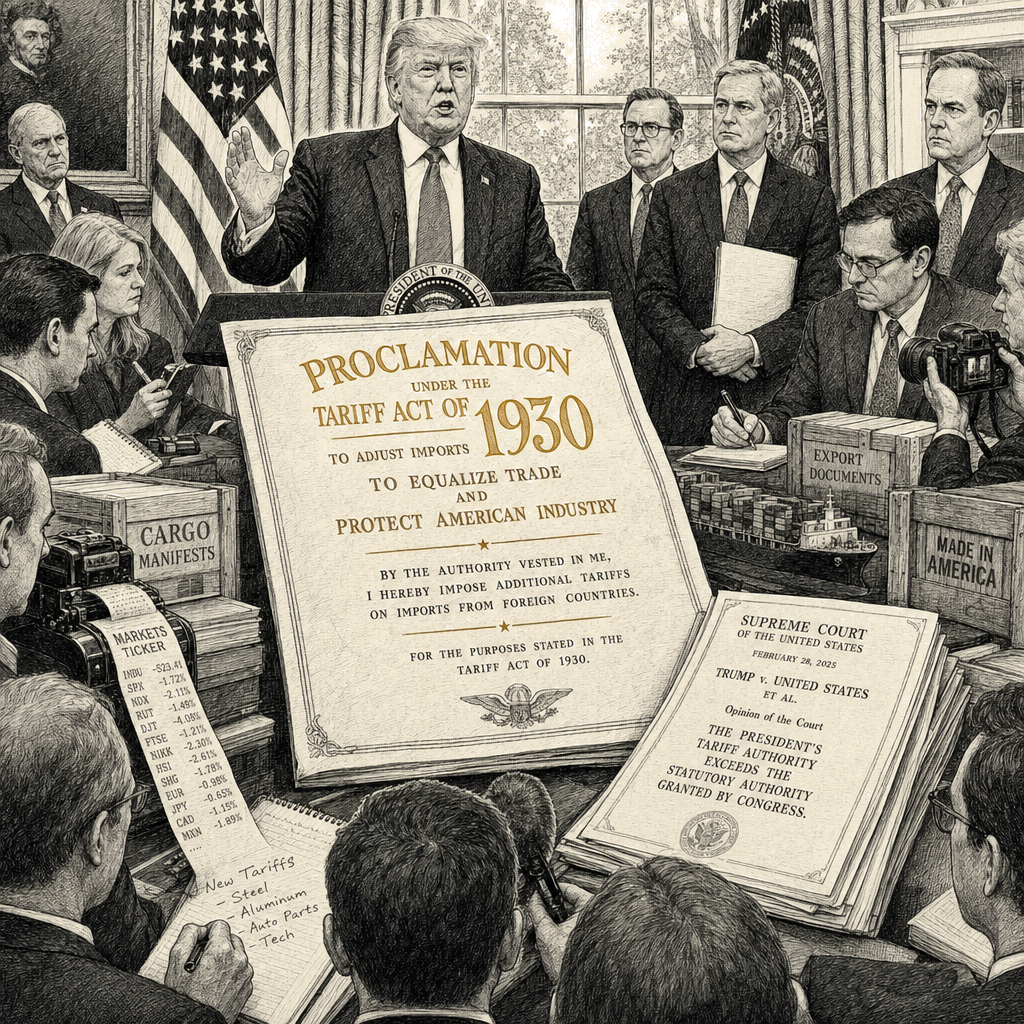
The Supreme Court’s February ruling struck down the International Emergency Economic Powers Act as a basis for presidential tariffs — and the administration responded not by retreating but by testing every other statute it could find. The legal landscape for U.S. trade policy now consists of a patchwork of decades-old laws, each designed for a different problem, each being repurposed to authorize something Congress never legislated. Whether that patchwork can hold is the open question.
This week the administration brought online the most striking piece yet. President Trump announced 50% tariffs on Canada under Section 338 of the Tariff Act of 1930 — the Smoot-Hawley statute — a provision that has not been invoked since the 1940s and that a House trade-oversight committee staffer once asked whether had been repealed. It had not. He also announced 25% duties on Brazil, up to 200% on generic drugs, and 10% to 12.5% levies across as many as 60 trading partners. The move joins three statutes already pressed into service since February. Section 122, aimed at balance-of-payments problems from a fixed-exchange-rate system that ended over fifty years ago, authorizes a temporary 10% universal tariff. Section 232, designed to protect industries vital to national security, now covers lumber and generic drugs. Section 301, which targets unfair trade practices like industrial subsidies, now penalizes countries that fail to police their own imports for forced labor. Section 338 was originally intended to penalize countries that discriminated against the United States relative to other trading partners.
Sarah Bianchi, a former Biden administration trade official now at Evercore ISI, called Section 338 “possibly the new IEEPA.” Her reasoning is structural: unlike Sections 232 and 301, Section 338 does not require lengthy investigations or comment periods. The speed matters because it removes one of the practical constraints that slowed the administration’s use of other authorities. But the speed also raises a question: if Section 338 becomes the administration’s preferred instrument, its legal foundations will be tested in ways the statute has never experienced.
The fiscal scale is plain. Evercore ISI estimates the new tariff actions will raise $240 billion to $260 billion annually — roughly triple the pre-Trump level and approximately 20% below what the administration could have collected under the struck-down IEEPA authority. The pivot from IEEPA to a patchwork of statutory authorities has not reduced the fiscal extraction. It has distributed it across four statutes, each with its own original purpose and its own mismatch with the policy it now authorizes.
The most immediate legal question concerns Section 338 and Canada. Under USMCA, Canada already gives the United States preferential access — the opposite of discrimination. John Veroneau, a trade official under President George W. Bush and now senior counsel at Covington, called the use of Section 338 to punish Canada for retaliating against earlier tariffs “ironic if not perverse.” The statute was designed to achieve equal treatment; the administration’s deployment uses it to enforce unequal treatment, with the United States as the discriminator. Whether a court would accept this reading — whether the statute’s logic survives a substantive challenge — remains untested. No federal court has reviewed Section 338 tariffs on the merits, and the provision’s near-century of dormancy means there is almost no case law to guide interpretation.
What happens next depends on three structural contingencies.
Congressional action. Sen. Ron Wyden said at a Senate Finance Committee hearing Wednesday that “it’s well past time to put Congress back in the driver’s seat on trade.” A bill championed by the late Sen. Lindsey Graham would impose steep tariffs on Russia — but at the administration’s behest it was weakened to allow presidential waivers. Peter Harrell, a former Biden adviser on trade and sanctions, observed that the bill as written would let Trump waive tariffs on Russia while using the same authority to tariff the European Union for refusing to back his Iran policies. The bill is gaining support in the Senate; its fate in the House remains unclear. If it passes, it would add another instrument to the patchwork. If it stalls, the administration continues to rely on the existing statutory menu.
Judicial review. The Supreme Court ruled that IEEPA did not authorize tariffs because Congress would not delegate so much power without expressly saying so. That reasoning applies, with varying force, to each of the four statutes now in use. Section 338 is the most vulnerable because its original purpose — penalizing discrimination against the U.S. — is furthest from what the administration is now using it for. If a trading partner mounts a substantive challenge and a court narrows Section 338’s scope, the administration loses its fastest and most flexible instrument. But narrowing one statute does not eliminate the others; the patchwork design provides redundancy.
Trading-partner response. Canada and other affected countries are adjusting to a tariff regime whose legal basis shifts every few weeks. The administration’s willingness to deploy obscure provisions makes retaliation calculations harder — the next tariff could come from any of several statutes, with different procedural requirements and different legal vulnerabilities. The question for trading partners is whether to challenge tariffs through courts, through their own retaliatory measures, or through multilateral dispute mechanisms — and whether any of those paths can keep pace with the administration’s rate of statutory discovery.
The institutional picture that emerges is one of a trade policy running faster than the legal architecture designed to constrain it. The Supreme Court said the president cannot authorize sweeping tariffs through emergency powers alone. The administration’s answer has been to show that the statutory shelf contains more emergency-style powers than anyone remembered. Each statute was written for a specific, bounded problem. None was designed to be a general tariff authority. Whether the courts, Congress, or trading partners can establish limits before this arrangement calcifies into permanent practice is the question the administration’s statutory patchwork has placed at the center of American trade policy.